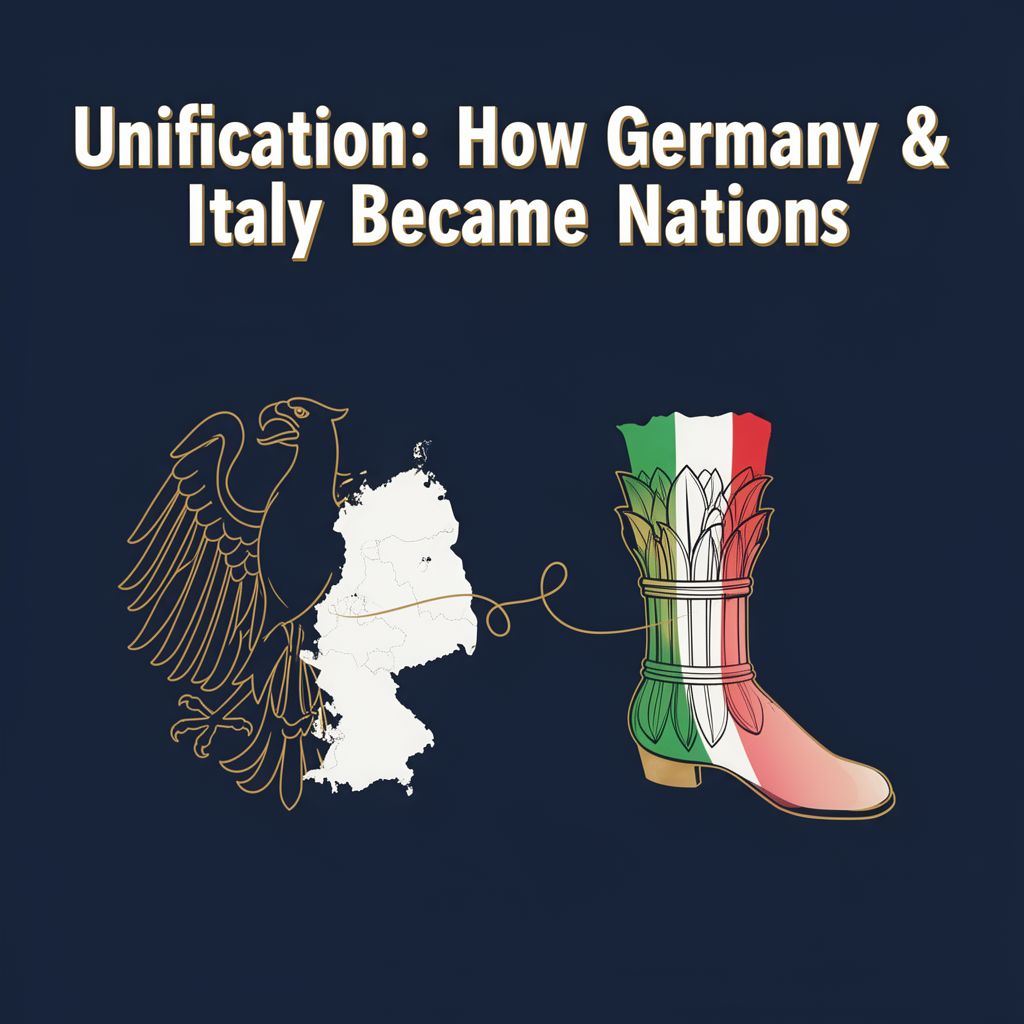
Unification: How Germany & Italy Became Nations - kapak
Tarih#history#unification#germany#italy

Unification: How Germany & Italy Became Nations

Ever wondered how modern Germany and Italy came to be? Join me as we explore the fascinating 19th-century movements that transformed fragmented regions into powerful unified nations. You'll learn about the key figures, strategies, and conflicts that shaped these pivotal moments in European history.

January 2, 2026 ~18 dk toplam
01

Sesli Özet

7 dakika

Konuyu otobüste, koşarken, yolda dinleyerek öğren.

Sesli Özet

Unification: How Germany & Italy Became Nations

0:007:19
02

Flash Kartlar

25 kart

Karta tıklayarak çevir. ← → ile gez, ⎵ ile çevir.

1 / 25
Tüm kartları metin olarak gör
  1. 1. What was the general political state of Germany and Italy before their 19th-century unifications?

    Both Germany and Italy were fragmented regions, consisting of numerous smaller states, kingdoms, and duchies rather than unified nations.

  2. 2. What were the primary driving forces behind the unification movements in 19th-century Europe?

    The primary forces were a rising sense of nationalism, where people felt a shared identity, and the desire for stronger, unified states.

  3. 3. What is the term for the Italian unification movement?

    The Italian unification movement is often referred to as the 'Risorgimento'.

  4. 4. What does the Italian term 'Risorgimento' mean in English?

    'Risorgimento' translates to 'Resurgence' or 'Rebirth', reflecting the desire for a renewed Italian nation.

  5. 5. How was Italy described by a statesman before its unification?

    Before unification, Italy was famously described as merely a 'geographical expression' due to its fragmented political state.

  6. 6. Who was Giuseppe Mazzini and what was his contribution to Italian unification?

    Giuseppe Mazzini was the 'soul' of Italian unification, an idealist who founded 'Young Italy' and advocated for a unified, republican Italy.

  7. 7. What was 'Young Italy'?

    'Young Italy' was a secret society founded by Giuseppe Mazzini, aimed at inspiring nationalist fervor for a unified, republican Italy.

  8. 8. Who was Count Camillo di Cavour and what was his role in Italian unification?

    Count Camillo di Cavour was the 'brain' of Italian unification, serving as Prime Minister of Piedmont-Sardinia and a master diplomat who practiced 'realpolitik'.

  9. 9. Define 'realpolitik' as practiced by leaders like Cavour and Bismarck.

    'Realpolitik' is a political philosophy that emphasizes practical considerations and power, rather than ideals or moral principles, in foreign policy.

  10. 10. Who was Giuseppe Garibaldi and what was his key contribution to Italian unification?

    Giuseppe Garibaldi was the 'sword' of Italian unification, a military genius who led his 'Red Shirts' to conquer the Kingdom of the Two Sicilies.

  11. 11. What was the name of Garibaldi's volunteer army?

    Garibaldi's famous volunteer army was known as the 'Red Shirts'.

  12. 12. Which major territory did Garibaldi conquer in southern Italy?

    Garibaldi successfully conquered the Kingdom of the Two Sicilies in the south of Italy.

  13. 13. To whom did Garibaldi hand over his conquests, leading to the formation of the Kingdom of Italy?

    Garibaldi handed over his conquests to King Victor Emmanuel II of Piedmont-Sardinia, paving the way for a unified monarchy.

  14. 14. When was the Kingdom of Italy officially declared?

    The Kingdom of Italy was officially declared in 1861, though some territories like Rome and Venice were still missing.

  15. 15. How did Venice become part of unified Italy?

    Venice joined Italy in 1866 following a war between Austria and Prussia, which weakened Austrian control and allowed Italy to annex the territory.

  16. 16. When did Rome become the capital of Italy, and what event facilitated this?

    Rome became the capital in 1870 after French troops, who had been protecting the Pope, were withdrawn due to the Franco-Prussian War.

  17. 17. What was the Zollverein, and why was it important for German unification?

    The Zollverein was an economic customs union that removed tariffs between many German states, demonstrating the benefits of cooperation and paving the way for political unity.

  18. 18. Who was the central figure in German unification, often referred to as the 'Iron Chancellor'?

    Otto von Bismarck, the Prime Minister of Prussia, was the central figure and driving force behind German unification.

  19. 19. What was Bismarck's famous declaration regarding how the great questions of the day would be decided?

    Bismarck famously declared that the great questions would be decided not by speeches or resolutions, but by 'blood and iron'.

  20. 20. What did Bismarck mean by 'blood and iron'?

    By 'blood and iron', Bismarck meant that military power and warfare would be the decisive tools for achieving German unification, rather than diplomacy alone.

  21. 21. Name the three wars Bismarck orchestrated to achieve German unification.

    Bismarck orchestrated the Danish War (1864), the Austro-Prussian War (1866), and the Franco-Prussian War (1870-1871).

  22. 22. What was the significance of the Austro-Prussian War (1866) for German unification?

    This war was crucial as Prussia defeated Austria, effectively removing Austrian influence from German affairs and leading to the formation of the North German Confederation under Prussian leadership.

  23. 23. When and where was the German Empire proclaimed, marking the culmination of unification?

    The German Empire was proclaimed in January 1871 in the Hall of Mirrors at the Palace of Versailles, a powerful symbolic location.

  24. 24. Who became the first German Emperor upon the proclamation of the German Empire?

    King Wilhelm I of Prussia became the first German Emperor, solidifying Prussian dominance in the newly unified state.

  25. 25. What was a key difference in the approach to unification between Italy and Germany?

    Italy's unification involved more elements of popular uprising, especially with Garibaldi's campaigns, while Germany's was more of a top-down process driven by the powerful Prussian state and Bismarck's strategic genius.

03

Detaylı Özet

6 dk okuma

Tüm konuyu derinlemesine, başlık başlık.

📚 Study Guide: The Unification of Germany and Italy

Introduction to Nation-Building in 19th Century Europe

The 19th century witnessed a profound transformation of the European map, as fragmented regions coalesced into powerful nation-states. For centuries, what we now know as Germany and Italy were not unified countries but rather a mosaic of smaller states, kingdoms, and duchies. This study guide explores the incredible journeys of how these two major European powers achieved unification, driven by powerful forces of nationalism, strategic leadership, and, often, warfare.


🇮🇹 The Unification of Italy: The Risorgimento (Resurgence)

Before its unification, Italy was famously described as merely a "geographical expression" – a collection of diverse territories rather than a single nation. This period of unification is known as the Risorgimento, meaning "Resurgence" or "Rebirth."

🗺️ Italy Before Unification

  • Fragmented Landscape: Italy was divided into numerous states with different rulers, laws, and loyalties.
    • North: Largely under Austrian control.
    • Central: Ruled by the Pope in the Papal States.
    • South: The Kingdom of the Two Sicilies.

👥 Key Figures and Their Roles

Italian unification can be understood through the contributions of three pivotal figures:

  1. Giuseppe Mazzini: The "Soul" 💡

    • Role: An idealist and passionate writer who championed a unified, republican Italy. He planted the intellectual and emotional seeds of nationalism.
    • Key Action: Founded 'Young Italy,' a secret society that inspired many with its fervent nationalist ideals and desire for a united Italian republic.
  2. Count Camillo di Cavour: The "Brain" 🧠

    • Role: Prime Minister of Piedmont-Sardinia (a kingdom in the northwest), he was a shrewd diplomat and master of 'Realpolitik' – practical politics focused on power rather than ideals.
    • Key Actions:
      • Recognized Italy could not unify alone and sought strategic alliances.
      • Formed an alliance with France to push Austrian influence out of northern Italy.
      • Carefully planned political and military moves, acting as a "chess master."
  3. Giuseppe Garibaldi: The "Sword" ⚔️

    • Role: A charismatic military genius and revolutionary leader.
    • Key Actions:
      • Led his famous volunteer army, the 'Red Shirts,' in a campaign to conquer the Kingdom of the Two Sicilies in the south.
      • Gained widespread popular support as he swept through Sicily and Naples.
      • Despite his republican leanings, he famously handed over his conquests to King Victor Emmanuel II of Piedmont-Sardinia, paving the way for a unified monarchy.

🗓️ Key Events in Italian Unification

  • 1859: Piedmont-Sardinia, allied with France, defeats Austria, gaining Lombardy.
  • 1860: Garibaldi's "Red Shirts" conquer the Kingdom of the Two Sicilies. Central Italian states also vote to join Piedmont-Sardinia.
  • 1861: ✅ The Kingdom of Italy is officially proclaimed, with Victor Emmanuel II as its first king. However, Venice and Rome remain outside the new kingdom.
  • 1866: 1️⃣ Venice is incorporated into Italy after Austria's defeat in the Austro-Prussian War (Italy allied with Prussia).
  • 1870: 2️⃣ Rome finally becomes the capital of Italy after French troops, who had been protecting the Pope, are withdrawn due to the Franco-Prussian War.

🇩🇪 The Unification of Germany: Blood and Iron

The German unification story shares the goal of nation-building but differed significantly in its execution, primarily driven by the powerful state of Prussia and its formidable leader.

🗺️ Germany Before Unification

  • Fragmented States: Before 1871, Germany was a collection of 39 independent states, loosely organized into the German Confederation.
  • Dominant Powers: Two major powers, Austria and Prussia, vied for influence within the Confederation.
  • Shared Identity: Despite political fragmentation, there was a growing sense of shared language and culture among German-speaking peoples.
  • Economic Unity: The Zollverein (Customs Union), established earlier, removed tariffs between many German states. This economic cooperation demonstrated the benefits of working together and laid groundwork for political unity.

👥 Key Figure: Otto von Bismarck

  • Role: Prime Minister of Prussia and the absolute driving force behind German unification.
  • Philosophy: A master of 'Realpolitik,' even more so than Cavour. He famously declared that the great questions of the day would be decided not by speeches and majority resolutions, but by "blood and iron" – meaning military power and warfare.
  • Goal: Believed Prussia, with its strong army, was destined to lead German unification and was prepared to use force to achieve it.

⚔️ Bismarck's Wars of Unification

Bismarck strategically orchestrated three wars to achieve his goal of a unified Germany under Prussian leadership:

  1. 1️⃣ Danish War (1864):

    • Combatants: Prussia and Austria allied against Denmark.
    • Outcome: Denmark was defeated, and Schleswig and Holstein were taken, setting the stage for future conflict between Prussia and Austria over their administration.
  2. 2️⃣ Austro-Prussian War (1866):

    • Combatants: Prussia against Austria.
    • Bismarck's Strategy: Skillfully isolated Austria diplomatically.
    • Outcome: A swift and decisive Prussian victory (Battle of Königgrätz/Sadowa). This war effectively removed Austria from German affairs and dissolved the German Confederation.
    • Result: Formation of the North German Confederation under Prussian leadership, excluding Austria.
  3. 3️⃣ Franco-Prussian War (1870-1871):

    • Combatants: Prussia and its German allies against France.
    • Bismarck's Strategy: Cleverly provoked France into declaring war (e.g., through the Ems Dispatch).
    • Outcome: The southern German states, fearing French aggression, rallied behind Prussia. The Prussian-led German forces decisively defeated France, capturing Emperor Napoleon III.
    • Significance: This victory completed the unification process, as the southern German states joined the North German Confederation.

👑 Proclamation of the German Empire (1871)

  • Location: In a powerful symbolic act, the German Empire was proclaimed in the Hall of Mirrors at the Palace of Versailles (near Paris), the heart of defeated France.
  • Leadership: King Wilhelm I of Prussia became the first German Emperor (Kaiser Wilhelm I).
  • Impact: This event marked the birth of a new, powerful German nation-state, fundamentally reshaping the balance of power in Europe.

📊 Two Paths to Nationhood: A Comparative Summary

Both Italy and Germany achieved unification in the 19th century, but through distinct processes.

✅ Similarities

  • Nationalism: Both movements were fueled by a rising sense of shared identity and a desire for a single, strong nation.
  • Strong Leaders: Relied on powerful, charismatic leaders (Mazzini, Cavour, Garibaldi for Italy; Bismarck for Germany) who employed a mix of diplomacy, political maneuvering, and military force.
  • Warfare: Both processes involved significant warfare, demonstrating that major political change often came at a high cost.
  • Realpolitik: Both Cavour and Bismarck were masters of practical, power-driven politics.

⚠️ Differences

  • Nature of Unification:
    • Italy: Had more elements of popular uprising and revolutionary fervor, especially with Garibaldi's campaigns, alongside diplomatic and military efforts.
    • Germany: Was largely a "top-down" process, driven primarily by the powerful Prussian state and Bismarck's strategic genius.
  • Dominant State:
    • Italy: Piedmont-Sardinia played the leading role.
    • Germany: Prussia was the undisputed leader.

🌍 Impact on Europe

The unifications of Italy and Germany profoundly reshaped the map and balance of power in Europe. They created two new major powers that would significantly influence global events for decades to come, contributing to the complex web of alliances and tensions that eventually led to World War I.


📚 Key Terms & Definitions

  • Risorgimento: (Italian for "Resurgence" or "Rebirth") The political and social movement that unified the different states of the Italian peninsula into the single nation of Italy in the 19th century.
  • Realpolitik: (German for "realistic politics") A political philosophy or practice based on practical objectives rather than on ideals, morals, or ethics. It emphasizes power and national interest.
  • Young Italy: A secret society founded by Giuseppe Mazzini in 1831, advocating for a unified, independent, and republican Italy.
  • Red Shirts: The volunteer army led by Giuseppe Garibaldi, instrumental in the conquest of the Kingdom of the Two Sicilies.
  • Zollverein: (German for "Customs Union") A coalition of German states formed to manage tariffs and economic policies within their territories. It was a crucial step towards German political unification.
  • Blood and Iron: A phrase used by Otto von Bismarck to describe his policy of using military force and industrial power to achieve German unification.
  • North German Confederation: A union of 22 German states north of the Main River, formed in 1867 under Prussian leadership after the Austro-Prussian War.
  • Ems Dispatch: A telegram edited by Bismarck to provoke France into declaring war on Prussia, leading to the Franco-Prussian War.
Kendi çalışma materyalini oluştur

PDF, YouTube videosu veya herhangi bir konuyu dakikalar içinde podcast, özet, flash kart ve quiz'e dönüştür. 1.000.000+ kullanıcı tercih ediyor.

Sıradaki Konular

Tümünü keşfet
Ottoman Empire's 18th Century Decline

Ottoman Empire's 18th Century Decline

An academic summary of the Ottoman Empire's period of decline in the 18th century, examining internal weaknesses, external pressures, and reform attempts.

7 dk 25 15
Ottoman Empire: Early 20th Century Challenges

Ottoman Empire: Early 20th Century Challenges

Explore the critical internal and external challenges faced by the Ottoman Empire in the early 20th century, leading to its eventual decline and dissolution.

Özet 15 Görsel
Cultural Foundations: Art, Music, and Literature in Early 19th Century America

Cultural Foundations: Art, Music, and Literature in Early 19th Century America

Explore the development of American identity through the distinctive art, music, and literature of the early 1800s, reflecting a growing sense of nationhood.

25 15
Britain's Transformation: From Thatcherism to the Age of Insecurity

Britain's Transformation: From Thatcherism to the Age of Insecurity

Explore Britain's profound political, economic, and social changes from the late 1970s, covering Thatcherism, New Labour, the age of insecurity, multiculturalism, and evolving social and cultural landscapes.

Özet 25 15
The Ottoman Empire's 18th-Century Decline

The Ottoman Empire's 18th-Century Decline

An academic overview of the Ottoman Empire's period of decline during the 18th century, examining its political, military, and economic challenges and the factors contributing to its weakening.

6 dk Özet 25 15
Ottoman Empire: Culture and Civilization

Ottoman Empire: Culture and Civilization

An academic overview of the Ottoman Empire's culture and civilization, covering its administrative structure, social organization, legal system, educational institutions, scientific advancements, and artistic expressions.

6 dk 25 15
Women's Evolving Roles and Suffrage in Wartime Britain

Women's Evolving Roles and Suffrage in Wartime Britain

This podcast explores the significant changes in women's roles and the suffrage movement in Britain, from early campaigns to their contributions during both World Wars, and the lasting impact on society.

6 dk 25 15
The History of Beşiktaş

The History of Beşiktaş

An in-depth look at the history of Beşiktaş Jimnastik Kulübü, from its founding in 1903 as a gymnastics club to its evolution into a major multi-sport institution in Turkish football and beyond.

4 dk Özet