1. What is the primary goal of literary analysis according to the text?
Literary analysis aims to go beyond simply reading words. Its primary goal is to peel back layers to understand the context, the creator's intent, and the artistic choices made within a text. This allows for a deeper appreciation and engagement with the literature.
2. What are the four key aspects of literary analysis discussed in the lesson?
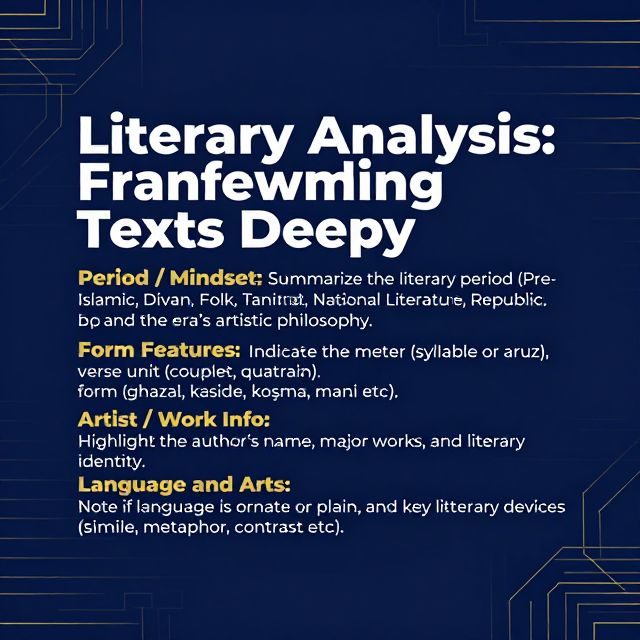
The four key aspects discussed are: understanding the historical period and artistic mentality, recognizing formal characteristics, appreciating the artist's background and work, and dissecting the language and literary devices employed. These aspects provide a comprehensive framework for analysis.
3. Why is understanding the historical period crucial for analyzing a literary text?
Understanding the historical period is crucial because every text is a product of its time. It provides immediate clues about the text's worldview, themes, and intended audience. This context helps in interpreting the work within its original cultural and social framework.
4. Give examples of Turkish literary periods mentioned in the text that provide clues about a text's worldview.
Examples of Turkish literary periods mentioned include Pre-Islamic, Divan, Folk, Tanzimat, National Literature, and Republican periods. Each period offers distinct insights into the prevailing worldview, themes, and artistic approaches of its era, shaping the literary output.
5. What does 'mentality' refer to in the context of literary analysis?
In literary analysis, 'mentality' refers to the general artistic understanding or prevailing intellectual and emotional atmosphere of a specific era. It dictates the dominant themes, stylistic preferences, and philosophical underpinnings that characterize the literature of that period.
6. How does the 'mentality' of Divan poetry differ from that of the Tanzimat period?
Divan poetry's mentality often focused on divine love and classical forms, adhering to established traditions. In contrast, the Tanzimat period's mentality was more concerned with social issues and Western influences, reflecting a shift towards modernization and societal critique.
7. What are 'formal characteristics' in literary analysis?
Formal characteristics refer to the structural and stylistic elements of a literary work. These include aspects like meter, verse unit, and poetic form. Recognizing these elements helps categorize the text and understand its lineage and adherence to specific literary traditions.
8. Explain the difference between syllabic meter and aruz meter.
Syllabic meter counts the number of syllables in each line and often indicates a connection to folk traditions. Aruz meter, on the other hand, is a more complex quantitative system borrowed from Arabic and Persian poetry, typical of classical works, focusing on the length of syllables.
9. Name two common verse units mentioned in the text.
Two common verse units mentioned are the couplet and the quatrain. A couplet consists of two lines, often rhyming, while a quatrain is a stanza of four lines, typically with a specific rhyme scheme. These units form the building blocks of many poetic forms.
10. List three poetic forms mentioned in the text and explain their significance.
Three poetic forms mentioned are ghazal, qasida, and koşma. Each form carries its own set of rules, expectations, and historical baggage, influencing the poem's structure and often its content. Recognizing them helps understand the text's traditional context.
11. Why is knowing the writer or poet considered 'paramount' in literary analysis?
Knowing the writer or poet is paramount because their life experiences, beliefs, and artistic goals profoundly shape their creations. Understanding their background, important works, and literary personality provides crucial insights into the themes, style, and intent behind their texts.
12. How can an author's Sufi background illuminate their work?
An author's Sufi background can illuminate their work by revealing the allegories and mystical insights embedded within their texts. Sufism often uses symbolic language to convey spiritual truths, and recognizing this background helps in deciphering these deeper, often hidden, meanings.
13. How does the choice of language reflect the author's intent or the literary period?
The choice of language is never accidental; it reflects the author's intent or the literary period. For instance, ornate language with loanwords might indicate classical Divan poetry aiming for sophistication, while simple, colloquial language might reflect a desire to connect with a broader audience in Folk or Republican era literature.
14. What is a 'literary device'?
A literary device is a technique or tool used by writers and poets to convey deeper meanings, evoke emotions, and add layers of beauty and complexity to their work. These rhetorical figures are not mere decorations but serve specific artistic and communicative purposes.
15. Define 'teşbih' and provide an English equivalent.
Teşbih is a literary device referring to a simile, which compares two different things using words like 'like' or 'as'. It explicitly draws a parallel between two distinct entities to enhance description or understanding.
16. Define 'istiare' and provide an English equivalent.
İstiare is a literary device referring to a metaphor, where a comparison between two unlike things is implied without using 'like' or 'as'. It directly states one thing is another, creating a stronger, more direct imaginative connection.
17. Define 'tezat' and provide an English equivalent.
Tezat is a literary device referring to antithesis, which highlights contrasts or opposing ideas to emphasize a point. It involves the juxtaposition of contrasting concepts, often in a balanced or parallel structure, to create a striking effect.
18. Why are literary devices considered more than 'mere decorations'?
Literary devices are considered more than mere decorations because they are powerful tools that poets and writers use to convey deeper meanings, evoke specific emotions, and add layers of beauty and complexity to their work. They actively shape the reader's interpretation and experience of the text.
19. How does analyzing a text's historical context help in understanding its themes?
Analyzing a text's historical context helps in understanding its themes by revealing the social, political, and cultural issues prevalent during its creation. This context often directly influences the themes an author chooses to explore, making them more comprehensible and relevant.
20. What role does the 'audience' play in the choices made by a writer?
The 'audience' plays a significant role in the choices made by a writer, influencing aspects like language, themes, and style. A writer might choose simpler language for a broader audience or more complex themes for a specialized one, tailoring their work to resonate effectively with their intended readers.
21. How can recognizing the meter of a poem help categorize it?
Recognizing the meter of a poem, such as syllabic or aruz, can help categorize it by indicating its traditional origins and influences. Syllabic meter often points to folk traditions, while aruz meter suggests classical Arabic/Persian influences, thus placing the poem within a specific literary lineage.
22. What is the benefit of transforming reading from a passive activity into an active exploration?
Transforming reading from a passive activity into an active exploration allows for a much richer and more nuanced understanding of any literary piece. It enables readers to truly engage with the art and wisdom embedded within the words, uncovering deeper meanings and appreciating the author's craft.
23. How do an author's beliefs influence their creations?
An author's beliefs profoundly influence their creations by shaping their worldview, moral compass, and the messages they wish to convey. These beliefs often manifest in the themes, character development, and overall philosophical underpinnings of their literary works.
24. What is the significance of recognizing a poem's 'poetic form'?
Recognizing a poem's 'poetic form' (e.g., ghazal, koşma) is significant because each form carries its own set of rules, expectations, and historical baggage. This knowledge helps in understanding the poem's structural constraints, traditional context, and how these elements influence its content and meaning.
25. How does the use of Arabic or Persian loanwords in a text provide clues about its period?
The use of Arabic or Persian loanwords often provides clues about a text's period, particularly in Turkish literature. A high prevalence of such words typically indicates a classical period like Divan poetry, where these linguistic influences were strong, contrasting with later periods that favored simpler, more vernacular Turkish.
 Podit
Podit