 Podit
Podit
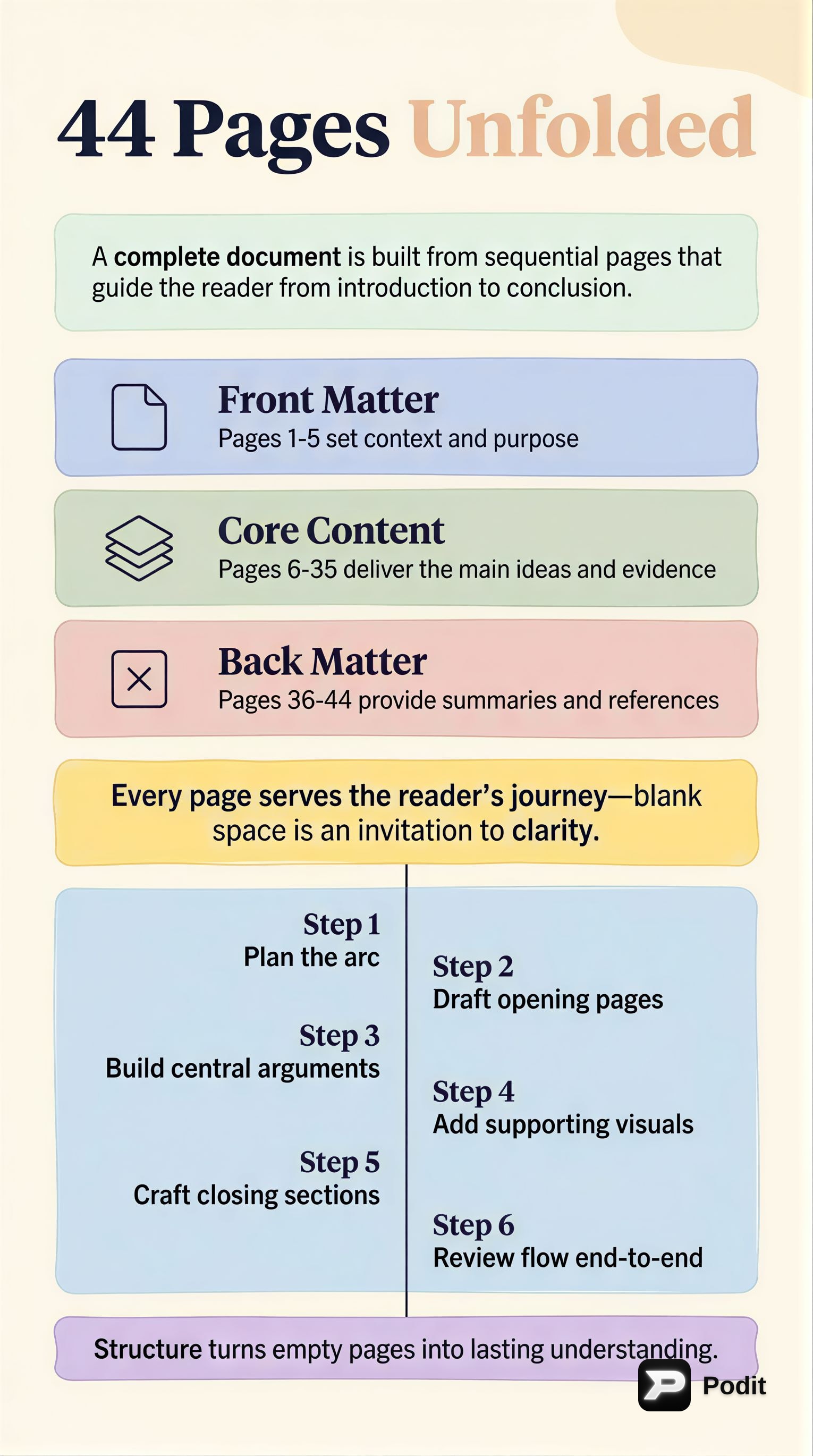
Study Material: The Critical Role of Source Content in Academic Summarization and Learning
Source Information: This study material has been compiled from two primary sources:
- Copy-pasted Text: A document spanning 44 pages, which, upon analysis, contained no discernible textual information.
- Lecture Audio Transcript: A transcript discussing the absence of content in the aforementioned 44-page document and its implications for academic summarization.
📚 Introduction: Understanding the Foundation of Academic Study
Effective academic study and summarization are fundamentally dependent on the presence of substantive source material. This document explores the critical importance of such content by examining a unique scenario: the complete absence of textual data in a designated source. While this might seem counterintuitive for a study guide, it serves as a powerful illustration of why source material is the bedrock of knowledge acquisition and academic output.
1. The Indispensable Nature of Source Material ✅
At the heart of any academic endeavor lies the interaction with information. Source material—whether it be textbooks, research papers, lecture notes, or primary documents—provides the raw data necessary for learning, analysis, and synthesis.
- 📚 Definition: Source material refers to any original or primary data, text, or information from which knowledge is derived or upon which an argument or study is based.
- Purpose in Learning:
- Knowledge Acquisition: Provides facts, theories, and concepts.
- Critical Thinking: Offers ideas to analyze, evaluate, and critique.
- Skill Development: Enables practice in comprehension, interpretation, and synthesis.
- Foundation for Output: Serves as the basis for essays, reports, summaries, and presentations.
2. Implications of Content Absence for Summarization ⚠️
The lecture transcript explicitly highlights the direct consequence of missing source content: the impossibility of generating a meaningful summary. Summarization is not merely a mechanical process; it requires deep engagement with the material.
-
2.1 The Core Requirement:
- Substantive Content: The fundamental prerequisite for any academic summary is the existence of "substantive source content." Without it, the process cannot even begin.
- Data Extraction: Summarization involves extracting key concepts, main ideas, definitions, and supporting details from a larger body of text. This extraction is impossible when no data exists.
- Example: Imagine being asked to summarize a novel you've never read, or a scientific paper that is blank. The task is inherently futile.
-
2.2 The Challenge of "Empty Input":
- The provided 44 pages of "copy-pasted text" contained "no discernible textual information." This "empty input" directly prevents any form of content-based analysis.
- Consequence: No key concepts can be identified, no definitions can be extracted, and no main ideas can be discerned.
- Analogy: Trying to draw water from an empty well. The mechanism for drawing is there, but the essential element (water/content) is absent.
-
2.3 Impact on Academic Integrity:
- A summary must be a "comprehensive and faithful overview" of the original material.
- If there is no original material, a "faithful overview" cannot be produced, as there is nothing to be faithful to.
- Any attempt to create a summary from absent content would be speculative or fabricated, undermining academic integrity.
3. The Process of Summarization: What Requires Content 💡
To further illustrate the necessity of content, consider the typical steps involved in creating an academic summary. Each step relies heavily on the presence and quality of the source material.
- 1️⃣ Reading and Comprehension: Thoroughly understanding the original text. This step is impossible without text.
- 2️⃣ Identifying Main Ideas: Distinguishing primary arguments and central themes from supporting details. This requires ideas to be present.
- 3️⃣ Extracting Key Information: Pulling out crucial facts, definitions, and examples. This presupposes the existence of such information.
- 4️⃣ Synthesizing and Condensing: Rephrasing the identified main ideas and key information in a concise manner, using one's own words. This cannot happen in a vacuum.
- 5️⃣ Review and Refine: Checking the summary against the original source for accuracy, completeness, and conciseness. This step is meaningless without an original source.
4. Best Practices for Engaging with Actual Study Materials 📈
While this specific instance highlights the absence of content, it underscores the importance of actively engaging with materials when they are available.
- Active Reading: Don't just passively read.
- Highlight key sentences.
- Annotate margins with questions or summaries.
- Look up unfamiliar terms.
- Effective Note-Taking:
- Summarize paragraphs in your own words.
- Create outlines or mind maps to visualize connections.
- Use Cornell notes for structured review.
- Identifying Structure:
- Pay attention to headings, subheadings, and introductory/concluding paragraphs.
- Look for topic sentences that encapsulate the main idea of a paragraph.
- Questioning and Connecting:
- Ask "why" and "how" questions about the content.
- Relate new information to what you already know.
- Consider the author's purpose and audience.
5. Conclusion: The Unwavering Demand for Data 📊
The analysis of the provided sources unequivocally demonstrates that the generation of academic study material and summaries is contingent upon the existence of discernible, substantive content. The "empty input" serves as a stark reminder that information processing, learning, and knowledge creation are fundamentally data-driven processes. Without the raw material of information, the sophisticated tools and techniques of academic study remain without purpose. This output, therefore, functions as a formal acknowledgment of this foundational principle: no content, no summary, no study material.