Podit
Podit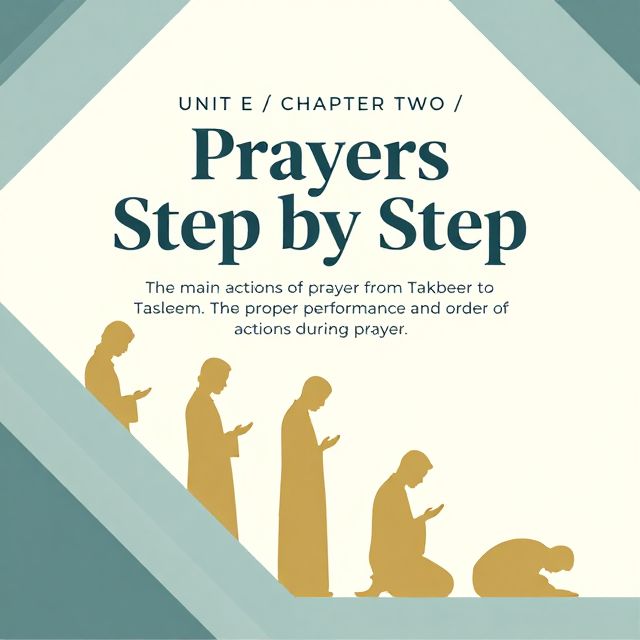
Flash Kartlar
25 kartKarta tıklayarak çevir. ← → ile gez, ⎵ ile çevir.
Tüm kartları metin olarak gör
1. What is the primary purpose of performing Salah in Islam?
The primary purpose of performing Salah, or Islamic prayer, is to connect with Allah and show devotion. It is a fundamental act of worship that helps Muslims remember their Creator, seek guidance, and express gratitude, ultimately aiming for a deeper spiritual connection and understanding.
2. What is "Niyyah" in the context of Islamic prayer, and how is it made?
Niyyah is the intention to perform prayer, made silently in one's heart and mind. It confirms that the prayer is solely for Allah's sake and specifies the type of prayer being performed. As Prophet Muhammad stated, 'actions are judged by intentions,' highlighting its crucial role in the validity and acceptance of the prayer.
3. What is the significance of the "Takbeerat-ul-Ihram" in Salah?
Takbeerat-ul-Ihram is the initial declaration of 'Allahu Akbar' at the start of prayer, accompanied by raising hands. It signifies the separation between one's regular daily life and the sacred act of prayer. After this point, actions like eating, drinking, talking, or laughing become prohibited until the prayer concludes, marking the formal commencement of worship.
4. What actions become prohibited after saying the Takbeerat-ul-Ihram until the prayer concludes?
After saying the Takbeerat-ul-Ihram, actions such as eating, drinking, talking, or laughing become prohibited. This initial takbeer marks the transition from daily life to the sacred state of prayer, requiring full focus and devotion to the worship of Allah. These actions are only permissible again at the tasleem.
5. What is "Qiyam" in Salah, and what is the recommended body posture during it?
Qiyam refers to the standing position during prayer. During Qiyam, one faces the Qiblah. The recommended posture involves placing the right hand over the left, typically between the navel and the chest, after raising hands by the ears or shoulders during the initial Takbeer.
6. What is "Du'aa'-ul-Istiftah," and when is it recited during prayer?
Du'aa'-ul-Istiftah is the opening supplication, such as 'Wajjahtu wajhya lilathi fatar-as-samawati wal arda...'. It is preferred to recite this silently after the initial Takbeerat-ul-Ihram and before reciting Surat ul-Fatihah. This supplication expresses one's sincere devotion and turning towards Allah.
7. Why is reciting Surat-ul-Fatihah crucial in every Rak'ah of Salah?
Reciting Surat-ul-Fatihah is crucial because Prophet Muhammad emphasized its importance, stating that 'The prayer would not be accepted from one who does not recite the opening of the Book.' It is considered the mother of the Quran and a fundamental pillar of each unit (Rak'ah) of prayer, without which the prayer is incomplete.
8. When is it Sunnah to say "Ameen" during prayer, and what is its significance?
It is Sunnah to say 'Ameen' after reciting Surat-ul-Fatihah, especially when praying in a group. Its significance lies in matching the angels' 'Ameen,' which is believed to lead to the forgiveness of past sins. It is a supplication for Allah to accept the prayer and the requests made within it.
9. Describe the action of "Rukoo'" in Salah and the associated recitation.
Rukoo' is the bowing part of Salah. After reciting Fatihah and an additional surah, one makes Takbeer, raises hands, and bows, placing palms firmly on the knees with straight legs and a back almost parallel to the ground. During Rukoo', one recites 'Subhana Rabbiyal Azeem' (Glory be to my Lord, the Most Great) at least three times.
10. What is recited when rising from Rukoo', and what does it mean?
When rising from Rukoo', one first recites 'Sami'allahu liman Hamidah' (Allah hears him who praises Him). Immediately after standing upright, one then recites 'Rabbana walakal Hamd' (Our Lord, to You be all praise). These recitations acknowledge Allah's attentiveness to praise and express gratitude.
11. What is "Sujood" in Salah, and why is it considered a highly significant part?
Sujood is the prostration, where one kneels and places the forehead, nose, palms, knees, and inner toes firmly on the ground. It is considered by some scholars as the most important part because a Muslim is closest to Allah in this position. It symbolizes ultimate humility and submission to the Creator.
12. Which body parts must be firm on the ground during Sujood?
During Sujood, the forehead, nose, palms, knees, and the inner toes of both feet must be firm on the ground. Additionally, the elbows should be kept apart from the floor. This specific posture ensures proper submission and connection during prostration.
13. What is recited during Sujood, and what additional supplications can be made?
During Sujood, one recites 'Subhana Rabbiyal A'la' (Glory be to my Lord, the Most High) at least three times. Additionally, one can make Du'aa's such as 'Rabbighfirlee' (My Lord, forgive me) and 'Oh Allah, I prostrated to you, I believed in you and I submitted to you. My face prostrated to its Creator, the One who made its ears and eyes. Blessed is Allah the best of creators.'
14. What is "Juloos" in Salah, and what is recited during the brief sitting between prostrations?
Juloos is the brief sitting period between the two prostrations in each Rak'ah. During this short sitting, one recites 'Rabbighfirlee' (My Lord, forgive me). This supplication seeks forgiveness from Allah during a moment of rest and reflection within the prayer.
15. When do longer "Juloos" positions occur in different types of prayers?
Longer Juloos positions occur at the end of two-Rak'ah prayers like Fajr. In four-Rak'ah prayers (Dhuhr, Asr, Maghrib, Ishaa'), longer Juloos occurs twice: once after the second Rak'ah and again at the very end of the prayer. These sittings are for reciting At-Tashahhud and other supplications.
16. Recite the full "At-Tashahhud" and explain its meaning.
At-Tashahhud is: 'At-Tahiyyat lillah, Wassalawatu wattayyibat, As-Salamu Alayka Ayuhan-nabiyyu Wa Rahmatullahi wa barakatuh, As-Salamu Alayna Wa 'Ala 'ibadullah-is-saliheen. Ash-hadu Anna La Illaha Illallah, Wa Ash-hadu Anna Muhammadan Abduhu wa Rasooluh.' It means: 'Greetings, prayers and good deeds are due to Allah. May peace, Allah's mercy and blessings be upon you oh Prophet. May peace be upon us and the pious servants of Allah. I bear witness that there is no god but Allah and Muhammad is His servant and Prophet.'
17. What is "As-Salat ul-Ibraheemiyyah," and when is it recited?
As-Salat ul-Ibraheemiyyah, also known as the Abrahamic Prayer, is a supplication that invokes blessings upon Prophet Muhammad and his family, similar to those bestowed upon Prophet Ibrahim. It is recited in the final Juloos of all prayers, except for Fajr prayer, after reciting At-Tashahhud.
18. Describe the recommended hand position during the Tashahhud sitting.
During the Tashahhud sitting, the Prophet used to keep his back upright. He would place his left hand flat on his left thigh, and fold the palm of his right hand, pointing with his index finger during the recitation of At-Tashahhud. This gesture emphasizes the oneness of Allah.
19. What is recommended to do before the final Tasleem, and provide an example of a Du'aa'?
Before the final Tasleem, it is Sunnah to make Du'aa' (supplication). An example is 'Allahuma innee a'oothu bika min 'athabi jahannam...' which means 'Oh Allah protect me from the punishment of Hellfire, the punishment in the grave, the trial of life and death, and the trial of the false messiah.' This is a moment to seek protection and blessings.
20. How is the prayer concluded with "Tasleem," and what does it signify?
The prayer is concluded with Tasleem by turning one's face completely to the right and saying 'Assalamu Alaikum warahmatullah,' then turning to the left and repeating the same. This action signifies the formal end of the prayer, greeting the angels and fellow worshippers, and marking the return to permissible daily activities.
21. What is the importance of "Khushoo'" in Salah?
Khushoo' refers to mindfulness, humility, and devotion during prayer. It is paramount to perform Salah with sincerity and Khushoo', recognizing that one is in the presence of their Lord. This deep concentration and connection of the heart with Allah enhances the spiritual benefit and acceptance of the prayer.
22. According to the Prophet Muhammad, what is considered the "key to prayer"?
According to the Prophet Muhammad, peace be upon him, Wudoo' (ablution) is considered the 'key to prayer.' This highlights the essential prerequisite of ritual purity before commencing Salah, ensuring that the worshipper is physically and spiritually prepared for the sacred act.
23. What is the meaning of 'Wajjahtu wajhya lilathi fatar-as-samawati wal arda...'?
The meaning of 'Wajjahtu wajhya lilathi fatar-as-samawati wal arda...' is 'I have turned my face to the One Who created the Heavens and Earth as a sincere servant...'. This is part of the Du'aa'-ul-Istiftah, the opening supplication, expressing one's sincere devotion and turning towards Allah, the Creator.
24. What is the meaning of 'Subhana Rabbiyal Azeem' recited during Rukoo'?
'Subhana Rabbiyal Azeem' means 'Glory be to my Lord, the Most Great'. This phrase is recited at least three times during Rukoo', the bowing position in Salah. It is an act of glorifying and exalting Allah, acknowledging His greatness and majesty during this posture of humility.
25. What is the meaning of 'Subhana Rabbiyal A'la' recited during Sujood?
'Subhana Rabbiyal A'la' means 'Glory be to my Lord, the Most High'. This phrase is recited at least three times during Sujood, the prostration position in Salah. It is an act of glorifying and exalting Allah, acknowledging His supreme transcendence and loftiness during this posture of ultimate submission.
Bilgini Test Et
15 soruÇoktan seçmeli sorularla öğrendiklerini ölç. Cevap + açıklama.
A Muslim is about to begin prayer. What is the first internal act they must perform?