 Podit
Podit
Ancient Civilizations: Rome and Egypt Study Guide 📚
This study material has been compiled from a lecture audio transcript and various copy-pasted text sources, providing a comprehensive overview of Ancient Rome and Egypt.
🌍 Introduction to Ancient Civilizations
Ancient Rome and Egypt represent foundational pillars of human civilization, each contributing profoundly to our understanding of history, technology, and culture. This guide explores their societal structures, technological advancements, daily life practices, and significant archaeological discoveries, highlighting their lasting impact on human development.
🔍 Archaeological Discoveries and Historical Insights
1. King Tutankhamun's Tomb (Ancient Egypt) 👑
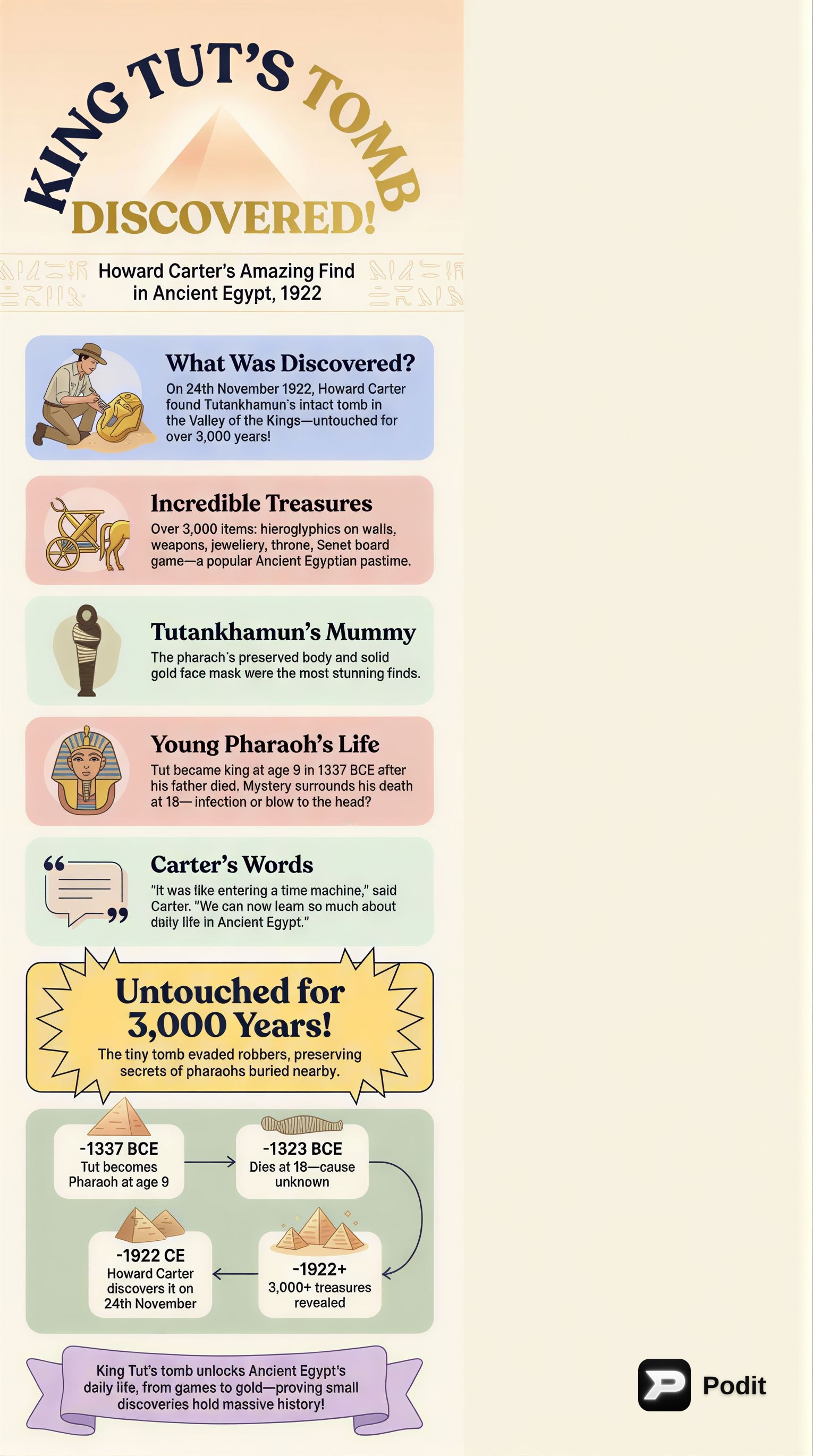
A landmark archaeological event was the discovery of King Tutankhamun's tomb by Howard Carter on November 24, 1922.
- Location: Valley of the Kings, Egypt.
- Significance: The tomb was remarkably small and remained undisturbed for over 3,000 years, offering an unprecedented glimpse into Ancient Egyptian daily life. Carter famously described it as "entering a time machine."
- Contents: Over 3,000 treasures were found, including:
- Hieroglyphics ✅
- A golden chariot 🐎
- Weapons and jewelry 🛡️💎
- A board game called Senet 🎲
- The most incredible discovery: Tutankhamun's mummy and his solid gold face mask.
- Tutankhamun's Life:
- Became Pharaoh at age nine in 1337 BCE after his father's death.
- His death at eighteen remains a mystery, with theories suggesting an infection from a broken leg or a blow to the head.
2. Roman Artifacts in London (Ancient Rome) 🏛️
Recent discoveries in London have unearthed thousands of Roman artifacts at a building site.
- Contents: Plates and bowls, dating back 2,000 years, found in excellent condition.
- Historical Context: Historians believe these items were abandoned when Romans left London around 410 CE, possibly due to attacks from Scotland and Germany.
- Further Finds: An entire Roman street, a bear skull (suggesting entertainment at amphitheatres), and numerous Roman coins were recovered from a deep well. This was hailed as the "best find in years" by archaeologists.
💡 Innovations and Daily Life in Ancient Egypt
Ancient Egypt was a hub of innovation, developing several inventions and practices that influenced civilization.
1. Key Egyptian Inventions 🧪
- Medicine: Developed remedies for various infections.
- Honey mixed with brains for eye ailments.
- Cooked mouse used to cure coughs.
- Paper (Papyrus): The first form of paper was made from papyrus reeds along the Nile.
- Process: Inner plant parts were cut into strips, flattened, and dried for scribes to write on.
- Hieroglyphics: The first form of writing, using picture words.
- Thousands of symbols represented sounds, letters, or whole words.
- Scribes studied for years to master this complex system.
- Toothpaste: A peculiar paste for oral hygiene.
- Made from salt, mint, pepper, and dried flowers.
2. Structures, Beliefs, and Practices 🗿
- Pyramids: Monumental stone tombs for Pharaohs.
- Sphinx: A mythical creature believed to guard the Pharaohs' tombs.
- Mummification: A preservation process for the deceased.
- Took approximately three months.
- Organs like the liver, stomach, and lungs were placed in canopic jars.
- The heart was typically left in the body.
- The body was covered in salt and wrapped in linen.
🛠️ Innovations and Daily Life in Ancient Rome
Ancient Rome left an indelible mark through its engineering, societal structures, and cultural practices.
1. Engineering Marvels 🏗️
- Roads: Romans showed how to build straight roads, crucial for military and trade.
- Aqueducts: Transported fresh water to Roman cities, a testament to their advanced hydraulic engineering.
2. Society, Entertainment, and Professions 🏟️
- Colosseum: A major entertainment venue, structurally similar to a modern football stadium.
- Gladiators: Fought against wild animals and each other for public entertainment.
- Roman Baths: Centers for washing, bathing, and social interaction.
- Professions: Engineers and lawyers were prominent roles in Roman society.
- Daily Life: Encompassed distinct aspects of clothes, food, transport, and housing.
3. Roman Numerals 🔢
- A unique numerical system (e.g., I, V, X, L, C, D, M).
- Notably lacked a symbol for zero.
4. Roman Stories 📖
- Horatius at the Bridge: A famous story illustrating Roman heroism and selflessness.
📝 Language Focus and Study Tips
This section highlights key linguistic elements and study strategies.
1. Fact vs. Opinion ✅❓
- Fact: A statement that can be proven true (e.g., "Tutankhamun became Pharaoh when he was nine years old.").
- Opinion: A personal belief or judgment that cannot be proven (e.g., "It was like entering a time machine.").
2. Prepositions of Time, Location, and Position 📍
- Time:
on(24th November 1922),in(410 CE),at(this time). - Location:
in(the Valley of the Kings, London),at(a building site). - Position:
at(the bottom of a well),on(the walls).
3. Imperative Forms (Instructions/Commands) 🗣️
- Used to give orders, instructions, or advice.
- Uses the base form of the verb with no subject (e.g., "Crush some rock salt," "Cut into strips").
- Can be made polite with "please" (e.g., "Please don't shout in class").
- Caution: Do not use "you" with imperatives (e.g., "Feed the cat," not "You feed the cat").
4. Expressing Opinions and Beliefs 🤔
- Use phrases like:
- "I think that..."
- "I know that..."
- "I believe that..."
- Caution: Do not use a comma after "I think/know/believe that" (e.g., "I think that Romans wore togas," not "I think, that Romans wore togas").
5. Writing a News Report 📰
Follow these steps for effective news reporting:
- Research and Planning: Use a mind map to organize facts and ideas.
- Writing:
- Create an interesting headline.
- Use past tenses to describe events.
- Include quotations from discoverers.
- Include both facts and opinions.
- Display: Add pictures or photos.
- Checklist: Ensure you've used past tenses, direct speech, facts, and opinions.
🌟 Enduring Legacy of Ancient Civilizations
Both Ancient Rome and Egypt laid much of the groundwork for subsequent human development. From the intricate details of King Tutankhamun's tomb to the practical innovations of papyrus and toothpaste, and from the engineering marvels of Roman aqueducts to the societal structures reflected in their daily lives, these civilizations continue to offer invaluable perspectives on human progress. Ongoing archaeological efforts constantly unearth new insights, allowing us to reconstruct and appreciate the complexities of their societies and their continuous quest for knowledge.