 Podit
Podit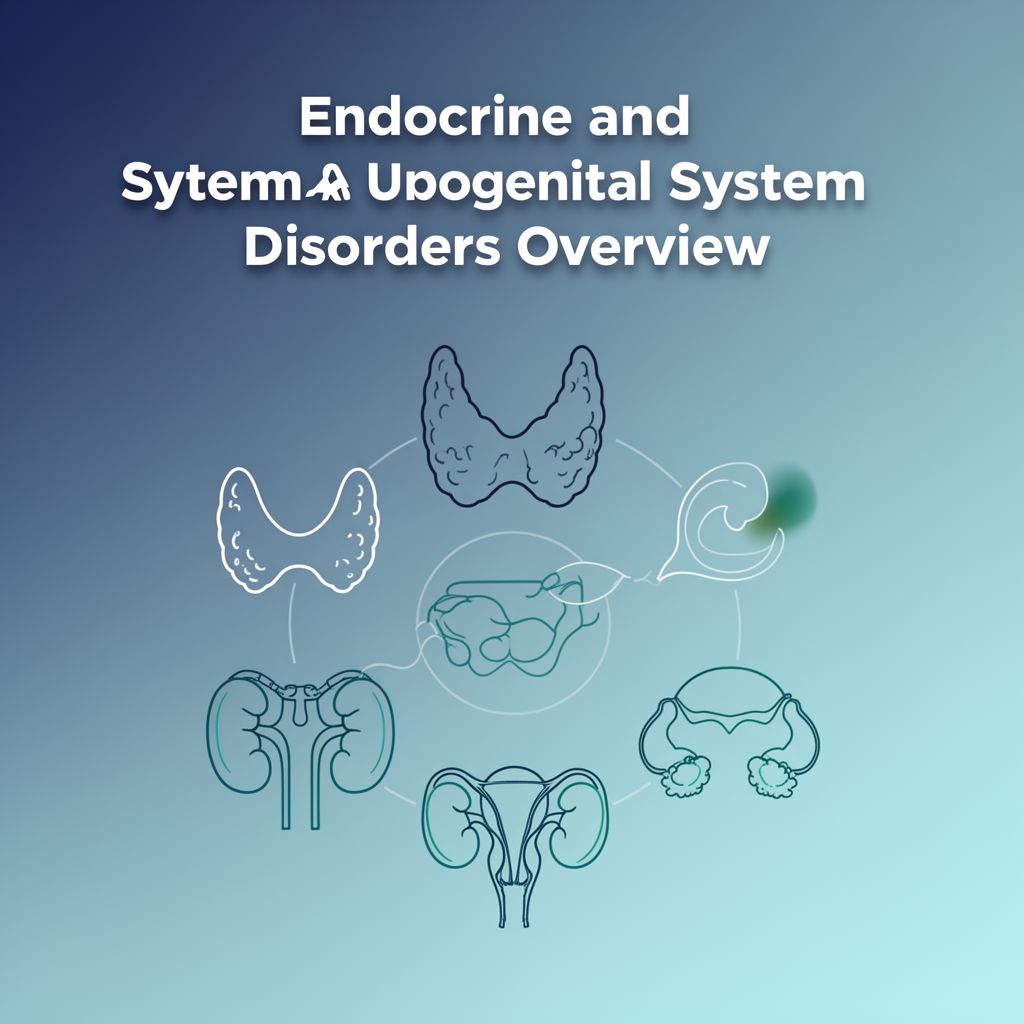
This study material has been compiled from various sources, including copy-pasted text and a lecture audio transcript, to provide a comprehensive overview of endocrine and urogenital disorders.
Endocrine and Urogenital Disorders: A Study Guide
📚 Introduction
This guide offers a structured overview of significant medical conditions affecting the endocrine system and various pathologies related to the male and female urogenital and pelvic systems. Understanding these diverse conditions is fundamental for comprehensive medical knowledge and clinical practice.
🧠 Endocrine System Pathologies
1. Pituitary Tumors
Pituitary tumors can cause a range of symptoms primarily due to compression of surrounding structures. ✅ Key Symptoms & Complications:
- Headaches
- Chiasma Opticum Compression: Leads to bilateral temporal (bitemporal) hemianopsia (loss of vision in the outer half of both visual fields).
- Sinus Cavernosus Compression: Can result in cranial nerve paralyses affecting nerves III, IV, V1, V2, and VI.
- Hypothalamic Compression: Disrupts vital functions such as:
- Thermoregulation (body temperature control)
- Sleep-wake cycles
- Hunger-satiety centers
- Sella Turcica Erosion: May lead to cerebrospinal fluid (CSF) rhinorrhea (leakage of CSF from the nose).
2. Thyroid Gland (Glandula Thyroidea)
The thyroid gland plays a crucial role in regulating numerous physiological processes. ✅ Thyroid Hormones & Functions:
- Thyroxine (T4) & Triiodothyronine (T3):
- Influence basal metabolic rate.
- Essential for protein synthesis, growth, and development.
- Regulate metabolism of carbohydrates, fats, and proteins.
- Affect body temperature and heart rhythm.
- Calcitonin:
- Acts in opposition to parathormone (PTH).
- Decreases blood calcium (Ca) levels.
- Inhibits osteoclast activity in bones.
- Reduces calcium reabsorption by the kidneys.
⚠️ Thyroid Disorders:
- Goiter: Enlargement of the thyroid gland, often due to iodine deficiency.
- Hyperthyroidism:
- Graves-Basedow Disease: An autoimmune condition causing toxic diffuse goiter.
- Toxic Multinodular Goiter: Caused by autonomous thyroid nodules.
- Hypothyroidism:
- Hashimoto's Thyroiditis: An autoimmune condition leading to thyroid gland damage.
3. Adrenal Gland (Glandula Suprarenalis)
The adrenal glands consist of two main parts: the cortex and the medulla.
a. Adrenal Cortex
Regulated by the hypothalamic-pituitary-adrenal (HPA) axis (Hypothalamus → CRF → Pituitary → ACTH → Adrenal Cortex). ✅ Steroid Hormones Synthesized:
- Glucocorticoids (e.g., Cortisol):
- Affect carbohydrate, fat, and protein metabolisms.
- 💡 Clinical Note: Prolonged excess glucocorticoid secretion leads to Cushing's Syndrome.
- Mineralocorticoids (e.g., Aldosterone):
- Regulate sodium (Na) and potassium (K) balance.
- Androgens (Gonadocorticoids):
- Contribute to sex hormone production.
b. Adrenal Medulla
Considered the largest sympathetic ganglion. ✅ Catecholamines Produced:
- Epinephrine, Norepinephrine, Dopamine: Synthesized from tyrosine.
- 💡 Clinical Note: Pheochromocytoma is a catecholamine-secreting tumor of the adrenal medulla.
4. Diabetes Mellitus (DM)
Characterized by reduced or absent insulin effectiveness, leading to hyperglycemia. ⚠️ Complications of Hyperglycemia:
- Microvascular Issues: Retinopathy, Nephropathy, Neuropathy.
- Macrovascular Issues: Stroke, Myocardial Infarction (MI), Renovascular diseases, Ischemia. ✅ Types of Diabetes Mellitus:
- 1️⃣ Type 1 DM:
- Typically presents in adolescents (though can occur at any age).
- Etiology: Autoimmune destruction of insulin-secreting β-cells in the pancreas, resulting in insulin deficiency.
- Management: Patients require exogenous insulin.
- Predisposition: Prone to ketoacidosis and weight loss. May co-exist with other autoimmune diseases.
- 2️⃣ Type 2 DM (Insulin-Independent DM):
- Usually affects individuals over 40 (but can occur earlier).
- Etiology: Decreased insulin secretion and/or increased insulin resistance.
- Risk Factors: Strongly associated with lifestyle, obesity, increased food intake, and alcoholism.
5. Diabetes Insipidus (DI)
A rare condition (approx. 3/100,000) resulting from arginine-vasopressin (ADH) deficiency or resistance. ✅ Hallmark Symptoms:
- Production of large volumes of dilute urine (up to ~20 liters/day).
- Increased thirst (polydipsia), leading to increased fluid intake.
- Risk of dehydration and seizures.
- No glucose in the urine (distinguishing it from DM). ✅ Types of Diabetes Insipidus:
- 1️⃣ Central DI:
- Typically begins between 10-20 years of age.
- Caused by a deficiency in vasopressin (ADH) production.
- 2️⃣ Nephrogenic DI:
- Can occur at any age.
- Characterized by decreased renal sensitivity to vasopressin.
- 3️⃣ Dipsogenic DI:
- Results from damage to the hypothalamic thirst mechanism, leading to excessive water intake.
- 4️⃣ Gestational DI:
- Observed exclusively during pregnancy.
♂️ Male Urogenital and Pelvic Conditions
1. Penis Conditions
- Phimosis: Inability of the prepuce (foreskin) to retract over the glans penis, often due to fibrous adhesions, increasing infection risk.
2. Scrotum & Testis Conditions
- Hydrocele: Accumulation of serous fluid between the two peritoneal layers forming the tunica vaginalis.
- Varicocele: Dilation of the pampiniform plexus.
- Affects 15-20% of males, with incidence increasing with age.
- Most frequently observed on the left side.
- Testicular Torsion: A critical condition where the spermatic cord twists.
- Results in reduced or absent blood flow to the testis, requiring urgent medical attention.
3. Prostate Anatomy
The prostate gland has both anatomical lobes and functional zones. ✅ Anatomical Lobes:
- Anterior Lobe: Located anterior to the urethra (fibromuscular).
- Median Lobe: Situated between the ejaculatory ducts and the urethra.
- Lateral Lobes (Right & Left): The main bulk of the gland.
- Posterior Lobe: Located posterior to the urethra and inferior to the ejaculatory ducts.
- ⚠️ Clinical Significance: This lobe is palpable during a digital rectal exam. ✅ Functional Zones:
- Central Zone: Includes the median lobe. Hormonal growth in this zone can lead to Benign Prostatic Hyperplasia (BPH).
- Peripheral Zone: The largest zone, where most prostate cancers originate.
- Transitional Zone: Surrounds the urethra, also a common site for BPH.
- Fibromuscular Zone: Anterior portion, primarily muscular.
♀️ Female Pelvic Conditions
1. Pelvic Organ Prolapse (POP)
Occurs when pelvic organs descend from their normal position. ✅ Types of Prolapse:
- Cystocele: Prolapse of the bladder into the vagina, often accompanied by urethral prolapse (cystourethrocele).
- Rectocele: Prolapse of the rectum into the vagina.
- Other forms: Enterocele, Sigmoidocele, Uterine prolapse, Vaginal (vault) prolapse.
2. Clinical Anatomy of the Female Pelvis
Key ligaments provide support to the uterus and other pelvic structures. ✅ Important Ligaments:
- Ligamentum Cardinale (Transverse Cervical Ligament of Mackenrodt):
- Extends between the cervix uteri and the lateral pelvic walls.
- Serves as the primary passive support for the uterus.
- The uterine artery crosses superiorly (anteriorly) to the ureter within this ligament.
- Crucial for supporting the vaginal vault.
- Ligamentum Rectouterinum (Sacrouterine/Uterosacral Ligament):
- Connects the cervix uteri to the sacrum.
- Provides secondary passive support for the uterus.
- The inferior hypogastric plexus is located within this ligament.
- 💡 Clinical Note: In the Laparoscopic Uterosacral Nerve Ablation (LUNA) procedure, this ligament is cauterized to alleviate dysmenorrhea and chronic pelvic pain.
- Ligamentum Teres Uteri (Round Ligament):
- Attaches to the uterotubal junction.
- Passes through the inguinal canal and inserts into the labium majus pudendi.
- One of two remnants of the gubernaculum (the other being the ovarian ligament), guiding ovarian positioning during development.
- Nuck's Canal Cyst: A related anatomical consideration, sometimes referred to as a female hydrocele.
💡 Conclusion
This study guide has provided a detailed overview of critical endocrine disorders affecting the pituitary, thyroid, and adrenal glands, along with discussions on diabetes mellitus and diabetes insipidus. Furthermore, it has elucidated various pathologies and anatomical considerations pertinent to the male and female urogenital and pelvic systems. A thorough understanding of these conditions is essential for medical students and practitioners.