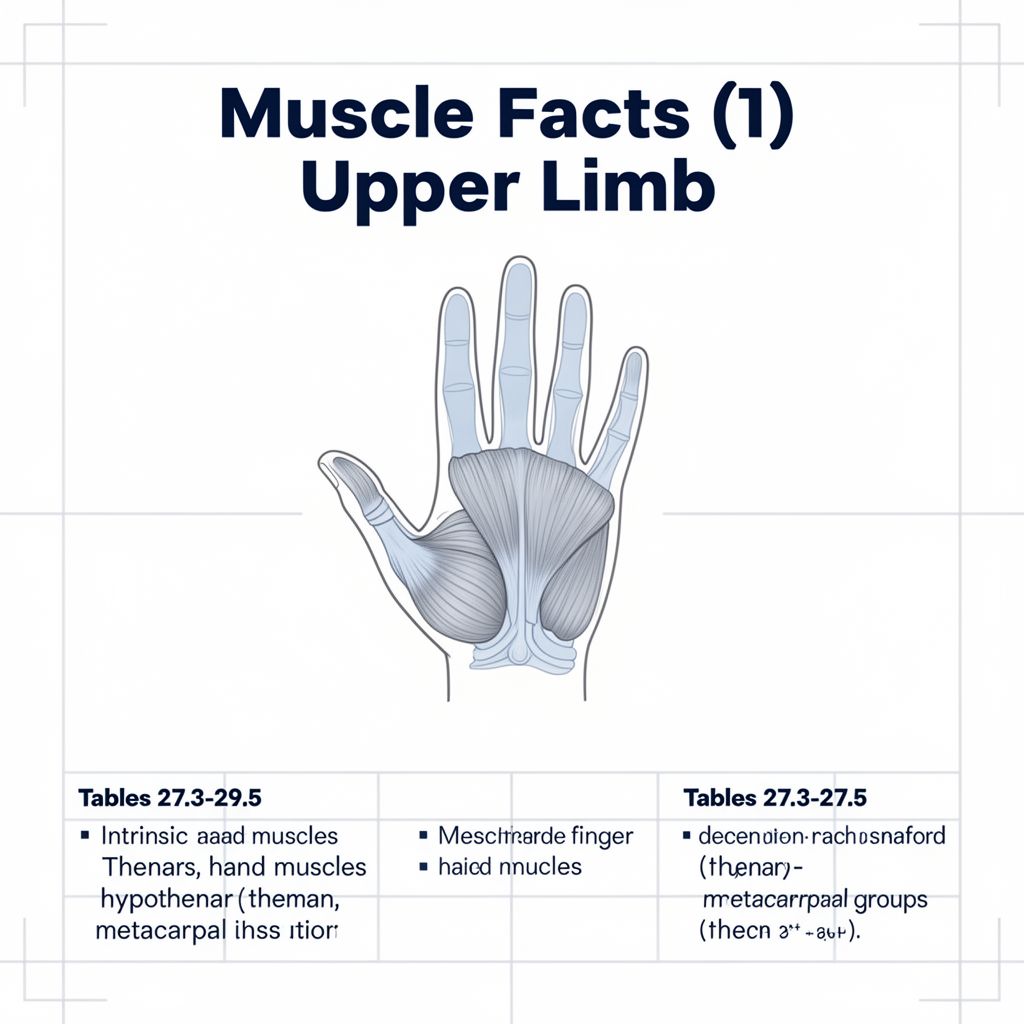
Intrinsic Muscles of the Hand: Thenar, Hypothenar, and Metacarpal Groups - kapak
Bilim#anatomy#hand muscles#thenar muscles#hypothenar muscles

Intrinsic Muscles of the Hand: Thenar, Hypothenar, and Metacarpal Groups

Explore the intricate anatomy and functions of the intrinsic muscles of the hand, including the thenar, hypothenar, and metacarpal muscle groups, their origins, insertions, innervations, and actions.

rana_lJanuary 19, 2026 ~16 dk toplam
01

Flash Kartlar

25 kart

Karta tıklayarak çevir. ← → ile gez, ⎵ ile çevir.

1 / 25
Tüm kartları metin olarak gör
  1. 1. What are the three main groups of intrinsic hand muscles?

    The three main groups of intrinsic hand muscles are the thenar, hypothenar, and metacarpal muscles. These muscles are responsible for the intricate and precise movements of the fingers, including the thumb and little finger. They play a crucial role in fine motor skills and hand dexterity.

  2. 2. What is the primary role of the intrinsic hand muscles?

    The primary role of the intrinsic hand muscles is to enable the complex and precise movements of the fingers. They are essential for delicate manipulations, gripping, and overall hand functionality, allowing for actions like writing, playing instruments, and grasping small objects.

  3. 3. Which muscles constitute the thenar group of the hand?

    The thenar group consists of four muscles responsible for thumb movement: Adductor Pollicis, Abductor Pollicis Brevis, Flexor Pollicis Brevis, and Opponens Pollicis. These muscles work together to facilitate the thumb's critical functions such as grasping and manipulation.

  4. 4. What is the main function of the Adductor Pollicis muscle?

    The Adductor Pollicis muscle is primarily responsible for the adduction of the thumb, meaning it draws the thumb towards the palm. It also contributes to the flexion of the thumb's metacarpophalangeal joint. This action is vital for powerful gripping and holding objects securely.

  5. 5. Describe the origin, insertion, and innervation of the Adductor Pollicis.

    The Adductor Pollicis has two heads: the transverse head originates from the palmar surface of the third metacarpal, and the oblique head from the capitate bone and bases of the second and third metacarpals. It inserts into the base of the proximal phalanx of the thumb via the ulnar sesamoid bone. It is innervated by the ulnar nerve (C8, T1).

  6. 6. What is the function of the Abductor Pollicis Brevis?

    The Abductor Pollicis Brevis is responsible for the abduction of the thumb, moving it away from the palm. This action occurs at the carpometacarpal joint of the thumb. It is crucial for opening the hand and positioning the thumb for various tasks.

  7. 7. Which nerve innervates the Abductor Pollicis Brevis and what are its origins?

    The Abductor Pollicis Brevis is innervated by the median nerve (C8, T1). It originates from the scaphoid and trapezium bones, as well as the flexor retinaculum. It inserts into the base of the proximal phalanx of the thumb via the radial sesamoid bone.

  8. 8. What is the primary action of the Flexor Pollicis Brevis muscle?

    The Flexor Pollicis Brevis primarily provides flexion at the carpometacarpal joint of the thumb. This muscle helps in bending the thumb, which is essential for gripping and manipulating objects. Its two heads contribute to this crucial movement.

  9. 9. Differentiate the innervation of the superficial and deep heads of the Flexor Pollicis Brevis.

    The superficial head of the Flexor Pollicis Brevis is innervated by the median nerve (C8, T1), while the deep head is innervated by the ulnar nerve (C8, T1). Both heads originate from the flexor retinaculum and trapezium (superficial) or capitate and trapezium (deep), inserting into the base of the proximal phalanx of the thumb.

  10. 10. What is the unique function of the Opponens Pollicis muscle?

    The Opponens Pollicis muscle performs the opposition movement of the thumb at the carpometacarpal joint. This action involves rotating the thumb towards the tips of the other fingers, allowing for precise grasping and pinching. It is critical for fine motor skills.

  11. 11. Which nerve innervates the Opponens Pollicis and where does it insert?

    The Opponens Pollicis is innervated by the median nerve (C8, T1). It originates from the trapezium and inserts onto the radial border of the first metacarpal bone. This muscle's action is crucial for the thumb's ability to oppose other fingers.

  12. 12. Name the muscles that form the hypothenar group.

    The hypothenar group, responsible for movements of the little finger, includes the Opponens Digiti Minimi, Flexor Digiti Minimi Brevis, Abductor Digiti Minimi, and Palmaris Brevis. These muscles contribute to the little finger's delicate movements and the shaping of the palm.

  13. 13. What is the function of the Opponens Digiti Minimi?

    The Opponens Digiti Minimi contributes to the opposition movement of the little finger by drawing its metacarpal bone towards the palm. This action helps the little finger make contact with other fingers, enhancing gripping ability. It is innervated by the ulnar nerve (C8, T1).

  14. 14. Describe the origin and insertion of the Flexor Digiti Minimi Brevis.

    The Flexor Digiti Minimi Brevis originates from the hook of the hamate bone and the flexor retinaculum. It inserts into the base of the proximal phalanx of the fifth finger. This muscle provides flexion at the metacarpophalangeal joint of the little finger, playing a key role in its bending.

  15. 15. What are the actions of the Abductor Digiti Minimi muscle?

    The Abductor Digiti Minimi muscle performs flexion and abduction (moving away from the palm) at the metacarpophalangeal joint of the little finger. It also assists in extension of the proximal and distal interphalangeal joints. This muscle is active when separating and extending the little finger.

  16. 16. Which nerve innervates all muscles of the hypothenar group?

    All muscles of the hypothenar group (Opponens Digiti Minimi, Flexor Digiti Minimi Brevis, Abductor Digiti Minimi, and Palmaris Brevis) are innervated by the ulnar nerve (C8, T1). This common innervation highlights their coordinated function in little finger movements and palm shaping.

  17. 17. What is the unique role of the Palmaris Brevis muscle?

    The Palmaris Brevis muscle's primary function is to tighten the skin of the palm by tensing the palmar aponeurosis. This action provides a protective function to the palmar surface. It originates from the ulnar border of the palmar aponeurosis and inserts into the skin of the hypothenar eminence.

  18. 18. How many lumbrical muscles are there, and what is their general function?

    There are four lumbrical muscles. Their main function is to cause flexion at the metacarpophalangeal joints and extension at the proximal and distal interphalangeal joints of the second to fifth fingers. This creates the characteristic "numaracı" (tabletop or intrinsic plus) position of the fingers.

  19. 19. Differentiate the innervation of the lumbrical muscles.

    The first and second lumbrical muscles are innervated by the median nerve (C8, T1). The third and fourth lumbrical muscles are innervated by the ulnar nerve (C8, T1). This dual innervation pattern is unique and important for their coordinated action.

  20. 20. What is the origin and insertion of the first and second lumbrical muscles?

    The first and second lumbrical muscles originate from the radial side tendons of the flexor digitorum profundus. They insert into the dorsal digital expansion of the second to fifth fingers. Their action contributes to the "intrinsic plus" position of the fingers.

  21. 21. How many dorsal interossei muscles are there, and what is their primary action?

    There are four dorsal interossei muscles. Their primary action is abduction of the second to fourth fingers, meaning they spread the fingers away from the third finger. They also contribute to flexion at the metacarpophalangeal joints and extension at the interphalangeal joints.

  22. 22. What is the innervation for all dorsal interossei muscles?

    All four dorsal interossei muscles are innervated by the ulnar nerve (C8, T1). They are bipennate muscles, originating from the adjacent sides of the metacarpal bones and inserting into the dorsal digital expansion and bases of the proximal phalanges.

  23. 23. Describe the specific insertion of the first dorsal interossei muscle.

    The first dorsal interossei muscle inserts into the radial side of the proximal phalanx of the second finger and its dorsal digital expansion. This specific insertion allows it to abduct the second finger away from the midline of the hand.

  24. 24. How many palmar interossei muscles are there, and what is their primary action?

    There are three palmar interossei muscles. Their primary action is adduction of the second, fourth, and fifth fingers towards the third finger. Like the dorsal interossei, they also contribute to flexion at the metacarpophalangeal joints and extension at the interphalangeal joints.

  25. 25. What is the innervation for all palmar interossei muscles?

    All three palmar interossei muscles are innervated by the ulnar nerve (C8, T1). They originate from the metacarpal bones of the fingers they act upon and insert into the dorsal digital expansion and bases of the proximal phalanges.

02

Bilgini Test Et

15 soru

Çoktan seçmeli sorularla öğrendiklerini ölç. Cevap + açıklama.

Soru 1 / 15Skor: 0

Which of the following is NOT one of the three main groups of intrinsic hand muscles mentioned in the text?

03

Detaylı Özet

6 dk okuma

Tüm konuyu derinlemesine, başlık başlık.

This study material has been compiled from various sources, including copy-pasted text from a document (likely a textbook or anatomical reference) and a lecture audio transcript.


Intrinsic Muscles of the Hand: A Comprehensive Study Guide 🖐️

The human hand is a marvel of intricate design, allowing for both powerful grips and delicate, precise movements. This remarkable dexterity is largely attributed to the intrinsic muscles of the hand, which are located entirely within the hand itself. These muscles are crucial for fine motor control, manipulation of objects, and the overall functionality of the digits.

The intrinsic muscles are broadly categorized into three main groups based on their location and primary function:

  1. Thenar Muscles: Responsible for movements of the thumb.
  2. Hypothenar Muscles: Responsible for movements of the little finger.
  3. Metacarpal Muscles: Comprising the lumbricals and interossei, these muscles control the movements of the other digits (2nd through 5th fingers).

Let's delve into each group in detail.


1. Thenar Muscles: The Thumb's Movers 👍

The thenar eminence, the fleshy mound at the base of the thumb, houses a group of four muscles vital for thumb movement. These muscles enable the thumb's unique ability to oppose the other fingers, a key feature of human dexterity.

📚 Key Functions:

  • Adduction: Moving the thumb towards the palm.
  • Abduction: Moving the thumb away from the palm.
  • Flexion: Bending the thumb at its joints.
  • Opposition: Rotating the thumb to touch the tips of other fingers.

Individual Thenar Muscles:

1.1. Adductor Pollicis

  • Origin:
    • Transverse head: Palmar surface of the 3rd metacarpal.
    • Oblique head: Capitate bone, bases of the 2nd and 3rd metacarpals.
  • Insertion: Base of the proximal phalanx of the thumb, via the ulnar sesamoid bone.
  • Innervation: Ulnar nerve (C8, T1).
  • Action: ✅ Adduction of the thumb at the carpometacarpal (CMC) joint; flexion at the metacarpophalangeal (MCP) joint of the thumb.

1.2. Abductor Pollicis Brevis

  • Origin: Scaphoid bone, trapezium, and flexor retinaculum.
  • Insertion: Base of the proximal phalanx of the thumb, via the radial sesamoid bone.
  • Innervation: Median nerve (C8, T1).
  • Action: ✅ Abduction of the thumb at the CMC joint.

1.3. Flexor Pollicis Brevis

  • Origin:
    • Superficial head: Flexor retinaculum and trapezium.
    • Deep head: Capitate bone and trapezium.
  • Insertion: Base of the proximal phalanx of the thumb (superficial head via ulnar sesamoid, deep head via radial sesamoid).
  • Innervation: Superficial head by the Median nerve (C8, T1); Deep head by the Ulnar nerve (C8, T1).
  • Action: ✅ Flexion of the thumb at the CMC joint.

1.4. Opponens Pollicis

  • Origin: Trapezium.
  • Insertion: Radial border of the 1st metacarpal.
  • Innervation: Median nerve (C8, T1).
  • Action: ✅ Opposition of the thumb at the CMC joint, rotating it towards the palm to meet other fingers.

💡 These muscles work in concert to enable the thumb's critical functions in gripping and manipulation.


2. Hypothenar Muscles: The Little Finger's Control 🤏

The hypothenar eminence, located on the ulnar side of the palm at the base of the little finger, contains a group of muscles dedicated to the movements of the 5th digit. These muscles contribute to the hand's ability to cup the palm and perform fine adjustments with the little finger.

📚 Key Functions:

  • Opposition: Drawing the little finger's metacarpal towards the palm.
  • Flexion: Bending the little finger.
  • Abduction: Moving the little finger away from the palm.
  • Tightening: Providing protective tension to the palmar aponeurosis.

Individual Hypothenar Muscles:

2.1. Opponens Digiti Minimi

  • Origin: Hook of hamate and flexor retinaculum.
  • Insertion: Ulnar border of the 5th metacarpal.
  • Innervation: Ulnar nerve (C8, T1).
  • Action: ✅ Draws the 5th metacarpal in a palmar direction, contributing to opposition and cupping of the palm.

2.2. Flexor Digiti Minimi Brevis

  • Origin: Hook of hamate and flexor retinaculum.
  • Insertion: Base of the 5th proximal phalanx.
  • Innervation: Ulnar nerve (C8, T1).
  • Action: ✅ Flexion at the MCP joint of the little finger.

2.3. Abductor Digiti Minimi

  • Origin: Pisiform bone.
  • Insertion: Ulnar base of the 5th proximal phalanx and the dorsal digital expansion of the 5th digit.
  • Innervation: Ulnar nerve (C8, T1).
  • Action: ✅ Flexion and abduction at the MCP joint of the little finger; assists in extension of the PIP and DIP joints of the little finger.

2.4. Palmaris Brevis

  • Origin: Ulnar border of the palmar aponeurosis.
  • Insertion: Skin of the hypothenar eminence.
  • Innervation: Ulnar nerve (C8, T1).
  • Action: ✅ Tightens the palmar aponeurosis, providing a protective function to the palm's skin.

3. Metacarpal Muscles: Lumbricals and Interossei ✍️

These muscles are located between the metacarpal bones and are crucial for the precise movements of the 2nd through 5th digits, enabling fine motor skills like writing, playing instruments, and manipulating small objects.

3.1. Lumbricals

There are four lumbrical muscles, unique in that they originate from tendons and insert into tendons/expansions.

  • Origin: Tendons of the flexor digitorum profundus.
    • 1st & 2nd Lumbricals: Radial sides of the flexor digitorum profundus tendons.
    • 3rd & 4th Lumbricals: Bipennate, from the medial and lateral sides of the flexor digitorum profundus tendons.
  • Insertion: Dorsal digital expansion (dde) of the 2nd to 5th digits.
  • Innervation:
    • 1st & 2nd Lumbricals: Median nerve (C8, T1).
    • 3rd & 4th Lumbricals: Ulnar nerve (C8, T1).
  • Action: ✅ Flexion at the MCP joints and extension at the proximal and distal interphalangeal (IP) joints of the 2nd to 5th digits. This action is often described as the "number-making" or "waiter's" position, where the MCP joints are flexed and the IP joints are extended.

3.2. Dorsal Interossei

There are four dorsal interossei muscles, each bipennate and responsible for abducting the fingers.

  • Origin: Adjacent sides of the metacarpals.
    • 1st: 1st and 2nd metacarpals.
    • 2nd: 2nd and 3rd metacarpals.
    • 3rd: 3rd and 4th metacarpals.
    • 4th: 4th and 5th metacarpals.
  • Insertion: Dorsal digital expansion (dde) and the radial/ulnar side of the proximal phalanx of the 2nd to 4th digits.
    • 1st: Radial side of 2nd proximal phalanx.
    • 2nd: Radial side of 3rd proximal phalanx.
    • 3rd: Ulnar side of 3rd proximal phalanx.
    • 4th: Ulnar side of 4th proximal phalanx.
  • Innervation: Ulnar nerve (C8, T1).
  • Action: ✅ Flexion at the MCP joints, extension at the proximal and distal IP joints, and abduction of the 2nd to 4th digits away from the 3rd digit.

3.3. Palmar Interossei

There are three palmar interossei muscles, responsible for adducting the fingers.

  • Origin:
    • 1st: Ulnar side of the 2nd metacarpal.
    • 2nd: Radial side of the 4th metacarpal.
    • 3rd: Radial side of the 5th metacarpal.
  • Insertion: Dorsal digital expansion (dde) and the base of the proximal phalanx of the 2nd, 4th, and 5th digits.
  • Innervation: Ulnar nerve (C8, T1).
  • Action: ✅ Flexion at the MCP joints, extension at the proximal and distal IP joints, and adduction of the 2nd, 4th, and 5th digits towards the 3rd digit.

⚠️ Important Note on Innervation:

While the median nerve primarily innervates the thenar muscles (except for the deep head of flexor pollicis brevis and adductor pollicis), and the ulnar nerve primarily innervates the hypothenar and interossei muscles, there is a shared innervation for the lumbricals (1st and 2nd by median, 3rd and 4th by ulnar) and a dual innervation for the flexor pollicis brevis. This complex innervation pattern highlights the intricate control mechanisms of the hand.

Understanding these intrinsic muscles, their origins, insertions, innervations, and actions is fundamental to comprehending the complex motor control and functional capabilities of the human hand.
Kendi çalışma materyalini oluştur

PDF, YouTube videosu veya herhangi bir konuyu dakikalar içinde podcast, özet, flash kart ve quiz'e dönüştür. 1.000.000+ kullanıcı tercih ediyor.

Sıradaki Konular

Tümünü keşfet
Forearm Muscles: Anatomy and Clinical Relevance

Forearm Muscles: Anatomy and Clinical Relevance

An in-depth look at the anterior and posterior compartments of the forearm, detailing muscle origins, insertions, innervations, actions, and clinical conditions like lateral epicondylitis.

10 dk Özet 25 15
Muscles of the Lower Limb: Leg Compartments

Muscles of the Lower Limb: Leg Compartments

Explore the anatomy of the leg muscles, categorized by their compartments: lateral, anterior, and posterior. Learn about the origin, insertion, innervation, and actions of key muscles.

Özet 25 15
Upper Limb Muscle Anatomy: Deltoid, Rotator Cuff, Pectoralis Major, and Coracobrachialis

Upper Limb Muscle Anatomy: Deltoid, Rotator Cuff, Pectoralis Major, and Coracobrachialis

Explore the detailed anatomy and functions of key upper limb muscles: the deltoid, rotator cuff, pectoralis major, and coracobrachialis.

Özet 25 15
The Nervous and Endocrine Systems: Body's Control Centers

The Nervous and Endocrine Systems: Body's Control Centers

Explore the intricate workings of the nervous and endocrine systems, their structures, functions, and how they maintain the body's homeostasis.

Özet 25 15 Görsel
Fundamental Biological Principles and Nutrition

Fundamental Biological Principles and Nutrition

An academic summary covering biological organization from cells to organ systems, key cellular processes, major organ system functions, and essential nutritional components with their identification tests.

5 dk Özet 25 15
Skeletal Muscle Structure and Neuromuscular Junction

Skeletal Muscle Structure and Neuromuscular Junction

This audio summary provides an academic overview of skeletal muscle terminology, morphology, filament and sarcomere structure, innervation, and the intricate process of excitation-contraction coupling.

7 dk Özet 18 12
Neuron Types and Nervous System Structures

Neuron Types and Nervous System Structures

This summary explores the diverse morphology and classification of neurons, their fundamental components, synaptic connections, and the crucial role of glial cells and peripheral nervous system structures.

6 dk Özet 25 15
Male Reproductive Anatomy and Gonad Descent

Male Reproductive Anatomy and Gonad Descent

Explore the gross anatomy of the male reproductive system, accessory glands, and the embryological development and descent of gonads, including clinical correlations.

7 dk Özet 15