 Podit
Podit
📚 Chapter 5: Understanding Learning Theories
Source Information: This study material has been compiled from a lecture audio transcript and copy-pasted text provided by the user.
💡 Introduction to Learning Theories
Learning is a fundamental process through which individuals acquire new knowledge, skills, behaviors, or attitudes. This chapter explores various theories that explain how learning occurs, focusing on the applications of operant conditioning, cognitive learning processes, and the impact of observational learning. These frameworks offer a comprehensive understanding of how behaviors are acquired, modified, and retained through direct reinforcement, mental processes, and social observation.
1️⃣ Applications of Operant Conditioning
Operant conditioning, a type of learning where behavior is strengthened if followed by a reinforcer or diminished if followed by a punisher, has wide-ranging applications.
1.1. Shaping
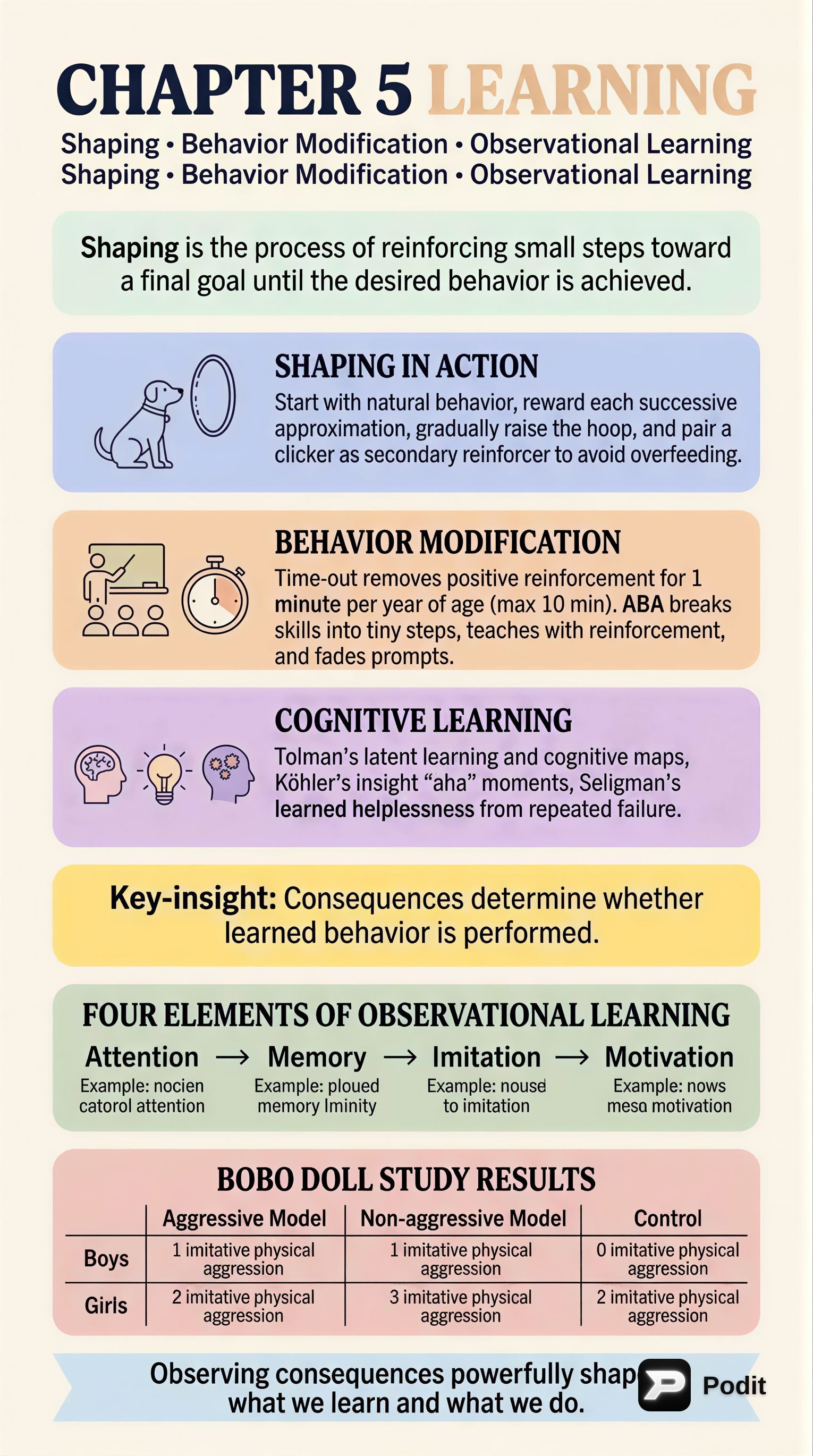
📚 Shaping is the process of reinforcing successive approximations of a desired behavior until the target behavior is fully achieved. It involves breaking down a complex behavior into smaller, manageable steps.
- ✅ Successive Approximations: These are small steps that progressively get closer to the ultimate behavioral goal.
- Example: Training a dog to jump through a hoop.
- Start by rewarding the dog for simply looking at the hoop.
- Reward for stepping near the hoop.
- Reward for stepping through the hoop on the ground.
- Gradually raise the hoop, rewarding each successful attempt.
- 💡 Secondary Reinforcers: Trainers often pair a sound (like a whistle or clicker) with food. The sound then becomes a secondary reinforcer, allowing for reinforcement without constant food delivery, preventing overfeeding.
- ⚠️ Biological Constraints: While powerful, operant conditioning is limited by an animal's biological predispositions. Not all behaviors can be taught to all species.
1.2. Behavior Modification
📚 Behavior modification uses operant conditioning principles (and sometimes classical conditioning) to change undesirable behaviors and encourage desirable ones. It's widely applied to both animals and humans, especially schoolchildren.
- ✅ Core Principles: Reinforcement and shaping are the main drivers.
- Example: Time-out
- A mild form of punishment by removal.
- A misbehaving individual is temporarily removed from a reinforcing environment (e.g., social attention, toys).
- This removes positive reinforcement, reducing the likelihood of the undesirable behavior.
- Recommended Duration: Typically 1 minute per year of age, with a maximum of 10 minutes.
1.3. Applied Behavior Analysis (ABA)
📚 Applied Behavior Analysis (ABA) is a modern, systematic form of behavior modification that combines analytical and behavioral techniques.
- ✅ Methodology: Breaks skills into small, teachable steps, uses reinforcement to teach, and gradually removes prompts as the learner becomes proficient.
- Applications:
- Used in schools, private practices, and institutions.
- Common for treating children with developmental disorders (e.g., autism).
- Effective in animal training and developing teaching methods for individuals with varied mental abilities.
1.4. Biofeedback
📚 Biofeedback is an application that uses biological information (e.g., heart rate, muscle tension, brain waves) to help individuals gain conscious control over involuntary physiological responses.
- ✅ Purpose: Helps individuals learn to regulate their own bodily functions.
- Benefits: Can aid in relieving or controlling problems such as stress, hyperactivity, or high blood pressure.
2️⃣ Cognitive Learning Theory
Cognitive learning theory focuses on understanding learning by examining the mental processes involved, rather than just observable behaviors.
2.1. Latent Learning (E. C. Tolman)
📚 Latent learning refers to learning that occurs but is not immediately expressed or observable until there is an incentive to demonstrate it.
- Tolman's Maze-Running Rats:
- Experiment: Rats were placed in a maze under three conditions:
- Group 1: Rewarded with food every day.
- Group 2: Not rewarded for the first 9 days, then rewarded from day 10 onwards.
- Group 3: Never rewarded.
- Results: Group 2 showed a sudden drop in errors once rewards were introduced, performing as well as Group 1. This suggested they had learned the maze layout (formed a cognitive map) during the unrewarded days, but only demonstrated this learning when a reward was present.
- ✅ Cognitive Map: A mental representation of the layout of one's environment.
- Experiment: Rats were placed in a maze under three conditions:
2.2. Insight Learning (Wolfgang Köhler)
📚 Insight learning is the sudden perception of relationships among various parts of a problem, allowing for a rapid and often "aha!" moment solution.
- Köhler's Smart Chimp (Sultan):
- Experiment: Sultan, a chimpanzee, was faced with the problem of reaching a banana hanging from the ceiling, with boxes and sticks scattered around.
- Solution: After initial failed attempts, Sultan suddenly grasped the relationship between the objects, stacked the boxes, and used a stick to knock down the banana.
- ✅ This demonstrated a sudden "coming together" of all problem elements, not a gradual trial-and-error process.
2.3. Learned Helplessness (Martin Seligman)
📚 Learned helplessness is the tendency to fail to act to escape from a situation because of a history of repeated failures in the past, leading to a belief that one has no control over the outcome.
- Seligman's Depressed Dogs:
- Experiment: Dogs were subjected to inescapable electric shocks. Later, when placed in a situation where escape was possible, these dogs often made no attempt to escape, even when the shocks were avoidable.
- Conclusion: The dogs had learned that their actions were futile in preventing the shocks, leading to a state of helplessness and increased fear/anxiety, even when circumstances changed.
3️⃣ Observational Learning
📚 Observational learning, also known as social learning, is learning by observing the behavior of a person or model. Albert Bandura's Social Cognitive Theory is central to this concept.
- Example: Learning how to drive a car by watching others, or a child learning manners by observing parents.
3.1. The Bobo Doll Study (Bandura, Ross, & Ross, 1961)
This seminal study demonstrated the power of observational learning, particularly concerning aggression.
- Participants: 72 preschool children (3-6 years old).
- Groups:
- Aggressive Model Group: Children observed an adult model aggressively interacting with a Bobo doll (e.g., hitting it with a hammer).
- Non-aggressive Model Group: Children observed an adult model playing quietly with other toys.
- Control Group: Children had no model.
- Results (📊):
- Children in the aggressive model group showed significantly more imitative physical aggression towards the Bobo doll.
- Boys generally exhibited more aggression than girls.
- Further experiments showed that children who saw a model rewarded for aggression imitated the behavior more readily than those who saw a model punished. However, even those who saw punishment had learned the behavior and would perform it if promised a reward.
- ✅ Conclusion: Consequences (reward or punishment) strongly influence whether a learned behavior is performed, even if the behavior has been learned through observation.
3.2. Four Elements of Observational Learning (Bandura)
For observational learning to occur effectively, four key elements are necessary:
- Attention: The learner must pay attention to the model's behavior.
- 💡 People are more likely to attend to models they find similar, attractive, or competent.
- Memory (Retention): The learner must be able to retain or remember what they observed.
- ✅ This involves encoding the observed behavior into memory for later retrieval.
- Example: Remembering the steps from a cooking show.
- Imitation (Reproduction): The learner must be physically and cognitively capable of reproducing the observed behavior.
- ⚠️ There's a difference between knowing how to do something and being able to do it.
- Example: A toddler might remember the steps for tying shoelaces but lack the fine motor skills (dexterity) to perform them.
- Desire (Motivation): The learner must have the motivation or desire to perform the behavior.
- 📈 Motivation increases if rewards are expected or observed for the behavior.
- ❌ People rarely imitate models who fail or are punished.
3.3. Media Influence on Behavior
The principles of observational learning extend to media consumption.
- Aggression and Media: Studies (e.g., Joy et al., 1986; Centerwall, 1992) have investigated the link between exposure to television/video games and aggressive behavior, comparing groups with varying media access.
- Media Usage Statistics:
- 📊 Young people spend an average of 6.5 hours a day (44.5 hours/week) on media.
- In contrast, they spend only 2 hours and 15 minutes a day with parents and 50 minutes a day on homework.
- Similar trends in media usage are observed in Türkiye (as indicated by provided source links).
🏁 Conclusion
Learning is a multifaceted process explained by various theories. Operant conditioning highlights the role of consequences in shaping behavior, while cognitive learning theory emphasizes internal mental processes like latent learning, insight, and learned helplessness. Observational learning, as demonstrated by Bandura, underscores the profound impact of social models and media on how we acquire and perform behaviors. Together, these theories provide a comprehensive understanding of how both humans and animals learn and adapt.