Podit
Podit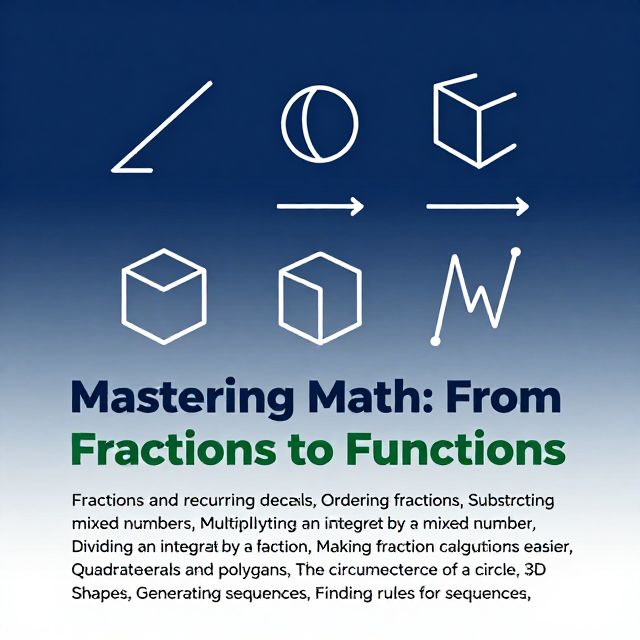
This study material is based on a lecture transcript titled "Mastering Math: From Fractions to Functions."
Mastering Math: From Fractions to Functions
Welcome to a comprehensive guide designed to demystify fundamental mathematical concepts. This material covers essential topics from numerical operations with fractions and decimals, through the properties of geometric shapes, to the logic of sequences and functions. Our goal is to provide clear, engaging, and easy-to-grasp explanations that are crucial for academic success and practical application.
1. Navigating Numbers: Fractions, Decimals, and Operations
This section explores the world of numbers, focusing on fractions, decimals, and how to perform various operations with them.
📚 Fractions and Recurring Decimals
- Fractions: Represent a part of a whole (e.g., one-half, three-quarters).
- Recurring Decimals: Decimals where a digit or block of digits repeats infinitely (e.g., 1/3 = 0.333...). Understanding how to convert between fractions and recurring decimals is a key skill.
📈 Ordering Fractions
To compare and order fractions, a common denominator is essential.
-
Find the Least Common Multiple (LCM): Determine the LCM of all denominators.
-
Convert Fractions: Rewrite each fraction with the LCM as its new denominator.
-
Compare Numerators: The fraction with the larger numerator will be the larger fraction.
✅ Example: Order 1/2, 2/3, and 3/5.
- Denominators are 2, 3, 5. The LCM is 30.
- 1/2 = 15/30
- 2/3 = 20/30
- 3/5 = 18/30
- Ordering them from smallest to largest: 15/30, 18/30, 20/30, which means 1/2, 3/5, 2/3.
🔢 Operations with Fractions
Subtracting Mixed Numbers
Mixed numbers combine a whole number and a fraction (e.g., 3 1/2).
- Method 1: Convert to Improper Fractions: Convert both mixed numbers into improper fractions (numerator is larger than denominator), then subtract.
- Method 2: Separate Whole and Fraction Parts:
- Subtract the whole numbers.
- Subtract the fractional parts.
- ⚠️ Borrowing: If the first fraction is smaller than the second, borrow 1 from the whole number part of the first mixed number and add it to its fractional part (e.g., 1 becomes x/x).
Multiplying an Integer by a Mixed Number
-
Convert to Improper Fraction: Change the mixed number into an improper fraction.
-
Multiply: Multiply the integer by the numerator of the improper fraction. The denominator remains the same.
-
Simplify: Convert the resulting improper fraction back to a mixed number or simplify if possible.
✅ Example: 5 multiplied by 2 1/2.
- 2 1/2 converts to 5/2.
- 5 * (5/2) = 25/2.
- 25/2 converts to 12 1/2.
Dividing an Integer by a Fraction
Use the "Keep, Change, Flip" rule:
-
Keep: Keep the first number (the integer) as it is.
-
Change: Change the division sign to a multiplication sign.
-
Flip: Flip the second number (the fraction) by inverting it (reciprocal).
✅ Example: 6 divided by 1/3.
- Keep 6.
- Change ÷ to ×.
- Flip 1/3 to 3/1 (or 3).
- 6 * 3 = 18.
💡 Making Fraction Calculations Easier
- Simplify First: Always simplify fractions to their lowest terms before performing calculations.
- Common Factors: Look for common factors to reduce numbers, which can significantly simplify the process and prevent large numbers.
2. Exploring Shapes: Geometry Fundamentals
This section shifts focus to geometric shapes, from two-dimensional polygons to three-dimensional objects.
📐 Quadrilaterals and Polygons
- Polygon: A closed two-dimensional shape made up of straight line segments.
- Quadrilateral: A specific type of polygon that has exactly four sides.
- Types of Quadrilaterals: Squares, rectangles, rhombuses, parallelograms, and trapezoids.
- Properties: Each type has unique properties (e.g., a square has four equal sides and four right angles; a parallelogram has opposite sides that are parallel and equal in length).
📏 The Circumference of a Circle
- Circumference (C): The distance around the edge of a circle.
- Pi (π): A special mathematical constant, approximately 3.14159, used in circle calculations.
- Formulas:
- C = πd (where 'd' is the diameter)
- C = 2πr (where 'r' is the radius)
- 💡 Remember: The diameter is twice the radius (d = 2r).
🧊 3D Shapes
- 3D Shapes: Objects that possess length, width, and height.
- Common Examples: Cubes, cuboids, cylinders, spheres, pyramids, and cones.
- Components:
- Faces: The flat or curved surfaces of the shape.
- Edges: Where two faces meet.
- Vertices: The corners where edges meet.
- Understanding these components is crucial for concepts like volume and surface area.
3. Patterns and Relationships: Sequences, Functions, and Percentages
Our final section delves into patterns, rules, and practical applications of mathematical relationships.
🔢 Generating Sequences
- Sequence: A list of numbers or objects in a specific order, often generated by a rule.
- Rule-Based Generation: Each term in a sequence is typically derived from the previous term(s) or its position in the sequence.
- ✅ Example: The sequence 2, 4, 6, 8... is generated by adding 2 to the previous term.
🔍 Finding Rules for Sequences & Using the nth Term
- Arithmetic Sequence: A sequence where the difference between consecutive terms is constant (the "common difference").
- The nth Term: A formula that allows you to find any term in a sequence based on its position ('n') without listing all preceding terms.
- ✅ Example: For the sequence 2, 4, 6, 8..., the nth term is 2n.
- To find the 10th term (n=10): 2 * 10 = 20.
- ✅ Example: For the sequence 2, 4, 6, 8..., the nth term is 2n.
⚙️ Representing Simple Functions
- Function: A rule that assigns exactly one output for each input. Think of it as a machine: you put something in (input), and a specific result comes out (output).
- Notation: Functions are often written as f(x) = [rule], where 'x' is the input.
- 💡 The nth term rule for a sequence is a type of function!
📊 Percentage Increases and Decreases
Percentages are vital for understanding financial changes, discounts, and growth.
-
Traditional Method:
- Increase: Calculate the percentage amount, then add it to the original amount.
- Decrease: Calculate the percentage amount, then subtract it from the original amount.
-
Using a Multiplier (Efficient Method):
- Percentage Increase: To increase an amount by X%, multiply the original amount by (1 + X/100).
- ✅ Example: To increase a price by 10%, multiply by 1.10 (1 + 10/100).
- Percentage Decrease: To decrease an amount by X%, multiply the original amount by (1 - X/100).
- ✅ Example: To decrease a price by 10%, multiply by 0.90 (1 - 10/100).
- 💡 This multiplier method is a powerful application of functions, where the original amount is the input, and the new amount is the unique output based on the percentage change rule.
- Percentage Increase: To increase an amount by X%, multiply the original amount by (1 + X/100).
Conclusion
We've journeyed through the fundamental concepts of fractions, decimals, geometric shapes, sequences, and functions. Each topic, while distinct, is interconnected, forming a robust foundation for your mathematical understanding. Remember, mathematics is not just about memorizing formulas; it's about understanding concepts, solving problems, and developing logical thinking. Keep exploring, questioning, and learning! Your mathematical adventure is just beginning.