1. What characterized the early 20th century for the Ottoman Empire?
The early 20th century was a period of intense crisis and terminal decline for the Ottoman Empire. It was marked by escalating internal dissent, persistent external pressures, and a desperate struggle for survival against rising nationalism among its diverse populations.
2. What significant political event preceded the final decline of the Ottoman Empire in the early 20th century?
The Young Turk Revolution of 1908 and the subsequent restoration of the constitutional monarchy preceded the final decline. This event initially aimed to modernize and strengthen the empire but ultimately ushered in a period of intense political instability and power struggles.
3. What were the primary challenges faced by the Ottoman Empire in the early 20th century?
The empire faced escalating internal dissent from various ethnic groups, persistent external pressures from European powers seeking to expand their influence, and a desperate struggle to maintain its integrity against rising nationalism within its borders. These factors contributed to its terminal decline.
4. What role did nationalism play in the Ottoman Empire's final era?
Rising nationalism among the empire's diverse populations was a significant factor in its decline. Various ethnic groups sought independence, leading to internal dissent and weakening the empire's cohesion, making it more vulnerable to external pressures and territorial losses.
5. What kind of political system was restored in the Ottoman Empire after the Young Turk Revolution of 1908?
After the Young Turk Revolution of 1908, a constitutional monarchy was restored. This aimed to introduce reforms and a more representative government, but it struggled to stabilize the empire amidst growing internal and external challenges.
6. Which war exposed the Ottoman Empire's military weakness in 1911-1912?
The Italo-Turkish War of 1911-1912 starkly exposed the Ottoman Empire's inherent fragility and military weakness. This conflict demonstrated the empire's inability to defend its distant provinces effectively against a modern European power.
7. What territories did Italy annex from the Ottoman Empire during the Italo-Turkish War?
Italy annexed the Ottoman provinces in North Africa, specifically Tripolitania and Cyrenaica, during the Italo-Turkish War. This annexation effectively ended over three centuries of Ottoman suzerainty in that region, marking a significant loss.
8. What was the significance of the Italo-Turkish War for Ottoman rule in North Africa?
The Italo-Turkish War marked the effective end of over three centuries of Ottoman suzerainty in North Africa. The loss of Tripolitania and Cyrenaica highlighted the empire's diminishing power and its inability to protect its distant territories from European expansionism.
9. When did the Italo-Turkish War take place, and what was its immediate consequence for the Ottoman Empire?
The Italo-Turkish War took place in 1911-1912. Its immediate consequence was Italy's annexation of Tripolitania and Cyrenaica, which significantly reduced the Ottoman Empire's territorial footprint and prestige in North Africa.
10. How did the Italo-Turkish War contribute to the overall decline of the Ottoman Empire?
The Italo-Turkish War contributed to the empire's decline by exposing its military weakness and leading to significant territorial losses in North Africa. This defeat further diminished its international prestige and emboldened other powers, like the Balkan states, to challenge its remaining European territories.
11. What major conflict immediately followed the Italo-Turkish War, further weakening the Ottoman Empire?
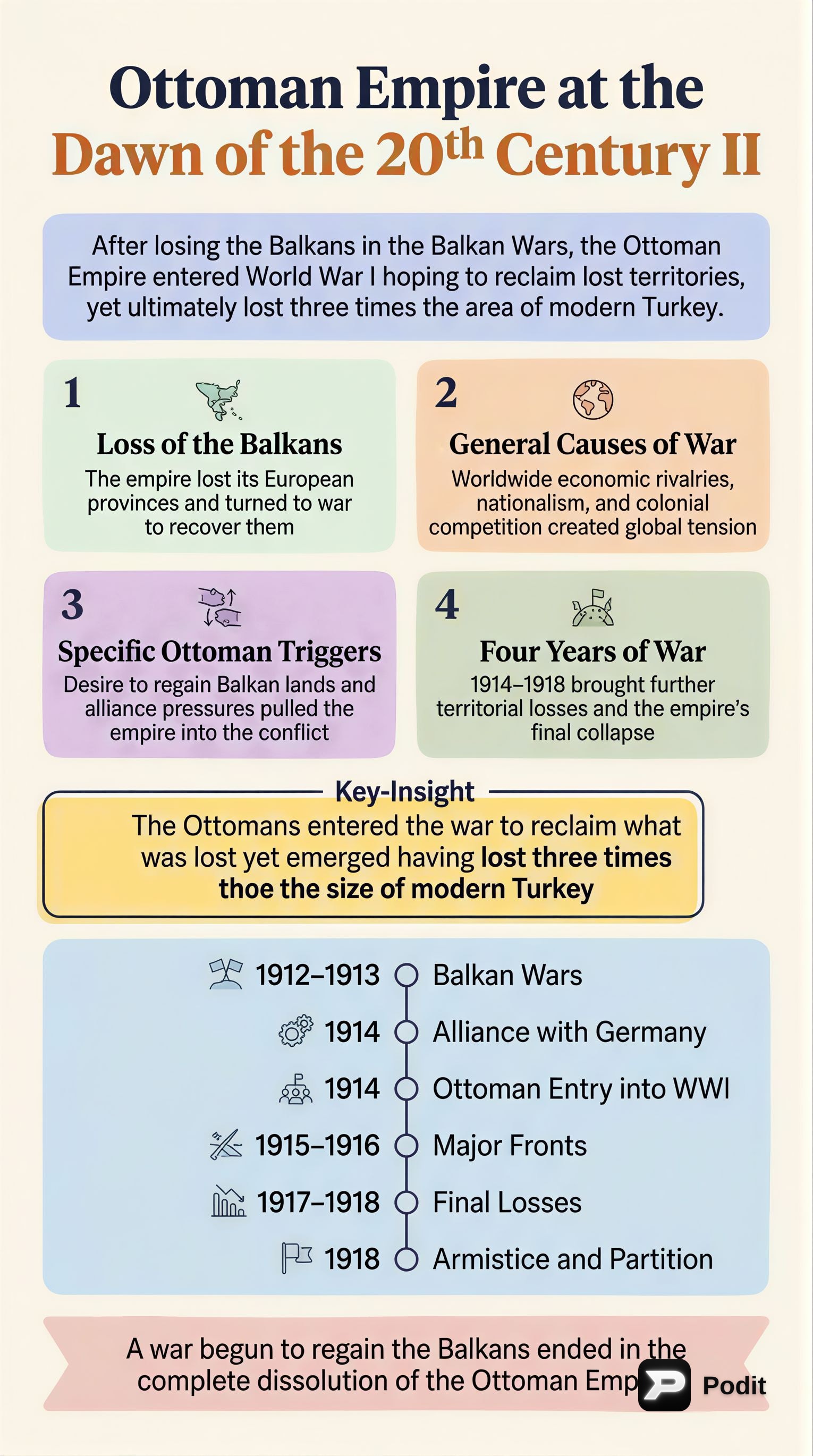
The First Balkan War in 1912 immediately followed the Italo-Turkish War. This conflict saw a coalition of Balkan states launch a coordinated offensive against the Ottomans, leading to even more significant territorial losses in Europe.
12. Which states formed the coalition against the Ottoman Empire in the First Balkan War?
The formidable coalition against the Ottoman Empire in the First Balkan War was formed by Bulgaria, Serbia, Greece, and Montenegro. These states united to challenge Ottoman rule in the Balkans, seeking to expand their own territories.
13. What was the outcome for Ottoman forces in the First Balkan War?
Ottoman forces suffered overwhelming losses in the First Balkan War. They were unable to withstand the coordinated offensive of the Balkan League, leading to a catastrophic defeat and the loss of vast territories in Europe.
14. Name some of the European territories ceded by the Ottoman Empire after the First Balkan War.
After the First Balkan War, the Ottoman Empire ceded nearly all its remaining European territories, including Macedonia, Albania, and most of Thrace. This drastically reduced the empire's geographical footprint on the European continent.
15. How did the First Balkan War impact the Ottoman Empire's geographical footprint?
The First Balkan War drastically reduced the Ottoman Empire's geographical footprint, as it led to the cession of nearly all its remaining European territories, including Macedonia, Albania, and most of Thrace. This marked a significant contraction of the empire.
16. What was the primary goal of the Balkan states in forming a coalition against the Ottoman Empire in 1912?
The primary goal of the Balkan states in forming a coalition was to expel the Ottoman Empire from Europe and expand their own national territories. They capitalized on the empire's weakness exposed by the Italo-Turkish War.
17. Describe the military performance of the Ottoman Empire in the First Balkan War.
The Ottoman Empire's military performance in the First Balkan War was disastrous. Its forces suffered overwhelming losses against the coordinated and highly successful offensive of the Balkan League, demonstrating severe deficiencies in organization, training, and equipment.
18. What was the long-term consequence of the First Balkan War for the Ottoman Empire's international standing?
The First Balkan War severely diminished the Ottoman Empire's international prestige. The loss of vast European territories highlighted its terminal decline and vulnerability, signaling to other powers that its days as a major force were numbered.
19. Which region was almost entirely lost by the Ottoman Empire in Europe after the First Balkan War?
The region of Macedonia, along with Albania and most of Thrace, was almost entirely lost by the Ottoman Empire in Europe after the First Balkan War. This represented a near-complete expulsion from its historical European heartland.
20. How did the First Balkan War contribute to the 'terminal decline' mentioned in the text?
The First Balkan War was a major catalyst for the 'terminal decline' by stripping the empire of most of its European territories and exposing its profound military and administrative weaknesses. It demonstrated the empire's inability to defend itself against regional powers, accelerating its collapse.
21. What was the nature of the Second Balkan War in 1913?
The Second Balkan War in 1913 was primarily a conflict among the former allies of the First Balkan War. Disputes over the division of newly acquired territories led to fighting, particularly between Bulgaria and its former partners.
22. What territory did the Ottomans manage to regain during the Second Balkan War?
During the Second Balkan War, the Ottomans managed to regain some territory in Eastern Thrace, most notably the city of Edirne. This was a small recovery amidst the overall catastrophic losses of the Balkan Wars.
23. Despite regaining some territory, what was the overall outcome of the Balkan Wars for the Ottoman Empire?
Despite regaining some territory in the Second Balkan War, the overall outcome of the Balkan Wars was catastrophic for the Ottoman Empire. It drastically reduced the empire's geographical footprint and severely diminished its international prestige.
24. How did the Second Balkan War differ from the First Balkan War in terms of participants?
The First Balkan War involved a coalition of Balkan states against the Ottoman Empire. The Second Balkan War, however, was primarily a conflict among these former allies themselves, with the Ottomans taking advantage of the situation to reclaim some land.
25. What was the significance of Edirne's recapture by the Ottomans in the Second Balkan War?
The recapture of Edirne (Adrianople) in the Second Balkan War was a symbolic victory for the Ottomans, as it was a historically significant city. However, it did little to offset the massive territorial losses and the overall catastrophic outcome of the Balkan Wars.
 Podit
Podit