 Podit
Podit
This content is based on a YouTube video.
📚 The Ottoman Empire in the Early 20th Century: A Period of Transformation and Decline
Introduction: The Empire at a Crossroads
The early 20th century marked a profoundly critical and tumultuous period for the Ottoman Empire. Following centuries of gradual decline, the empire faced an existential crisis, grappling with significant internal transformations and escalating external pressures. This era witnessed a complex interplay of reform movements, political upheavals, and devastating wars that ultimately led to the empire's dissolution. Understanding this period requires a thorough examination of its political dynamics, the geopolitical challenges it confronted, and the socio-economic and ideological shifts that reshaped its identity. This study material provides a comprehensive overview of the Ottoman Empire's final decades, highlighting key events and concepts crucial for understanding this pivotal historical era.
1️⃣ Internal Political Dynamics and Reform Efforts
The internal political landscape of the Ottoman Empire in the early 20th century was dominated by a struggle between absolutism, constitutionalism, and various reformist ideologies. This period is particularly important for understanding the empire's attempts to modernize and the forces that ultimately led to its collapse.
1.1. The Reign of Sultan Abdulhamid II (1876-1909)
Sultan Abdulhamid II's reign was characterized by a period of autocratic rule, which began after he suspended the first Ottoman Constitution of 1876.
- Autocratic Rule: Despite his authoritarianism, Abdulhamid II initiated significant modernization efforts.
- Modernization Initiatives: These included advancements in education, infrastructure development (like railways), and military organization. His goal was to strengthen the empire under centralized control.
- Growing Discontent: However, his rule led to increasing discontent among intellectuals and military officers, many of whom were educated in Western-style schools and yearned for constitutional governance.
1.2. The Rise of the Young Turks and the Committee of Union and Progress (CUP)
The discontent under Abdulhamid II fueled the rise of the Young Turk movement, a diverse group of reformists.
- Young Turk Movement: This movement sought to restore the constitution and parliamentary rule.
- Committee of Union and Progress (CUP): The CUP emerged as the most influential faction within the Young Turks. Its members were often military officers, bureaucrats, and intellectuals who believed that constitutionalism and modernization were essential for the empire's survival.
- 1908 Young Turk Revolution: In 1908, the Young Turk Revolution forced Sultan Abdulhamid II to restore the 1876 Constitution and reconvene the Ottoman Parliament. This event marked the beginning of the Second Constitutional Era.
- ✅ Key Event for KPSS: The Young Turk Revolution of 1908 is a critical turning point, signifying the end of absolute monarchy and the return to constitutional rule.
1.3. The Second Constitutional Era and CUP's Consolidation of Power
The Second Constitutional Era (1908-1918) was initially characterized by a multi-party political system, though it proved to be fragile.
- CUP's Ascendancy: The CUP quickly consolidated power, initially through popular support for their reformist agenda.
- The 31 March Incident (1909): This was a counter-revolutionary attempt by conservative elements and religious fundamentalists to restore absolute monarchy and Sharia law.
- ⚠️ Crucial Event for KPSS: The 31 March Incident is highly significant as it was swiftly suppressed by the CUP, demonstrating their growing military and political strength.
- Consequences: Following the suppression, Abdulhamid II was deposed, and his brother, Mehmed V, ascended to the throne. This solidified the CUP's control and marked a definitive shift in power.
- CUP's Agenda: The CUP pursued a complex agenda:
- Ottomanism: Initially, they promoted Ottomanism as a unifying ideology, aiming to create a common Ottoman identity regardless of ethnicity or religion.
- Centralization: They sought to centralize state power and implement further modernization reforms.
- Authoritarian Tendencies: Over time, their rule became increasingly authoritarian, especially as they faced internal dissent and external threats.
- Political Instability: The period was marked by frequent changes in government, military interventions, and a constant struggle to maintain control over a vast and ethnically diverse empire. These internal political dynamics significantly weakened the empire's ability to respond effectively to external threats.
2️⃣ Geopolitical Challenges and Wars: The "Sick Man of Europe"
The early 20th century was a period of relentless geopolitical challenges and devastating military conflicts for the Ottoman Empire, leading to significant territorial losses. The empire, often referred to as the 'Sick Man of Europe' by European powers, became a target for imperialist ambitions.
2.1. The Italo-Turkish War (1911-1912)
This conflict marked a significant blow to Ottoman prestige and territorial integrity.
- Italian Invasion: Italy invaded and annexed the Ottoman provinces of Tripolitania and Cyrenaica (modern-day Libya), along with the Dodecanese islands in the Aegean Sea.
- Ottoman Weakness: The war exposed the Ottoman military's weaknesses and its inability to defend distant territories effectively.
- Consequences: The loss of these North African possessions further diminished the empire's prestige, resources, and strategic depth.
- ✅ Key Territory Loss for KPSS: Libya (Tripolitania and Cyrenaica) and the Dodecanese islands were lost to Italy.
2.2. The Balkan Wars (1912-1913)
Immediately following the Italo-Turkish War, the Balkan Wars delivered an even more catastrophic blow to the empire.
2.2.1. The First Balkan War (1912)
- Balkan Coalition: A coalition of Balkan states—Bulgaria, Serbia, Greece, and Montenegro—launched a coordinated attack on the Ottoman Empire. Their aim was to seize remaining Ottoman territories in Europe.
- Catastrophic Defeats: Ottoman forces suffered devastating defeats.
- Massive Territorial Losses: The empire lost nearly all its remaining European territories, including:
- Macedonia
- Albania
- Most of Thrace
- 💡 Impact: This war resulted in a massive influx of Muslim refugees into Anatolia, creating immense social and economic strain and fueling Turkish nationalism.
- ✅ Key Losses for KPSS: Almost all European territories, including Macedonia and Albania.
2.2.2. The Second Balkan War (1913)
- Conflict Among Allies: This war was fought among the former Balkan allies over the division of the spoils from the First Balkan War.
- Ottoman Gains: The Ottomans managed to regain a small portion of Eastern Thrace, including the strategically important city of Edirne, from Bulgaria.
- Overall Devastation: Despite regaining Edirne, the overall outcome of the Balkan Wars was devastating:
- Territorial Reduction: The empire's European landmass was reduced by approximately 80%.
- Population Loss: Its population was reduced by about 70% in Europe.
- Psychological and Demographic Impacts: These losses had profound psychological and demographic impacts, further fueling Turkish nationalism and a sense of vulnerability within the empire.
- 📈 Data Point for KPSS: 80% landmass and 70% population loss in Europe.
2.3. Towards World War I
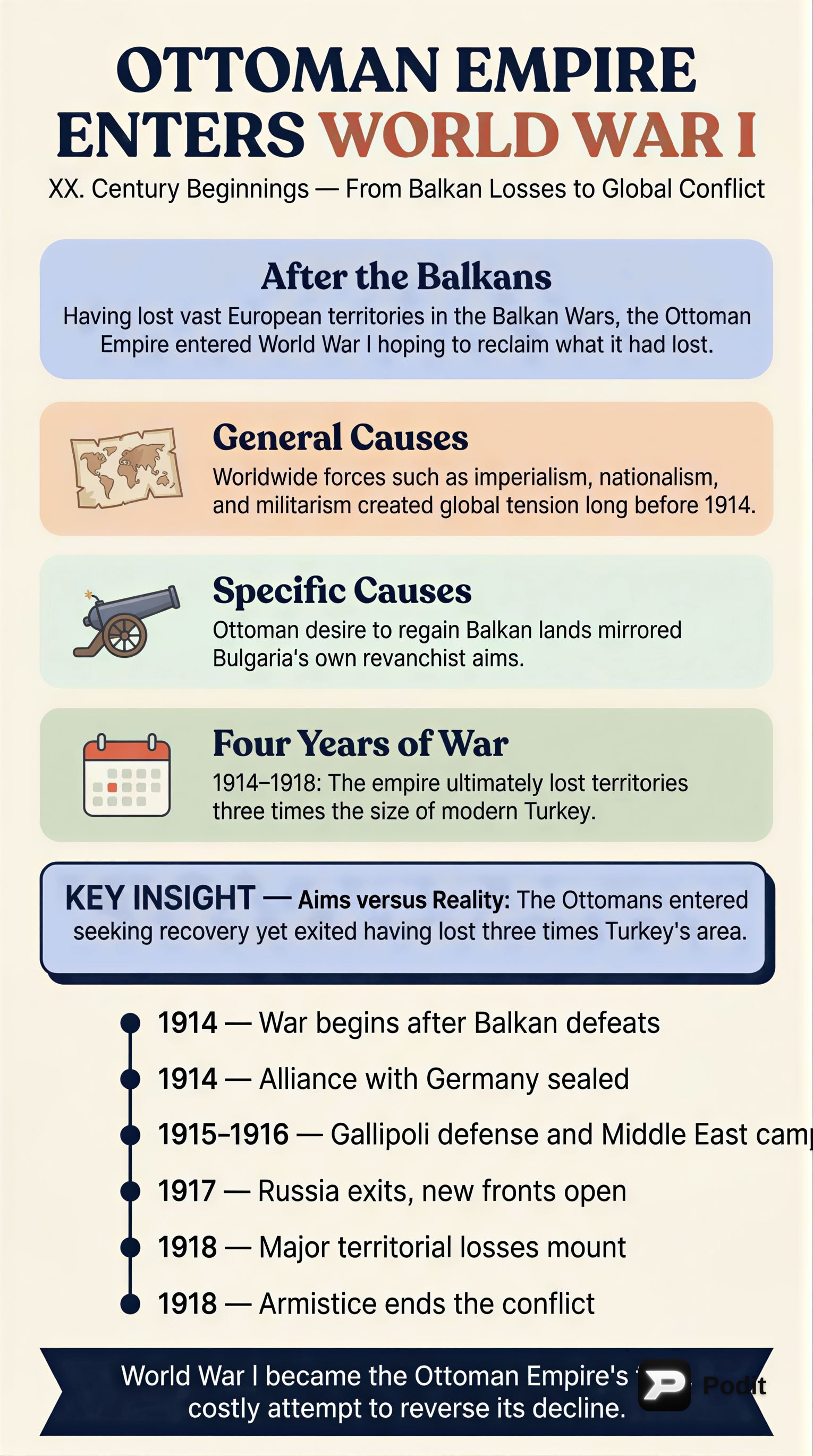
The empire's weakened state and its increasing isolation on the international stage ultimately pushed it towards an alliance with the Central Powers (Germany and Austria-Hungary).
- Entry into World War I (1914): This decision would prove fatal, leading to the empire's final defeat and dissolution.
- ⚠️ Critical Point for KPSS: The Ottoman Empire's entry into WWI on the side of the Central Powers is a direct consequence of its weakened state and geopolitical pressures.
3️⃣ Socio-Economic Transformations and Ideologies
Alongside political and military upheavals, the Ottoman Empire in the early 20th century experienced significant socio-economic transformations and a complex evolution of ideologies.
3.1. Economic Challenges
The empire struggled with severe economic difficulties that undermined its stability.
- Ottoman Public Debt Administration (OPDA): The empire carried a heavy foreign debt, managed by the OPDA. This administration gave European powers considerable control over Ottoman finances, effectively limiting its economic sovereignty.
- 📚 Definition for KPSS: OPDA was an organization established in 1881 to collect a portion of the Ottoman Empire's revenues to pay off its foreign debts.
- Capitulations: These were extraterritorial rights granted to foreign nationals, which hindered domestic economic development and favored foreign trade and businesses. They allowed foreign citizens to be exempt from local laws and taxes, creating an uneven playing field.
- 📚 Definition for KPSS: Capitulations were commercial and judicial privileges granted by the Ottoman sultans to foreign powers, severely limiting Ottoman sovereignty over its own economy and legal system.
- Impact of Wars: The continuous wars further crippled the economy, diverting precious resources, disrupting trade routes, and causing widespread destruction.
3.2. Evolving Ideologies
The rise of nationalism across Europe profoundly impacted the multi-ethnic Ottoman state, leading to the emergence and competition of various ideologies.
3.2.1. Ottomanism
- Initial Goal: An ideology promoting a common Ottoman identity regardless of religion or ethnicity. It aimed to unify the diverse populations of the empire under a single civic identity.
- Failure: Initially championed by the Young Turks, Ottomanism largely failed to stem the tide of secessionist movements, as ethnic and religious nationalisms proved stronger.
3.2.2. Turkish Nationalism and Pan-Turkism
- Rise of Turkish Nationalism: As the empire lost its non-Turkish territories, particularly after the Balkan Wars, Turkish nationalism gained prominence. This ideology focused on the cultural and political unity of ethnic Turks.
- Pan-Turkism: Often intertwined with Turkish nationalism, Pan-Turkism was the idea of uniting all Turkic peoples, extending beyond the Ottoman borders to Central Asia. This ideology became particularly influential within the CUP.
- ✅ Key Ideology for KPSS: Turkish Nationalism and Pan-Turkism became dominant ideologies, especially after territorial losses.
3.2.3. Islamism
- Emergence: Islamism also emerged as a significant ideology, advocating for the unity of Muslim peoples under the Caliphate.
- Defensive Response: It was often seen as a defensive response to Western encroachment and the internal fragmentation of the empire, seeking to rally Muslim populations around a common religious identity.
3.3. Socio-Cultural Transformations
The period also saw significant social and cultural shifts.
- Education Reforms: Education reforms continued, with an expansion of secular schools alongside traditional religious ones. This led to a more educated populace and the emergence of new social classes.
- Women's Rights: Women's rights movements began to gain traction, advocating for greater access to education and public life, reflecting broader modernization trends.
- Demographic Shifts: Wars, migrations, and forced population exchanges fundamentally altered the empire's social fabric. The massive influx of Muslim refugees from lost territories into Anatolia contributed to a more homogenous Anatolian core, laying the groundwork for the future Republic of Turkey.
4️⃣ Conclusion: The End of an Empire and Birth of New Identities
The early 20th century represents the final, tumultuous chapter of the Ottoman Empire. This period was characterized by a relentless struggle against internal fragmentation and external aggression.
- Political Experimentation: The restoration of the constitution and the rise of the Young Turks brought about a brief but intense period of political experimentation and reform. However, these efforts ultimately failed to stabilize the empire or reconcile its diverse populations.
- Devastating Wars: Devastating wars, including the Italo-Turkish War and the Balkan Wars, stripped the empire of vast territories and millions of its subjects. These conflicts exposed its military and administrative weaknesses, accelerating its decline.
- Economic and Ideological Challenges: These losses, coupled with persistent economic challenges (like the Ottoman Public Debt and Capitulations) and the corrosive effects of competing nationalisms (Ottomanism, Turkish Nationalism, Pan-Turkism, Islamism), created an environment of profound crisis.
- Fatal Miscalculation: The empire's decision to enter World War I in 1914 on the side of the Central Powers proved to be the ultimate miscalculation, leading to its final defeat and subsequent dissolution.
- Legacy: The legacy of this era is complex, marked by both the failure of a centuries-old imperial system and the birth of new national identities, most notably the Republic of Turkey. The events and transformations of these decades continue to shape the political and social landscape of the Middle East and the Balkans, underscoring the profound impact of the Ottoman Empire's final years on modern history.
This period is crucial for understanding the foundations of modern Turkey and the geopolitical landscape of the region. Key events, figures, and ideologies discussed here are frequently tested in examinations like KPSS, making their thorough comprehension essential.