Ottoman Decline and European Geopolitics (1774-1914) - kapak
Tarih#ottoman empire#european history#ottoman decline#küçük kaynarca treaty

Ottoman Decline and European Geopolitics (1774-1914)

An academic summary of the Ottoman Empire's decline, European partition efforts, major conflicts, and diplomatic strategies from the late 18th century to World War I.

ibrahim_44June 8, 2026 ~24 dk toplam
01

Sesli Özet

7 dakika

Konuyu otobüste, koşarken, yolda dinleyerek öğren.

Sesli Özet

Ottoman Decline and European Geopolitics (1774-1914)

0:006:57
02

Görsel Özet

İnfografik

Konunun tüm parçalarını tek bakışta gör.

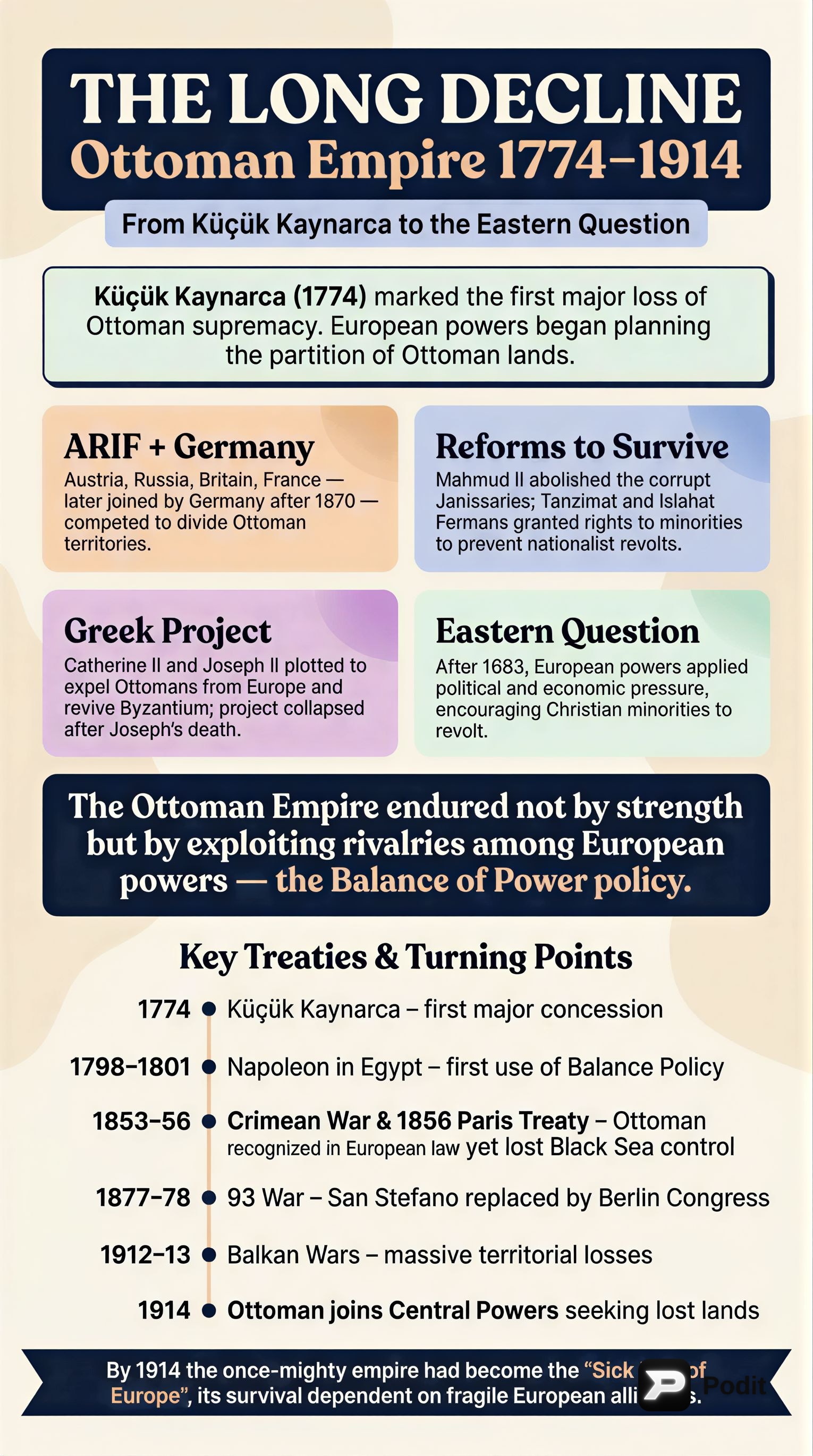
Ottoman Decline and European Geopolitics (1774-1914) - görsel özet infografik
Tam boyutta görüntüle →
03

Flash Kartlar

25 kart

Karta tıklayarak çevir. ← → ile gez, ⎵ ile çevir.

1 / 25
Tüm kartları metin olarak gör
  1. 1. What significant event in 1774 marked the beginning of the Ottoman Empire's substantial decline in power?

    The Treaty of Küçük Kaynarca in 1774 is widely recognized as the turning point that signaled the significant decline of the Ottoman Empire. This treaty, signed after a defeat against Russia, resulted in territorial losses and granted Russia certain rights within the Ottoman Empire, effectively weakening its sovereignty and opening the door for further European interference.

  2. 2. Which major European powers began to contend for the partition of Ottoman territories after its weakening became apparent?

    Following the Ottoman Empire's decline, several European powers vied for its territories. Key players included Austria, Russia, Britain, and France, all seeking to expand their influence or gain strategic advantages. Germany also joined this struggle after 1870, further complicating the geopolitical landscape.

  3. 3. Name two significant reform efforts undertaken by the Ottoman Empire in response to its diminishing strength.

    The Ottoman Empire initiated several reforms to modernize and address internal issues. Two notable efforts were the abolition of the Janissaries, a traditional military corps that had become a source of internal instability, and the promulgation of the Tanzimat and Islahat Edicts. These edicts aimed at administrative, legal, and social reforms, including the guarantee of minority rights, to strengthen the state and prevent further disintegration.

  4. 4. What foreign policy strategy did the Ottoman Empire adopt to navigate the complex geopolitical landscape during its decline?

    The Ottoman Empire adopted a 'balance of power' foreign policy. This strategy involved aligning with various European powers at different times to prevent any single power from becoming too dominant or from completely dismantling the Empire. It was a pragmatic approach to survive amidst the competing ambitions of European states, often playing one power against another to secure its own interests and territorial integrity, albeit temporarily.

  5. 5. What was the 'Greek Project' and which European leaders conceived it?

    The 'Greek Project' was a grand geopolitical scheme conceived by Russia's Catherine II and Austria's Joseph II. Its primary aim was to expel the Ottomans from Europe and re-establish a Byzantine Empire under Russian influence. Although ambitious, this project ultimately did not materialize, partly due to the death of Joseph II, but it highlighted the expansionist designs of European powers on Ottoman territories.

  6. 6. Describe the two phases of the 'Eastern Question' concerning the Ottoman Empire.

    The 'Eastern Question' evolved in two distinct phases. The initial period, from 1071 to 1683, saw European states primarily defending themselves against Ottoman expansion and territorial gains. The subsequent phase, however, involved European powers actively intervening in Ottoman internal affairs, often using the pretext of protecting non-Muslim minorities and inciting nationalist uprisings to further their own interests and facilitate the partition of Ottoman lands.

  7. 7. What pretext did European powers often use to intervene in Ottoman internal affairs?

    European powers frequently used the pretext of protecting non-Muslim minorities within the Ottoman Empire to justify their intervention in its internal affairs. This concern for minority rights often masked their true intentions, which included weakening Ottoman sovereignty, gaining influence, and ultimately facilitating the partition of its territories. They also incited nationalist uprisings among these groups to destabilize the Empire further.

  8. 8. How did the French Revolution of 1789 impact the multi-ethnic Ottoman Empire?

    The French Revolution of 1789 significantly impacted the multi-ethnic Ottoman Empire by spreading ideas of nationalism and liberty. These revolutionary ideals challenged the existing monarchical structures prevalent in Europe and, more critically, within the diverse Ottoman Empire. This fueled nationalist sentiments among various ethnic groups, leading to uprisings and demands for independence, thereby exacerbating internal tensions and contributing to the Empire's disintegration.

  9. 9. What was the purpose of the Vienna Congress of 1815 and the Metternich System?

    The Vienna Congress of 1815 aimed to restore the old monarchical order in Europe after the Napoleonic Wars and suppress the revolutionary ideals spread by the French Revolution. The Metternich System, named after Austrian statesman Klemens von Metternich, was a conservative political system designed to maintain this order through alliances and interventions, preventing the rise of nationalism and liberalism. Despite these efforts, nationalist movements continued to gain momentum, challenging the established order.

  10. 10. What was the Mora Rebellion and what was its outcome for Greece?

    The Mora Rebellion was a significant nationalist uprising in Greece, fueled by nationalist sentiments and instigated by European powers. This rebellion ultimately led to the independence of Greece from the Ottoman Empire. Despite Ottoman efforts to suppress it, including assistance from Mehmet Ali Pasha of Egypt, European intervention, particularly the destruction of the Ottoman fleet at Navarino, culminated in the Treaty of Edirne (1829), which formally recognized Greek sovereignty.

  11. 11. What role did Mehmet Ali Pasha of Egypt play in the Mora Rebellion?

    Mehmet Ali Pasha of Egypt provided military assistance to the Ottoman Empire in its efforts to suppress the Mora Rebellion. His forces were deployed to aid the Ottomans against the Greek nationalists. However, despite his contributions, European intervention, specifically the destruction of the Ottoman fleet at Navarino, ultimately undermined the Ottoman-Egyptian efforts and paved the way for Greek independence.

  12. 12. What was the significance of the Battle of Navarino in the context of Greek independence?

    The Battle of Navarino was a pivotal naval engagement where a combined European fleet (British, French, and Russian) decisively destroyed the Ottoman and Egyptian fleets in 1827. This intervention was crucial in securing Greek independence, as it severely weakened the Ottoman Empire's ability to suppress the Mora Rebellion. The battle effectively forced the Ottomans to accept Greek sovereignty, which was later formalized by the Treaty of Edirne.

  13. 13. What was the main outcome of the Treaty of Edirne (1829)?

    The main outcome of the Treaty of Edirne (1829) was the formal recognition of Greek sovereignty by the Ottoman Empire. This treaty concluded the Russo-Turkish War of 1828-1829 and was a direct consequence of the Mora Rebellion and European intervention, particularly the Battle of Navarino. It marked a significant territorial loss for the Ottomans and a triumph for nationalist movements in the Balkans.

  14. 14. What were the primary causes of the Crimean War (1853-1856)?

    The Crimean War (1853-1856) was primarily caused by Russia's ambition to gain access to warm-water ports and control the Ottoman Straits, which were crucial for naval power and trade. Additionally, disputes over the protection of Holy Places in Palestine, where Russia sought to assert its influence over Orthodox Christians, further escalated tensions. These factors, combined with European powers' desire to curb Russian expansion, led to the conflict.

  15. 15. What were the two main provisions of the Treaty of Paris (1856) regarding the Ottoman Empire?

    The Treaty of Paris (1856), which ended the Crimean War, had two main provisions concerning the Ottoman Empire. Firstly, it formally recognized the Ottoman Empire as a European power and guaranteed its territorial integrity, seemingly protecting it from further Russian encroachment. Secondly, it allowed for increased European interference in Ottoman affairs under the guise of protecting reforms, effectively giving European powers a pretext to meddle in its internal governance.

  16. 16. What were the main drivers behind the Russo-Turkish War of 1877-1878, also known as the 93 War?

    The Russo-Turkish War of 1877-1878, or the 93 War, was primarily driven by Russian expansionism and the ideology of Pan-Slavism. Russia sought to expand its influence in the Balkans and liberate Slavic populations under Ottoman rule, often using their protection as a pretext for military intervention. The brutal suppression of uprisings in the Balkans by the Ottomans also provided a casus belli for Russia.

  17. 17. Why was the Treaty of San Stefano, signed after the Russo-Turkish War of 1877-1878, rejected by European powers?

    The Treaty of San Stefano was rejected by European powers, particularly Britain and Austria-Hungary, because it significantly increased Russian influence in the Balkans and threatened the existing balance of power in Europe. The treaty created a large Bulgarian state, effectively a Russian satellite, which would have given Russia direct access to the Aegean Sea and upset the geopolitical equilibrium. Concerned about Russian dominance, other powers demanded a revision of the treaty.

  18. 18. Name three territorial losses for the Ottomans resulting from the Congress of Berlin (1878).

    The Congress of Berlin (1878) resulted in substantial territorial losses for the Ottoman Empire. These included Kars, Ardahan, and Batum, which were ceded to Russia. Additionally, Serbia, Romania, and Montenegro gained full independence, further diminishing Ottoman control in the Balkans. These losses highlighted the Empire's weakening state and the increasing assertiveness of European powers.

  19. 19. What was the administrative status of Bosnia-Herzegovina after the Congress of Berlin (1878)?

    After the Congress of Berlin (1878), Bosnia-Herzegovina was placed under Austrian administration. Although technically still part of the Ottoman Empire, this arrangement effectively gave Austria-Hungary control over the region. This decision was a compromise among European powers, aiming to prevent Russian dominance in the Balkans while further eroding Ottoman sovereignty and setting the stage for future conflicts.

  20. 20. Which European power gained control of Cyprus after the Congress of Berlin (1878)?

    Following the Congress of Berlin (1878), Cyprus was placed under British control. This move was part of a broader strategy by Britain to secure its interests in the Eastern Mediterranean and protect its routes to India. Although the island remained nominally under Ottoman sovereignty for a period, British administration effectively detached it from Ottoman control, marking another significant territorial loss for the Empire.

  21. 21. What was the significance of Article 61 of the Congress of Berlin (1878)?

    Article 61 of the Congress of Berlin (1878) concerned reforms for the Armenian population within the Ottoman Empire. It stipulated that the Ottoman government would carry out reforms in the provinces inhabited by Armenians and guarantee their security against Kurds and Circassians. This article laid the groundwork for what became known as the Armenian Question, providing European powers with a pretext for future intervention and contributing to the complex history of Armenian-Ottoman relations.

  22. 22. How did the Straits Question evolve and what was the outcome of the London Straits Convention of 1841?

    The Straits Question, originating from the Treaty of Küçük Kaynarca, evolved into an international issue concerning the control and passage through the Bosphorus and Dardanelles. The London Straits Convention of 1841 was a significant outcome, which formally ended full Ottoman sovereignty over the waterways. It stipulated that the Straits would be closed to warships of all nations during peacetime, effectively internationalizing their status and limiting Ottoman control.

  23. 23. Which states formed the coalition that attacked the Ottoman Empire in the First Balkan War (1912-1913), and what was a major territorial loss for the Ottomans?

    In the First Balkan War (1912-1913), a coalition of Balkan states—Bulgaria, Greece, Serbia, and Montenegro—attacked the weakened Ottoman Empire. A major territorial loss for the Ottomans was most of Thrace, which was formalized by the Treaty of London (1913). This war dramatically reduced the Ottoman Empire's remaining territories in Europe, marking a severe blow to its presence on the continent.

  24. 24. What was the outcome of the Second Balkan War for the Ottoman Empire?

    The Second Balkan War erupted among the victorious Balkan states over the division of spoils from the First Balkan War. The Ottoman Empire capitalized on this disunity and managed to reclaim some lost territory, specifically Eastern Thrace, including the strategically important city of Edirne. While still a period of overall decline, this brief recovery demonstrated a temporary opportunistic gain amidst the conflicts of its former subjects.

  25. 25. Name three internal factors attributed to the Ottoman defeats in the Balkan Wars.

    The Ottoman defeats in the Balkan Wars were attributed to several internal factors. These included the army's involvement in politics, which undermined its professional effectiveness and unity. Additionally, a lack of discipline within the military ranks and the premature demobilization of experienced troops before the conflicts began significantly weakened their fighting capacity. These internal weaknesses made the Empire vulnerable to the coordinated attacks of the Balkan coalition.

04

Bilgini Test Et

15 soru

Çoktan seçmeli sorularla öğrendiklerini ölç. Cevap + açıklama.

Soru 1 / 15Skor: 0

Which treaty is identified as marking the beginning of the Ottoman Empire's significant decline in power?

05

Detaylı Özet

7 dk okuma

Tüm konuyu derinlemesine, başlık başlık.

Ottoman Empire: Decline, European Intervention, and Geopolitical Shifts (18th-20th Centuries)

This study material synthesizes information from a lecture audio transcript and a copy-pasted text, providing a comprehensive overview of the Ottoman Empire's decline and its interactions with European powers from the late 18th to the early 20th century.


1. Introduction: The Dawn of Decline 📉

Following the Treaty of Küçük Kaynarca in 1774, the Ottoman Empire's long-standing military superiority over Europe began to wane. European powers, recognizing this weakening, intensified their efforts to partition Ottoman territories. This period marked a significant shift from Ottoman expansion to a struggle for survival, characterized by internal reforms and a complex foreign policy.

2. European Ambitions and Projects on Ottoman Lands 🌍

European states, driven by their own geopolitical interests, devised various strategies to dismantle the Ottoman Empire:

  • 📚 The Greek Project (Grek Projesi):

    • Conceived by: Russia's Catherine II and Austria's Joseph II.
    • Aim: To expel the Ottomans entirely from Europe and revive the Byzantine Empire.
    • Outcome: This ambitious project ultimately failed to materialize due to the death of Joseph II.
  • 📚 The Eastern Question (Şark Meselesi):

    • Definition: A long-standing diplomatic and political problem concerning the future of the Ottoman Empire, particularly its European territories, and the balance of power in Europe.
    • Phases:
      1. Phase 1 (1071-1683): European states primarily focused on stopping Turkish expansion (e.g., Crusades). They were largely on the defensive.
      2. Phase 2 (Post-1683, especially after Vienna Siege): European powers shifted to an offensive stance, actively seeking to expel Turks from Europe and partition Ottoman lands. They exerted political and economic pressure, often using non-Muslim minorities as a pretext to interfere in Ottoman internal affairs and incite nationalist uprisings.

3. Internal Challenges and Ottoman Responses 🛡️

The Ottoman Empire faced significant internal pressures, exacerbated by external influences:

  • Impact of the French Revolution (1789):
    • Spread of ideas like nationalism, liberty, and national will across Europe.
    • These ideas challenged monarchical rule and fueled nationalist movements within the multi-ethnic Ottoman Empire, leading to revolts by various minority groups.
  • Vienna Congress (1815) & Metternich System:
    • Purpose: European powers convened after the Napoleonic Wars to restore the old monarchical order and suppress revolutionary ideas.
    • Metternich System: Advocated for mutual assistance among monarchs to prevent nationalist and liberal movements. This system aimed to maintain the status quo against the principles of the French Revolution.
  • Ottoman Reforms:
    • Recognizing its decline, the Ottoman Empire initiated reforms to modernize and address internal issues.
    • Abolition of Janissaries: During the reign of Mahmud II, the Janissary Corps, which had become a source of internal instability, was abolished to establish a modern army.
    • Tanzimat and Islahat Edicts: These reform decrees aimed to grant more rights and privileges to minorities, hoping to appease them and prevent nationalist uprisings.
  • 💡 Balance of Power Policy (Denge Politikası):
    • As the Empire weakened, it adopted a foreign policy of aligning with different European powers to counter threats from others.
    • Example: During Napoleon's invasion of Egypt (1798), the Ottomans sought help from European powers. Later, they would align with Britain and France against Russia, or with Russia against other powers, to protect their interests. This policy was first used during the French occupation of Egypt.

4. Key Conflicts and Diplomatic Outcomes ⚔️

The 19th century was marked by a series of wars and treaties that progressively eroded Ottoman sovereignty:

  • Mora Rebellion and Greek Independence (1821-1829):

    • Causes: Nationalist sentiments fueled by the French Revolution, European instigation, and local revolts (e.g., Tepedelenli Ali Pasha's rebellion).
    • Ottoman Response: The Ottoman Empire, unable to suppress the rebellion alone, sought assistance from Mehmet Ali Pasha of Egypt.
    • European Intervention: Britain, France, and Russia intervened, culminating in the destruction of the Ottoman fleet at Navarino.
    • Treaty of Edirne (1829): Officially recognized Greek independence, marking the first successful nationalist secession from the Ottoman Empire.
  • Crimean War (1853-1856):

    • Causes: Russia's persistent ambition to gain access to warm seas (Mediterranean) via the Ottoman Straits, and disputes over the protection of Holy Places in Palestine.
    • Alliances: The Ottoman Empire, supported by Britain, France, and Piedmont (Italy), fought against Russia.
    • Outcome: The allies defeated Russia.
    • Treaty of Paris (1856):
      • The Ottoman Empire was formally recognized as a European power and its territorial integrity was guaranteed.
      • However, this also allowed for increased European interference under the pretext of overseeing Ottoman reforms (e.g., Islahat Fermanı).
      • The Black Sea was neutralized, prohibiting warships of both Russia and the Ottoman Empire.
      • ⚠️ This treaty, despite being a victory, highlighted Ottoman weakness as it needed European guarantees for its existence.
  • Russo-Turkish War (1877-1878) / 93 War:

    • Causes: Russian expansionism, Pan-Slavism (uniting Slavic peoples under Russian leadership), desire for revenge for the Crimean War, and Balkan uprisings.
    • Ottoman Defense: Notable resistance from commanders like Gazi Osman Pasha (Plevna) and Ahmet Muhtar Pasha (Caucasus).
    • Treaty of San Stefano (1878): A highly pro-Russian treaty that significantly increased Russian influence in the Balkans.
    • European Reaction: Other European powers, concerned about the shift in the balance of power, rejected San Stefano.
    • Congress of Berlin (1878):
      • Key Outcomes: Significant territorial losses for the Ottomans.
      • Kars, Ardahan, and Batum were ceded to Russia.
      • Serbia, Romania, and Montenegro gained full independence.
      • Bulgaria's borders were reduced, and it was divided into three parts.
      • Bosnia-Herzegovina was placed under Austrian administration.
      • Cyprus was temporarily ceded to Britain.
      • ⚠️ Article 61: Mandated reforms for Armenian-populated areas, laying the groundwork for the "Armenian Question" and future European interference.

5. The Straits Question 🌊

The control and passage through the Bosphorus and Dardanelles Straits became a persistent international issue:

  • Origin (1774): The Treaty of Küçük Kaynarca granted Russia commercial navigation rights in the Black Sea and through the Straits, effectively ending the Black Sea's status as a "Turkish lake."
  • Evolution:
    • 1798: Russian warships passed through the Straits for the first time during Napoleon's invasion of Egypt.
    • 1809 (Çanakkale/Kala-i Sultaniye Treaty): Britain agreed to close the Straits to warships during peacetime.
    • 1833 (Hünkar İskelesi Treaty): Following Mehmet Ali Pasha's rebellion, the Ottomans allied with Russia, granting Russia exclusive rights to close the Straits to non-Russian warships if Russia was at war. This was the last time the Ottoman Empire made a unilateral decision regarding the Straits.
    • 1841 (London Straits Convention): Internationalized the Straits, ending full Ottoman sovereignty over them. It stipulated that the Straits would be closed to all foreign warships during peacetime.

6. Balkan Wars (1912-1913) 🇧🇬🇬🇷🇷🇸🇲🇪

These wars marked the final stage of Ottoman territorial loss in Europe before WWI:

  • First Balkan War:
    • Combatants: A coalition of Bulgaria, Greece, Serbia, and Montenegro attacked the Ottoman Empire.
    • Causes: Nationalist aspirations, Ottoman weakness (especially after the Italo-Turkish War in Libya), and desire for territorial gains.
    • Outcome: Devastating defeat for the Ottomans, losing most of their remaining European territories, including much of Thrace.
    • Treaty of London (1913): Formalized these territorial losses.
  • Second Balkan War:
    • Causes: Disputes among the victorious Balkan states over the division of spoils from the First Balkan War. Bulgaria, having gained the most, was attacked by its former allies (Serbia, Greece, Montenegro) and Romania.
    • Ottoman Gain: The Ottoman Empire capitalized on this disunity to reclaim Eastern Thrace, including Edirne.
  • Reasons for Ottoman Defeat:
    • Ordunun siyasete karışması (Army's involvement in politics).
    • Lack of discipline and preparedness.
    • Premature demobilization of experienced soldiers before the war.

7. Ottoman Alliance Search Before World War I 🤝

Leading up to WWI, the Ottoman Empire actively sought alliances to secure its future:

  • Reasons for Seeking Alliance:
    • To recover lost territories.
    • To escape political isolation in a rapidly polarizing Europe.
  • Rejection by Entente Powers (Britain, France, Russia):
    • They perceived the Ottoman Empire as too weak and a liability.
    • They already had existing plans for the partition of Ottoman territories.
  • Alliance with Central Powers (Germany):
    • German Motives:
      • To open new fronts and divert Allied forces, especially Russia.
      • To leverage the Ottoman Caliphate's religious authority (Jihad) over Muslims in Allied colonial empires.
      • To utilize the Ottoman Empire's significant manpower.
      • To exploit its crucial geopolitical location, particularly control over the Straits.
    • Outcome: The Ottoman Empire joined the Central Powers alongside Germany, marking its entry into World War I.

Conclusion: A Century of Struggle 📜

The period from the late 18th to the early 20th century was a profound era of decline for the Ottoman Empire. Faced with relentless European expansionism, the rise of nationalism, and internal weaknesses, the Empire struggled to maintain its territorial integrity. Its attempts at modernization and diplomatic maneuvering through the "Balance of Power" policy provided temporary reprieves but ultimately could not prevent significant territorial losses and increasing foreign interference. These events progressively eroded Ottoman sovereignty and set the stage for its eventual entry into World War I, marking the final chapter of its long and complex history.
Kendi çalışma materyalini oluştur

PDF, YouTube videosu veya herhangi bir konuyu dakikalar içinde podcast, özet, flash kart ve quiz'e dönüştür. 1.000.000+ kullanıcı tercih ediyor.

Sıradaki Konular

Tümünü keşfet
The Ottoman Empire in the Early 20th Century II

The Ottoman Empire in the Early 20th Century II

An academic overview of the Ottoman Empire's critical period, focusing on its final conflicts and internal dynamics leading to World War I.

4 dk Özet 25 15 Görsel
The Ottoman Empire in the Early 20th Century

The Ottoman Empire in the Early 20th Century

An academic overview of the Ottoman Empire's political, social, and economic transformations during the early 20th century, focusing on key events and internal dynamics leading to its dissolution.

8 dk Özet 25 15 Görsel
Ottoman Decline: 18th Century Challenges

Ottoman Decline: 18th Century Challenges

Explore the complex internal and external factors that led to the Ottoman Empire's decline in the 18th century. Understand key events, military defeats, and administrative issues.

5 dk Özet 25 15 Görsel
Ottoman Decline: 18th Century Challenges

Ottoman Decline: 18th Century Challenges

Explore the 18th-century decline of the Ottoman Empire, examining its internal weaknesses, external pressures, and the pivotal events that marked this transformative period in its history.

Özet 15 Görsel
Ottoman Empire: Early 20th Century Challenges

Ottoman Empire: Early 20th Century Challenges

Explore the critical internal and external challenges faced by the Ottoman Empire in the early 20th century, leading to its eventual decline and dissolution.

Özet 15 Görsel
Ottoman Empire in the Early 20th Century II

Ottoman Empire in the Early 20th Century II

An academic summary of the Ottoman Empire's critical period in the early 20th century, focusing on internal political shifts, major wars, and territorial losses leading up to World War I.

5 dk Özet 25 15
The Road to War: Understanding WWI's Origins

The Road to War: Understanding WWI's Origins

Explore the complex web of rivalries, alliances, and events that led to World War I. This deep dive covers key terms from Alsace-Lorraine to the Battle of the Marne.

23 dk 23 10
Ottoman Empire: Culture and Civilization (Part 3)

Ottoman Empire: Culture and Civilization (Part 3)

An academic overview of the Ottoman Empire's cultural and civilizational aspects, including social structure, education, arts, and legal systems, highlighting its unique identity and enduring legacy.

7 dk Özet 25 15 Görsel