 Podit
Podit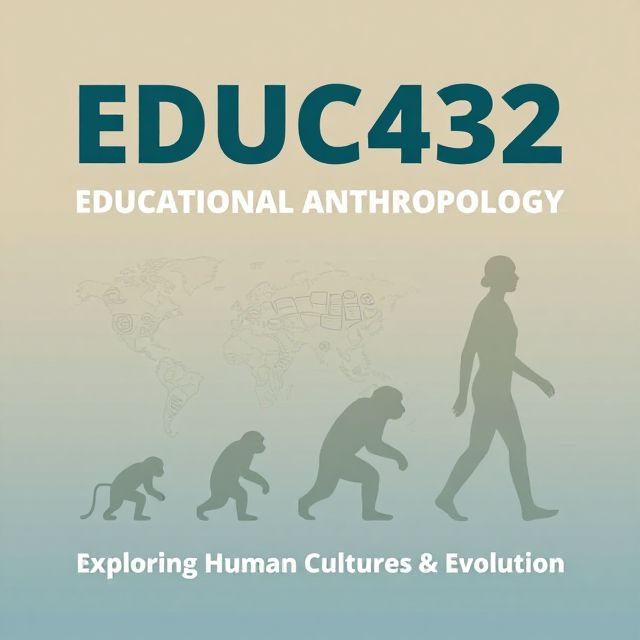
EDUC432: Educational Anthropology - A Comprehensive Study Guide
This study material has been compiled from various sources, including copy-pasted text and a lecture audio transcript, to provide a structured overview of Educational Anthropology and related concepts.
1. Introduction to Anthropology
Anthropology is the holistic 📚 study of humankind across all times and in all places. The term itself is derived from the Greek words "anthro" (people or human beings) and "ology" (the study of), literally meaning the study of people or human beings.
1.1. Core Aims of Anthropology ✅
Anthropology seeks to:
- Understand how people interpret and make meaning of the world.
- Explore what people think about the world.
- Compare the entire scope of humanity, both cross-culturally (across societies) and historically (across time).
- Understand humanity from its earliest days, striving to pinpoint at what stage humans truly became human beings.
- Identify similarities (universals) and differences among human populations and explain the reasons behind them.
1.2. Key Characteristics of Anthropology 💡
Anthropology is distinguished by several core characteristics:
- Holistic: It connects and benefits from a wide range of disciplines, including sociology, religious studies, philosophy, politics, and economics. For example, a religious holiday has both spiritual and economic implications (benefiting hotels, shops, travel agents).
- About Culture: Culture is viewed not as something people possess, but as an ongoing process of humans creatively adapting to each other, social structures, and political/economic institutions under various circumstances.
- Cultural Relativism (CR): This principle emphasizes understanding a culture or group on its own terms, rather than judging it by the standards of one's own culture or beliefs. It encourages understanding the rationale behind practices before forming judgments.
- Cross-Cultural Comparison: Comparing one's own perspectives and beliefs with those of others is fundamental. It helps identify how different groups meet universal human needs.
- Social Theory: Anthropological studies generate social theories that can be transferred to other places and times, moving beyond mere statistical generalizations.
- Evolutionary Perspective: Anthropology takes into account evolution, focusing on the biology and evolution of Homo sapiens, and how biological, social, and cultural aspects of life are constantly changing.
2. Major Branches of Anthropology
Anthropology is broadly divided into four main subfields, with additional specialized areas:
-
Cultural Anthropology:
- Focus: Understanding the cultural aspects of human societies, including customs, traditions, beliefs, and practices. It aims to collect, analyze, and explain information about how humans live and view their world.
- Methods: Often involves ethnographic research, where anthropologists live with and observe communities.
- Key Concepts:
- Edward Burnett Tylor's Definition: Culture is "that complex whole which includes knowledge, belief, art, morals, law, custom, and any other capabilities and habits acquired by man as a member of society." He emphasized culture as learned, not biologically inherited.
- Franz Boas's View: Challenged earlier linear evolutionary theories and the idea that culture is bound to race. Boas and his students asserted that there is no necessary connection between culture and "race," and that the capacity for culture is not genetically controlled, viewing cultural creativity independent of biology as a major human achievement.
- Acculturation: The process of cultural cross-fertilization and change, often observed in colonial contexts.
-
Social Anthropology:
- Emergence: Developed in Britain in the early 20th century.
- Characteristics: Comparative, fieldwork-based, with strong intellectual links to sociological ideas (e.g., Émile Durkheim).
-
Linguistic Anthropology:
- Focus: Investigates the intricate relationship between language and culture, exploring how language shapes communication, identity, social interactions, and societal structures.
- Core Idea: Human production of talk and text is a fundamental mechanism through which people create culture and social life.
- Methods: Analysis of "socially occurring" discourse (talk/text that naturally appears in a community), rather than investigator-imposed elicitation like interviews.
- Key Question: Do differences in language promote differences in how human communities understand the world? (e.g., absolute vs. relative directionals in English).
- Boas's Stance: Insisted that "race," "language," and "culture" are independent of one another.
-
Psychological Anthropology:
- Focus: Examines the mind, body, and subjectivity of the individual, and how culture and society are actualized in their life and experience.
- Debates: Explores the relative importance of culture versus individual psychology in shaping human action, and the universality versus variability of human existence.
- Methods: Often uses "person-centered" ethnography, studying one or a few individuals to describe their experience within a cultural system.
-
Archaeology:
- Nature: A historical science focused on reconstructing, interpreting, and understanding past human societies.
- Methods: Deploys analytical techniques from various scientific disciplines (botany, chemistry, genetics, etc.) to recover and interpret material remains (artifacts, buildings).
- Scope: Studies all past human societies, including preliterate (prehistoric) ones, where written records are absent. Its ultimate objective is to reconstruct the material world and interpret its historical significance and cultural meaning.
-
Physical (Biological) Anthropology:
- Focus: Concerned with the origin, evolution, and diversity of people.
- Key Problems: Human and nonhuman primate evolution, human variation and its significance, and the biological bases of human behavior.
- Research: Studies fossil hominins and nonhuman primates to explain diversity and the transformation to human anatomy and behavior over millions of years.
3. Educational Anthropology
Educational Anthropology is a specialized field that applies anthropological methods and theories to the study of education.
3.1. Methods and Focus Areas 📚
- Ethnographic Methods: Adopts long-term engagement, participant observation in natural settings, and formal/informal interviewing. Ethnography is the disciplined witnessing and recording of human events, valuing experiential learning.
- Key Topics:
- Education and multiculturalism
- Educational pluralism
- Culturally relevant pedagogy
- Mismatch between ways of knowing valued in school vs. home/community.
- Non-formal and informal education.
- Early Work: Focused on enculturation (how children learn a culture) and socialization (the process of learning social norms and ideologies).
3.2. Policy and Inequality 📊
- Beyond Schooling: Extends to the policy of education, policymaking, and its implementation.
- Cultural Production: Policy is viewed as a cultural production created by individuals.
- Actors: Considers an array of actors in education policy: school districts, staff, administrators, parents, teachers, and students, all with competing demands.
- Task: Identify and analyze problems related to education and seek strategies to overcome them.
- Inequalities: Examines the cultural production of inequalities linked to gender, race/ethnicity, nationality, migration status, language, literacy, and religion within educational contexts.
4. Human Evolution: Biological Anthropology in Focus
Physical Anthropology delves into the biological journey of humanity.
4.1. Primates: Our Evolutionary Relatives 🐒
- Definition: An order of generalist mammals (including humans, apes, monkeys) with adaptations for an arboreal lifestyle, evolving 55-65 million years ago.
- Classification: Traditionally divided into prosimians (lemurs, lorises, tarsiers) and anthropoids (monkeys, apes, humans).
- Evolutionary Trends:
- Elaboration of the brain, especially the neocortex, leading to advanced cognitive abilities (e.g., tool use).
- Increasing dependence on complex social behavior.
4.2. Key Hominin Species 📈
The human evolutionary tree includes several significant species:
- 1️⃣ Homo Habilis: Lived in sub-Saharan Africa 2.4 to 1.5 million years ago. Thought to be the first species to use stone tools.
- 2️⃣ Homo Erectus: Lived 1.9 million to 200,000 years ago. The first species to control fire. Remains found globally.
- 3️⃣ Neanderthals (Homo neanderthalensis): Lived in Eurasia from about 200,000 to 24,000 years ago. Evidence suggests interbreeding with Homo sapiens.
- 4️⃣ Homo Sapiens: Our own species, evolved in East Africa about 200,000 years ago and spread worldwide.
💡 Note: While stone tool use is often considered a key marker for "being human," tools dating back 3.3 million years suggest that Australopithecus might have used tools even before the Homo genus.
4.3. Defining Human Traits 🧠
Two pivotal developments in human evolution are:
- Bipedalism: The ability to comfortably stand and walk on two feet for extended periods. This involved significant anatomical changes to the cranial base, spine, pelvis, femur, knees, and feet.
- Big Brains: Human brains are approximately three times larger than expected for our body size. While early hominin brains were not much larger than other apes, a significant increase began with the emergence of the Homo genus. This growth was likely influenced by:
- Changes in diet allowing for more energy extraction.
- Production of tools and fire for pre-processing food, reducing the workload on jaws and digestive systems.
- Access to meat, a rich source of protein.