Podit
Podit
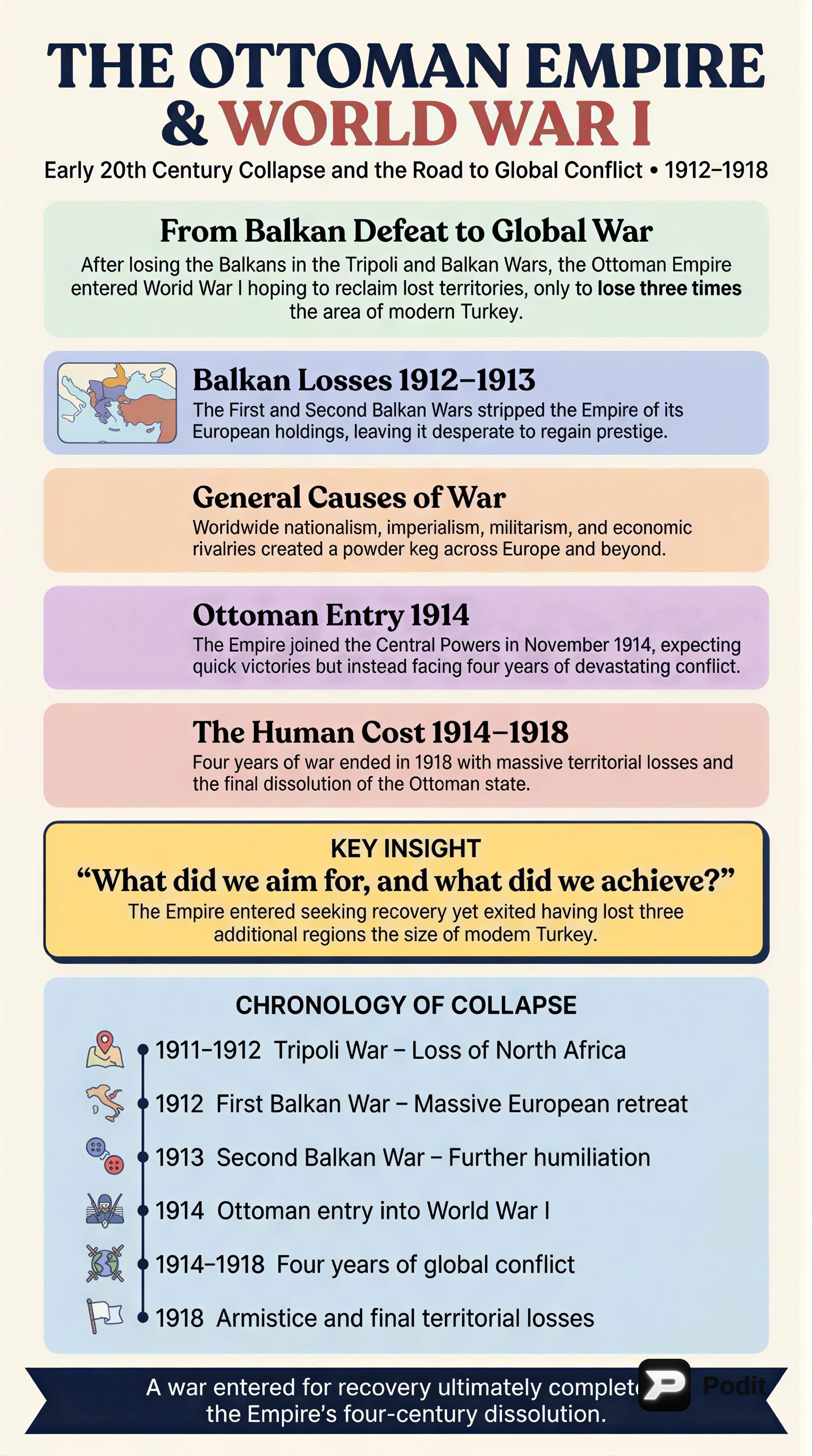
This content is based on a YouTube video.
📚 The Ottoman Empire in the Early 20th Century: Crisis, Transformation, and Dissolution
Introduction: A Tumultuous Era (Early 20th Century)
The early 20th century marked a period of profound crisis and transformation for the Ottoman Empire. Following centuries of gradual decline, the Empire faced an existential threat from both internal reformist movements and external imperialist ambitions. This era witnessed a series of pivotal events that irrevocably altered its trajectory and led to its eventual dissolution. Understanding this period requires an examination of the complex interplay between domestic political struggles, military defeats, and the shifting balance of power among European great powers. The Ottoman state, once a formidable global entity, grappled with modernization efforts, nationalist uprisings among its diverse populations, and the challenge of maintaining sovereignty in a rapidly changing world order. This study material will delineate the key political, military, and social developments that defined the Ottoman Empire's final decades, providing a comprehensive overview of the forces that shaped its demise and the emergence of new national entities from its ruins.
1️⃣ Internal Dynamics and Political Transformation
The turn of the 20th century saw intensified internal pressures within the Ottoman Empire, primarily driven by the Young Turk movement. This period is crucial for understanding the internal struggles that weakened the Empire from within, even as external pressures mounted.
1.1 The Young Turk Movement and the 1908 Revolution
📚 Definition: The Young Turk movement was a clandestine political organization composed largely of military officers and intellectuals. ✅ Primary Goal: They advocated for the restoration of the 1876 Ottoman Constitution and parliamentary rule, aiming to modernize the state and curb the absolute power of Sultan Abdülhamid II. 💡 Significance for KPSS: The Young Turks represented a significant internal challenge to the Sultan's autocratic rule and a desire for constitutional governance.
In July 1908, the Committee of Union and Progress (CUP), the most influential faction within the Young Turks, initiated a revolution. ✅ Outcome: This revolution compelled Sultan Abdülhamid II to reinstate the Constitution, ushering in the Second Constitutional Era. 📈 Characteristics of the Second Constitutional Era:
- Vibrant but tumultuous political landscape.
- Multi-party elections.
- Increased press freedom.
- A surge in nationalist sentiments among various ethnic groups within the Empire.
1.2 The 31 March Incident (1909) and the Rise of the CUP
⚠️ Initial Euphoria Short-Lived: Despite the initial hope, the CUP struggled to consolidate power and effectively address the Empire's myriad problems. Their policies, often centralist and Turkist in orientation, alienated non-Turkish populations and exacerbated existing ethnic tensions.
On March 31, 1909 (Gregorian calendar, April 13, 1909), a counter-revolutionary uprising occurred. 📚 Definition: The 31 March Incident was an attempt to restore absolute monarchy and overturn the constitutional government. ✅ Suppression: The Young Turks successfully suppressed this counter-revolution. ✅ Consequence: This event led to the deposition of Sultan Abdülhamid II and the ascension of Mehmed V to the throne. 💡 Significance for KPSS: The suppression of the 31 March Incident solidified the CUP's control, transforming it from a revolutionary movement into the dominant political force. They effectively governed the Empire through a parliamentary façade.
1.3 CUP's Rule and Policies
The CUP's rule was characterized by a blend of:
- Modernization Efforts: Including military reforms and administrative restructuring.
- Authoritarianism: An increasingly authoritarian approach to dissent.
- Nationalism: A growing emphasis on Ottomanism, which later evolved into a more pronounced Turkish nationalism. These internal political transformations occurred amidst a backdrop of continued territorial erosion and external interference, further complicating the Empire's efforts to stabilize and reform.
2️⃣ Escalating External Conflicts and Territorial Losses
The early 20th century was a period of relentless territorial attrition for the Ottoman Empire, driven by both European imperialist expansion and the rise of nationalism in the Balkans. These conflicts severely weakened the Empire and demonstrated its inability to defend its vast territories.
2.1 The Italo-Turkish War (1911-1912)
📚 Definition: Also known as the Tripolitanian War, this conflict erupted in 1911 when Italy invaded Ottoman Tripolitania and Cyrenaica (modern-day Libya). 🌍 Causes: Italy sought to expand its colonial empire, exploiting the Ottoman Empire's weakness and its inability to effectively defend distant provinces. ⚔️ Key Aspects:
- Despite fierce local resistance supported by Ottoman officers like Mustafa Kemal, the Ottoman Empire could not effectively counter the Italian invasion.
- The war concluded in 1912 with the Treaty of Lausanne (Ouchy). ✅ Consequences of the Treaty of Lausanne (Ouchy):
- Ceded Libya and the Dodecanese Islands to Italy.
- Highlighted the Empire's military vulnerabilities.
- Demonstrated its diminished capacity to protect its remaining African territories. 💡 Significance for KPSS: This war marked the loss of the Ottoman Empire's last remaining territories in North Africa and served as a precursor to the Balkan Wars, emboldening other powers to challenge Ottoman rule.
2.2 The Balkan Wars (1912-1913)
The loss of Libya emboldened the Balkan states, who saw an opportunity to further dismantle Ottoman rule in Europe.
2.2.1 The First Balkan War (October 1912 - May 1913)
⚔️ Combatants: The Balkan League (comprising Bulgaria, Serbia, Greece, and Montenegro) launched a coordinated attack against the Ottomans. ⚠️ Ottoman Weakness: The Ottoman army, still recovering from the war with Italy and plagued by internal divisions, suffered a series of devastating defeats. ✅ Territorial Losses: Within months, the Empire lost nearly all its remaining European possessions, including Macedonia, Albania, and most of Thrace. 📜 Treaty: The war concluded with the Treaty of London in May 1913. ✅ Consequence of Treaty of London: Drastically reduced Ottoman territory in Europe to a small area around Istanbul. 💡 Significance for KPSS: This war was a catastrophic defeat, leading to massive territorial and demographic losses in Europe.
2.2.2 The Second Balkan War (June 1913 - August 1913)
⚔️ Combatants: Primarily fought between Bulgaria and its former allies (Serbia, Greece, Montenegro, and Romania) over the division of Macedonia. 📈 Ottoman Opportunity: The Ottoman Empire, under the leadership of Enver Pasha and the CUP, seized this opportunity to reclaim some lost territory in Eastern Thrace, including Edirne. 📜 Treaty: This was achieved through the Treaty of Constantinople. ✅ Overall Consequences of Balkan Wars:
- Catastrophic for the Ottoman Empire.
- Resulted in the loss of 83% of its European territory and 69% of its European population.
- Inflicted immense demographic and economic costs.
- Fueled a sense of national humiliation.
- Intensified the CUP's nationalist policies, setting the stage for further radicalization and ultimately, the Empire's entry into World War I. 💡 Significance for KPSS: The Balkan Wars are critical for understanding the final collapse of Ottoman rule in Europe and the rise of Turkish nationalism as a dominant ideology within the CUP. The scale of territorial and population loss is a key detail.
3️⃣ The Ottoman Empire in World War I and its Aftermath
The Ottoman Empire's entry into World War I was a pivotal decision with far-reaching consequences, leading directly to its final dissolution.
3.1 Entry into World War I (October 1914)
🤝 Alignment: The Ottoman Empire aligned with the Central Powers (Germany and Austria-Hungary). 🤔 Motivations: This decision was driven by a complex mix of geopolitical calculations, German influence, and the CUP's desire to recover lost territories and prestige. ⚔️ New Fronts: The Empire opened several new fronts, significantly expanding the scope of the war.
3.2 Key Campaigns and Challenges
The Ottoman Empire fought on multiple fronts:
- Caucasus Front: Against Russia, where the Ottoman army suffered severe losses, particularly during the Sarıkamış Offensive.
- Gallipoli Campaign (Çanakkale): Against Allied forces (British, French, ANZAC) attempting to seize Istanbul and control the Dardanelles.
- ✅ Outcome: A strategic victory for the Ottomans, preventing the capture of Istanbul.
- ⚠️ Cost: Came at an immense human cost for both sides.
- 💡 Significance for KPSS: A crucial defensive victory for the Ottomans, and where Mustafa Kemal Pasha gained significant recognition.
- Mesopotamia Front: Against the British.
- Sinai-Palestine Front: Against the British.
Internal challenges during the war included:
- Arab revolts supported by the British.
- The tragic events surrounding the Armenian deportations and massacres, which remain a highly contentious and devastating chapter in Ottoman history.
3.3 Armistice of Mudros and Allied Occupation (1918)
By 1918, the Ottoman Empire was exhausted. Its armies were depleted, its economy shattered, and its territories largely occupied. ✅ End of Participation: The defeat of the Central Powers led to the signing of the Armistice of Mudros on October 30, 1918, effectively ending Ottoman participation in the war. ⚠️ Harsh Terms: This armistice was exceptionally harsh, allowing the Allied powers to occupy strategic points within the Empire and control its military and communications. 📈 Consequence: The subsequent occupation of Istanbul and parts of Anatolia by Allied forces, coupled with the proposed dismemberment of the Empire under the Treaty of Sèvres, ignited a powerful nationalist resistance movement. 💡 Significance for KPSS: The Armistice of Mudros marked the effective end of the Ottoman Empire's military and political sovereignty, paving the way for occupation and the subsequent national struggle.
3.4 The Treaty of Sèvres (1920) and the Turkish War of Independence
📜 Treaty of Sèvres (1920): This proposed treaty aimed to dismember the Ottoman Empire, allocating significant territories to various Allied powers and creating independent states. It was never ratified by the Ottoman parliament. ⚔️ Turkish National Movement: Led by Mustafa Kemal Pasha, a distinguished commander from the Gallipoli campaign, the Turkish National Movement emerged. ✅ Goal: Rejecting the terms of Sèvres, they fought for the independence and sovereignty of Anatolia. This struggle is known as the Turkish War of Independence. ✅ Outcome: This war ultimately led to the abolition of the Ottoman Sultanate in 1922, marking the official end of the six-century-old Empire. 💡 Significance for KPSS: The Treaty of Sèvres is crucial as it represents the Allied powers' plan for the Ottoman Empire's dismemberment, which directly triggered the Turkish War of Independence. Mustafa Kemal's leadership in this period is foundational to the modern Turkish Republic.
3.5 The Treaty of Lausanne (1923) and the Birth of the Republic
📜 Treaty of Lausanne (1923): Following the victory of the Turkish National Movement, this treaty recognized the new Republic of Turkey. ✅ Outcome: It established its modern borders and formally concluded the Ottoman era. 💡 Significance for KPSS: The Treaty of Lausanne is the internationally recognized peace treaty that established the borders of the modern Republic of Turkey, replacing the punitive Treaty of Sèvres.
Conclusion: Legacy of a Tumultuous Era
The early 20th century represents the final, tumultuous chapter of the Ottoman Empire. This period was defined by a relentless struggle against internal decay and external aggression.
✅ Key Takeaways:
- Internal Reform and Authoritarianism: The Young Turk Revolution initially offered a glimmer of hope for modernization and constitutional governance, yet its policies ultimately contributed to further fragmentation and authoritarianism under the CUP.
- Relentless Territorial Losses: Successive military defeats in the Italo-Turkish War and the Balkan Wars dramatically reduced the Empire's territorial footprint and severely weakened its military and economic capabilities.
- Catastrophic World War I: These losses, coupled with geopolitical pressures, pushed the Ottoman Empire into the catastrophic embrace of World War I. The war, fought on multiple fronts, exhausted the Empire's resources and population, leading to its ultimate defeat and the signing of the punitive Armistice of Mudros.
- Rise of Turkish Nationalism: The subsequent Allied occupation and the proposed Treaty of Sèvres catalyzed the Turkish National Movement, culminating in the Turkish War of Independence and the establishment of the Republic of Turkey.
- End of an Empire, Birth of a Nation: The dissolution of the Ottoman Empire in 1922 marked the end of an era and the beginning of a new geopolitical landscape in the Middle East and Southeastern Europe, formally recognized by the Treaty of Lausanne in 1923.
The challenges faced by the Ottoman Empire in this period—balancing modernization with tradition, managing diverse ethnic and religious populations, and resisting imperialist ambitions—offer critical insights into the complexities of state survival and transformation in the face of rapid global change. The events of these decades continue to shape the political and social dynamics of the successor states, underscoring the enduring legacy of the Ottoman Empire's final years.