 Podit
Podit
This content is based on a YouTube video.
📚 The Ottoman Empire in the Early 20th Century: A Period of Terminal Decline
Introduction: The "Sick Man of Europe" 🌍
The early 20th century marked a critical and ultimately terminal period for the Ottoman Empire. Following centuries of gradual decline, this era witnessed an acceleration of internal political instability, significant territorial losses, and intensified external pressures from European powers. The empire, often referred to as the "Sick Man of Europe," struggled to adapt to the rapidly changing global landscape, characterized by rising nationalism, industrialization, and imperialistic ambitions. This period, spanning roughly from the Young Turk Revolution of 1908 to the eve of World War I, was defined by a desperate struggle for survival, marked by constitutional experiments, military defeats, and profound societal transformations. Understanding this era is crucial for comprehending the eventual dissolution of the Ottoman Empire and the emergence of modern nation-states in its former territories.
1️⃣ Internal Dynamics and Political Turmoil: The Young Turk Era
The internal political landscape of the Ottoman Empire in the early 20th century was characterized by a complex interplay of reformist movements, conservative reactions, and burgeoning nationalist sentiments. This period is particularly important for understanding the empire's final decades.
The Young Turk Revolution of 1908 ✅
The Young Turk Revolution of 1908 stands as a pivotal event. It forced Sultan Abdülhamid II to restore the 1876 Ottoman Constitution, thereby ushering in the Second Constitutional Era. This revolution was initially met with widespread enthusiasm, promising liberty, equality, and fraternity for all Ottoman subjects, regardless of ethnicity or religion.
- Key Event: Young Turk Revolution (1908)
- Outcome: Restoration of the 1876 Ottoman Constitution, beginning of the Second Constitutional Era.
- Key Figure: Sultan Abdülhamid II (forced to restore the constitution).
- Initial Ideals: Liberty, equality, fraternity for all Ottoman subjects.
The Rise of the Committee of Union and Progress (CUP) 📈
This period saw the rise of the Committee of Union and Progress (CUP) as the dominant political force. The CUP's ideology, initially rooted in Ottomanism, aimed to preserve the empire's integrity by fostering a common Ottoman identity among its diverse populations. However, this ideal soon clashed with the growing nationalist aspirations of various ethnic groups within the empire, including Albanians, Arabs, and Armenians, as well as the already independent Balkan states. These groups increasingly sought self-determination or closer ties with their ethnic kin.
- Key Organization: Committee of Union and Progress (CUP)
- Initial Ideology: Ottomanism (aimed at unifying all subjects under a common Ottoman identity).
- Challenge: Rising nationalist aspirations among ethnic groups (Albanians, Arabs, Armenians) and independent Balkan states.
The 31 March Incident (1909) ⚠️
The brief period of constitutional rule was quickly challenged by the 31 March Incident in 1909. This was a counter-revolution aimed at restoring absolute monarchical rule and Sharia law. This uprising, supported by conservative religious elements and disgruntled military factions, highlighted the deep ideological fissures within Ottoman society.
- Key Event: 31 March Incident (1909)
- Nature: Counter-revolution.
- Goals: Restore absolute monarchy and Sharia law.
- Supporters: Conservative religious elements, disgruntled military factions.
- Significance: Demonstrated the fragility of the new constitutional order.
Suppression and Aftermath: Deposition of Abdülhamid II 💡
Although the 31 March Incident was swiftly suppressed by the "Action Army" led by Mahmud Shevket Pasha, it had profound consequences. Sultan Abdülhamid II was subsequently deposed and replaced by his less politically active brother, Mehmed V. Following this event, the CUP solidified its power, gradually shifting from its initial liberal stance towards a more authoritarian and Turkish nationalist orientation. This shift, driven by the perceived failures of Ottomanism and increasing external threats, further alienated non-Turkish populations and exacerbated internal tensions, laying the groundwork for future conflicts and the empire's eventual fragmentation.
- Suppression: By the "Action Army" led by Mahmud Shevket Pasha.
- Consequence 1: Deposition of Sultan Abdülhamid II.
- Consequence 2: Accession of Mehmed V.
- CUP's Evolution: Shift from liberal Ottomanism to authoritarian Turkish nationalism.
- Impact: Alienation of non-Turkish populations, increased internal tensions.
The political environment remained highly volatile, marked by frequent changes in government, military interventions in politics, and assassinations, reflecting the profound struggle between different visions for the empire's future. The CUP's increasing centralization and Turkification policies, while intended to strengthen the state, inadvertently accelerated the disintegration of the multi-ethnic empire.
2️⃣ External Pressures and Territorial Losses: The Empire Shrinks 📉
Concurrently with internal strife, the Ottoman Empire faced relentless external aggression, leading to significant territorial losses that further weakened its position. These losses were catastrophic and played a major role in the empire's eventual collapse.
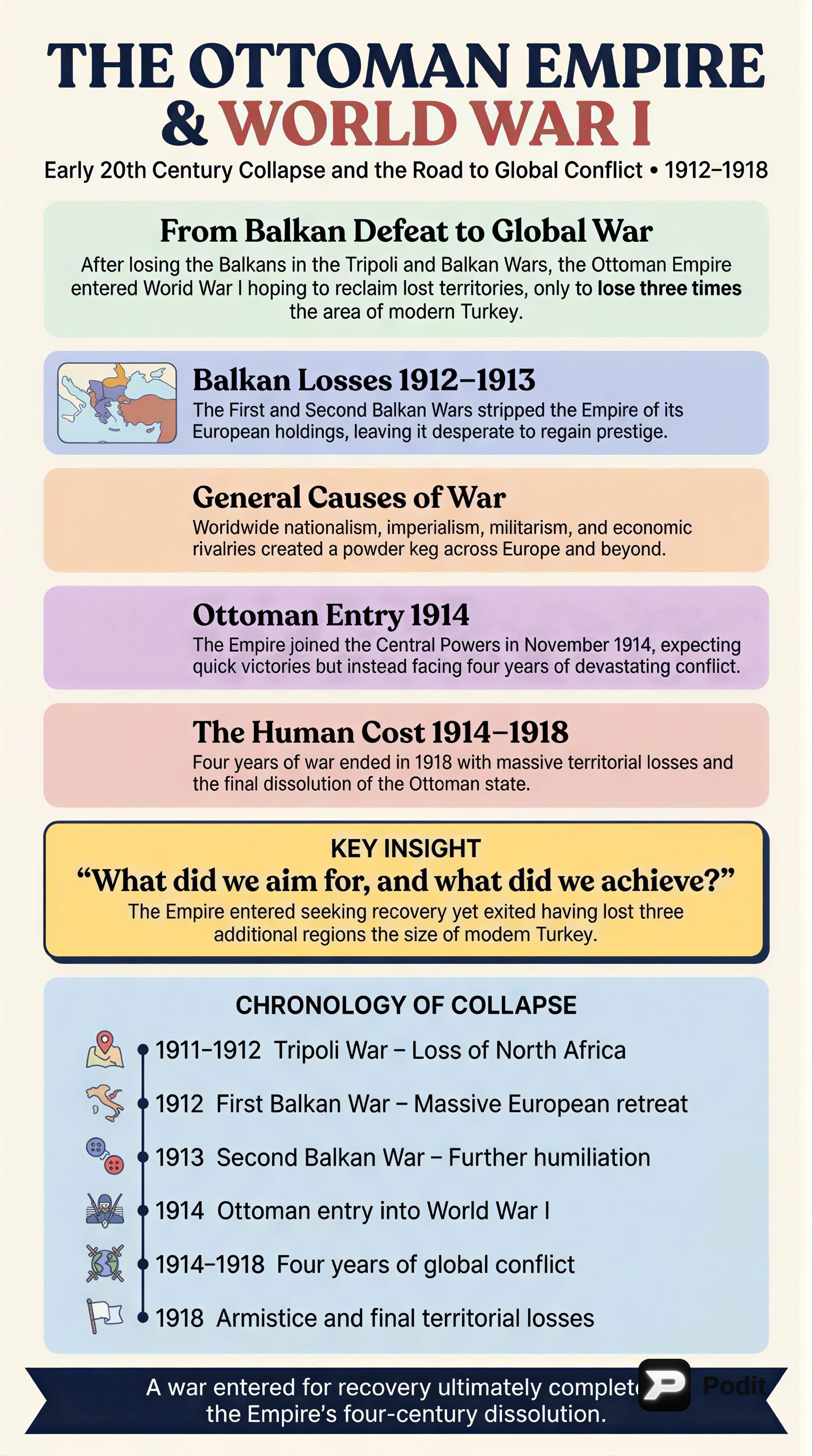
The Italo-Turkish War (Tripolitanian War) 1911-1912 🇮🇹
The Italo-Turkish War, also known as the Tripolitanian War, erupted in 1911 when Italy invaded Ottoman Tripolitania and Cyrenaica (modern-day Libya). Italy, seeking to expand its colonial empire, exploited the Ottoman Empire's weakness and its inability to effectively defend distant provinces.
- Key Event: Italo-Turkish War (1911-1912)
- Aggressor: Italy.
- Target: Ottoman Tripolitania and Cyrenaica (Libya).
- Reason: Italian colonial expansion, Ottoman weakness.
Despite fierce resistance from local Arab tribes and Ottoman officers like Mustafa Kemal, the empire was ultimately forced to cede these territories to Italy by the Treaty of Ouchy in 1912. This loss was a severe blow, as Tripolitania represented the last remaining Ottoman province in North Africa, signaling the end of Ottoman influence in the region.
- Ottoman Resistance: Led by local Arab tribes and officers like Mustafa Kemal.
- Outcome: Ottoman defeat.
- Key Treaty: Treaty of Ouchy (1912).
- Territorial Loss: Tripolitania and Cyrenaica (Libya) ceded to Italy.
- Significance: End of Ottoman presence in North Africa.
The Balkan Wars (1912-1913) ⚔️
The defeat in Tripolitania emboldened the Balkan states, who saw an opportunity to expand their territories at the expense of the weakened Ottoman Empire. This led directly to the devastating Balkan Wars.
The First Balkan War (1912) 🇧🇬🇬🇷🇲🇪🇷🇸
The First Balkan War broke out in October 1912, pitting the Balkan League (Serbia, Bulgaria, Greece, and Montenegro) against the Ottomans. The Ottoman army, still recovering from the war with Italy and plagued by internal divisions, suffered a series of devastating defeats.
- Key Event: First Balkan War (October 1912).
- Combatants: Balkan League (Serbia, Bulgaria, Greece, Montenegro) vs. Ottoman Empire.
- Ottoman Weaknesses: Still recovering from Italo-Turkish War, internal divisions.
- Outcome: Series of devastating Ottoman defeats.
Within months, the empire lost nearly all its remaining European possessions, including Macedonia, Albania, and most of Thrace. The Treaty of London in 1913 formalized these losses, drastically reducing the Ottoman presence in Europe to a small area around Istanbul.
- Major Territorial Losses: Macedonia, Albania, most of Thrace.
- Key Treaty: Treaty of London (1913).
- Impact: Drastic reduction of Ottoman territory in Europe.
The Second Balkan War (1913) 🔄
The aftermath of the First Balkan War saw the Second Balkan War in 1913, primarily fought between the former allies over the division of the spoils. Although the Ottoman Empire managed to regain Edirne (Adrianople) from Bulgaria during this conflict, the overall outcome of the Balkan Wars was catastrophic.
- Key Event: Second Balkan War (1913).
- Nature: Conflict among former Balkan League allies.
- Ottoman Gain: Regained Edirne (Adrianople) from Bulgaria.
- Overall Impact: Catastrophic for the Ottoman Empire.
The empire lost approximately 80% of its European territory and 70% of its European population, including a significant Muslim population that became refugees, further straining the empire's resources and social fabric. These wars not only diminished the empire's geographical extent but also severely damaged its prestige, military capability, and economic stability, setting the stage for its entry into World War I under precarious conditions.
- Total Losses from Balkan Wars:
- Approximately 80% of European territory.
- Approximately 70% of European population.
- Mass migration of Muslim refugees.
- Consequences: Diminished prestige, military capability, economic stability.
- Historical Context: Set the stage for Ottoman entry into World War I.
3️⃣ Socio-Economic Challenges and Reforms: A Struggling Economy 📊
The early 20th century also presented the Ottoman Empire with immense socio-economic challenges, exacerbated by continuous warfare and political instability.
Economic Dependency and the Capitulations 💸
The empire's economy was largely agrarian and underdeveloped compared to the industrialized European powers. It suffered from a heavy foreign debt burden, largely due to previous loans taken to finance modernization efforts and military expenditures, particularly after the Crimean War.
- Economic State: Agrarian, underdeveloped.
- Major Issue: Heavy foreign debt from past modernization and military spending.
The Capitulations, a series of treaties granting extraterritorial rights and economic privileges to foreign nationals and businesses, further hindered the empire's ability to control its own economy, implement protective tariffs, and develop domestic industries. This economic dependency made the empire vulnerable to external manipulation and limited its capacity for self-sustaining growth, creating a cycle of debt and underdevelopment.
- Key Concept: Capitulations (extraterritorial rights and economic privileges for foreigners).
- Impact of Capitulations: Hindered economic control, prevented protective tariffs, limited domestic industrial development.
- Result: Economic dependency, vulnerability to external manipulation, cycle of debt.
Attempts at Reform and Modernization 💡
Despite these profound challenges, there were concerted attempts at reform and modernization. The Young Turks, particularly after consolidating power, pursued policies aimed at strengthening the central government, modernizing the military, and improving infrastructure, including railways and communication networks.
- Young Turk Reforms:
- Strengthening central government.
- Modernizing the military.
- Improving infrastructure (railways, communication).
Efforts were made to promote education, particularly secular education, and to foster a sense of Ottoman identity through state-sponsored institutions, though these were often overshadowed by the rising tide of ethnic nationalism. Economic reforms included attempts to reduce foreign influence by renegotiating aspects of the Capitulations, establishing national banks like the Ottoman National Credit Bank, and encouraging domestic industry through subsidies and protective measures.
- Educational Reforms: Promotion of secular education.
- Identity Promotion: Fostering Ottoman identity through state institutions (challenged by nationalism).
- Economic Reforms:
- Renegotiating Capitulations.
- Establishing national banks (e.g., Ottoman National Credit Bank).
- Encouraging domestic industry.
However, these initiatives were often too little, too late, and frequently disrupted by ongoing conflicts and the empire's precarious financial state. The lack of a robust industrial base and the continuous drain of resources for military campaigns severely hampered any sustained economic recovery or transformation.
Social and Demographic Shifts 👥
Socially, the period was marked by significant demographic shifts and increasing communal strife. The Balkan Wars, in particular, led to mass migrations of hundreds of thousands of Muslim populations from lost territories into Anatolia, creating immense refugee crises and altering the demographic composition of the empire's core regions.
- Major Impact of Balkan Wars: Mass migrations of Muslim populations into Anatolia.
- Consequences: Refugee crises, demographic shifts, strain on resources.
These refugees often arrived impoverished and traumatized, placing enormous strain on the empire's already limited resources and social services. The rise of nationalism among various ethnic groups led to increased communal tensions and, in some cases, violence, as different communities vied for political influence and autonomy. The concept of Ottomanism, which sought to unite all subjects under a common identity, proved increasingly untenable in the face of these centrifugal forces. The empire, a mosaic of cultures and religions, found its attempts to forge a unified identity often alienated rather than integrated its diverse populations, ultimately contributing to its fragmentation. The cumulative effect of these socio-economic and demographic pressures further weakened the empire's foundations, making it increasingly susceptible to collapse.
- Failure of Ottomanism: Unable to unite diverse populations against rising ethnic nationalism.
- Overall Effect: Increased communal tensions, violence, and fragmentation.
Conclusion: The Eve of Dissolution 🔚
In conclusion, the early 20th century represented the final, tumultuous chapter of the Ottoman Empire. This period was characterized by a confluence of internal political upheavals, including the Young Turk Revolution and subsequent counter-revolutions, which destabilized the central government and fueled ethnic nationalism. Simultaneously, the empire faced relentless external aggression, culminating in the devastating Italo-Turkish War and the Balkan Wars, which stripped it of vast territories in North Africa and Europe.
These military defeats and territorial losses not only diminished the empire's geographical footprint but also severely eroded its military strength, economic viability, and international standing. Amidst these crises, socio-economic challenges such as foreign debt, economic dependency due to the Capitulations, and mass migrations further strained the empire's resources and social cohesion.
By the eve of World War I, the Ottoman Empire was a shadow of its former self, politically fractured, militarily weakened, and economically vulnerable, poised for its ultimate dissolution. The events of this era laid the groundwork for the subsequent collapse of the empire and the emergence of new political entities in the Middle East and the Balkans.