The First Turkic States: Origins and Early Empires - kapak
Tarih#turkic history#nomadic empires#central asia#kaganate

The First Turkic States: Origins and Early Empires

Explore the foundational elements of the first Turkic states, understanding their unique nomadic lifestyle, political structures like the Kaganate, military prowess, and cultural contributions in Central Asia.

q6syj662September 5, 2026 ~20 dk toplam
01

Sesli Özet

6 dakika

Konuyu otobüste, koşarken, yolda dinleyerek öğren.

Sesli Özet

The First Turkic States: Origins and Early Empires

0:006:20
02

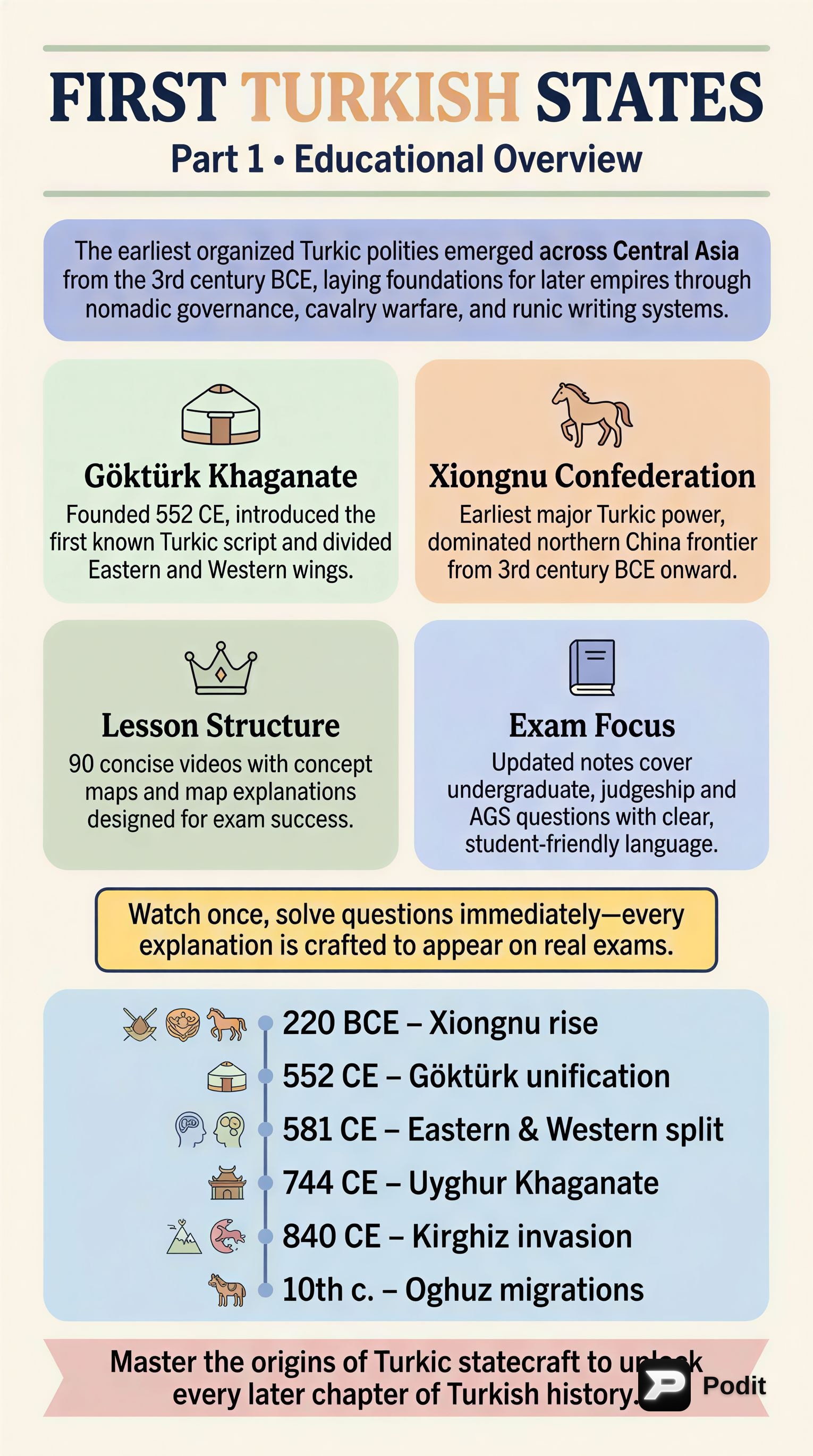
Görsel Özet

İnfografik

Konunun tüm parçalarını tek bakışta gör.

The First Turkic States: Origins and Early Empires - görsel özet infografik
Tam boyutta görüntüle →
03

Flash Kartlar

25 kart

Karta tıklayarak çevir. ← → ile gez, ⎵ ile çevir.

1 / 25
Tüm kartları metin olarak gör
  1. 1. What was the main geographical focus of the early Turkic states discussed in the content?

    The early Turkic states were primarily located in the heart of Central Asia. This region encompasses the vast Eurasian Steppe, which stretches from Eastern Europe all the way to Mongolia. This specific environment played a crucial role in shaping their nomadic lifestyle and political structures.

  2. 2. How does the content describe the nature of early Turkic entities, beyond just tribal groupings?

    The content emphasizes that early Turkic entities were not merely tribal groupings but sophisticated political entities. They left an indelible mark on history, influencing cultures and geopolitics for centuries. These states developed unique lifestyles, political structures, and cultural contributions that set them apart.

  3. 3. What was the defining characteristic of the environment inhabited by early Turkic states?

    The defining characteristic of their environment was the vast Eurasian Steppe, described as immense grasslands. This landscape was not suitable for settled agriculture like river valleys. Instead, it was perfectly suited for pastoral nomadism, which became the cornerstone of their society.

  4. 4. Define 'pastoral nomadism' as it relates to early Turkic societies.

    Pastoral nomadism for early Turkic societies meant a life centered around raising livestock such as horses, sheep, goats, and camels. These animals provided essential resources like food, clothing, and transportation. The constant need for fresh pastures necessitated a migratory lifestyle, following seasonal cycles across the steppe.

  5. 5. Which animals were central to the nomadic lifestyle of early Turkic tribes?

    The animals central to the nomadic lifestyle of early Turkic tribes were horses, sheep, goats, and camels. These livestock were fundamental to their survival and economy, providing food, clothing, and serving as the primary means of transportation. Their reliance on these animals dictated their constant movement across the steppe.

  6. 6. How did the nomadic lifestyle impact the resilience and adaptability of Turkic societies?

    The nomadic lifestyle fostered incredible resilience and adaptability among Turkic societies. Constantly moving and facing environmental challenges, they developed a strong ability to cope with change and hardship. This way of life also instilled a deep connection to nature, further enhancing their survival skills.

  7. 7. What military skills were fostered by the nomadic lifestyle of early Turkic peoples?

    The nomadic lifestyle fostered exceptional military skills, particularly horsemanship and archery. Every man was essentially a warrior, trained from a young age in these crucial combat techniques. Their entire way of life was geared towards rapid movement and effective defense or offense, making them formidable in battle.

  8. 8. Explain the role of mobility in the expansion and empire-building of early Turkic states.

    Mobility was a key factor in the ability of early Turkic states to expand and establish large empires. Their constant movement and skilled cavalry allowed for rapid deployment and strategic maneuvers. This inherent mobility enabled them to conquer vast territories and maintain control over dispersed populations, despite the fluid nature of their empires.

  9. 9. What unique challenge did governing dispersed populations pose for early Turkic states?

    Governing dispersed populations posed a unique challenge for early Turkic states due to their nomadic nature. Since people were always on the move, traditional static administrative structures were ineffective. This challenge necessitated the development of flexible political structures and unique forms of leadership to manage diverse tribal groups across vast territories.

  10. 10. What was the core organizational structure of early Turkic states?

    The core organizational structure of early Turkic states was often the 'Kaganate.' This system represented an empire led by a supreme ruler known as a 'Kagan.' The Kaganate provided a framework for unifying various tribes and clans under a single, powerful authority, balancing centralized leadership with tribal autonomy.

  11. 11. Define 'Kaganate' in the context of early Turkic states.

    A Kaganate was an empire led by a 'Kagan,' who served as the supreme ruler of early Turkic states. The Kagan held significant political and often spiritual authority over the various tribes and clans. This organizational structure allowed for the governance of vast, often dispersed, nomadic populations.

  12. 12. What was the role of a 'Kagan' in early Turkic states?

    A 'Kagan' was the supreme ruler of a Kaganate, holding both political and often spiritual authority. Their legitimacy was frequently tied to the concept of 'Kut,' a divine mandate from Tengri. The Kagan was seen as Tengri's chosen representative on Earth, responsible for leading and unifying the Turkic peoples.

  13. 13. Explain the concept of 'Kut' in relation to the Kagan's legitimacy.

    The concept of 'Kut' was a divine mandate or heavenly blessing believed to be bestowed by Tengri, the sky god. This belief was crucial for the Kagan's legitimacy, as it signified that the Kagan was Tengri's chosen representative on Earth. 'Kut' provided a spiritual foundation for the Kagan's rule, reinforcing their authority among the Turkic peoples.

  14. 14. What was the dominant religion among early Turkic peoples?

    The dominant religion among early Turkic peoples was Tengrism. This belief system centered around Tengri, the sky god, who was seen as the ultimate power. Tengrism played a significant role in their spiritual and political life, often legitimizing the rule of the Kagan through the concept of 'Kut'.

  15. 15. What were the key beliefs about Tengri in Tengrism?

    In Tengrism, Tengri was revered as the sky god and the ultimate power. He was believed to bestow 'Kut,' a divine mandate, upon the Kagan, making the Kagan his chosen representative on Earth. This belief system provided a spiritual foundation for the political structure and worldview of early Turkic peoples.

  16. 16. Describe the political structure of early Turkic states, considering their nomadic nature.

    The political structure of early Turkic states was typically hierarchical but also decentralized to a degree, reflecting their nomadic nature. While the Kagan was supreme, various tribal chiefs and nobles held significant power over their own clans. This system allowed for unity under a strong leader while providing flexibility in managing diverse and dispersed tribal groups across vast territories.

  17. 17. What role did tribal chiefs and nobles play in the political structure of early Turkic states?

    Tribal chiefs and nobles, often related to the Kagan, held significant power over their own clans within the hierarchical yet decentralized political structure. They managed local affairs and maintained order within their respective tribal groups. This distribution of power allowed the Kaganate to effectively govern a vast and mobile population.

  18. 18. What was the primary military strength of early Turkic states?

    The primary military strength of early Turkic states lay in their formidable cavalry, composed of highly skilled horse archers. These warriors were legendary for their prowess and effectiveness in battle. Their mastery of horsemanship and archery from a young age made them a dominant force on the steppe.

  19. 19. Name some military tactics employed by early Turkic states.

    Early Turkic states employed highly effective military tactics, notably feigned retreats and encirclement. These strategies were incredibly successful against more static, infantry-based armies. Their mobility and skill as horse archers allowed them to execute complex maneuvers that often overwhelmed their opponents.

  20. 20. Beyond conquest, what other crucial purpose did military prowess serve for Turkic states?

    Beyond conquest, military prowess was crucial for protecting vital trade routes. These routes were essential for acquiring goods not easily produced on the steppe, such as metals and luxury items. A strong military ensured the security of these economic lifelines, contributing to the prosperity and stability of the Turkic states.

  21. 21. How were early Turkic societies socially organized?

    Early Turkic societies were socially organized around clans and tribes, characterized by strong kinship ties. While a clear hierarchy existed, there was also a degree of social mobility, particularly for warriors who proved their worth in battle. This structure fostered strong communal bonds and a sense of collective identity.

  22. 22. Was there social mobility in early Turkic societies? Explain.

    Yes, there was a degree of social mobility in early Turkic societies, especially for warriors who proved their worth. While the society was organized around clans and tribes with a hierarchy, individual achievements, particularly in warfare, could elevate one's status. This provided opportunities for individuals to improve their social standing.

  23. 23. What was the role of women in early Turkic societies?

    Women in early Turkic societies often held more prominent roles than in many contemporary settled societies. They participated in warfare, governance, and economic activities, which was partly due to the necessities of nomadic life. Everyone had to contribute to the survival and functioning of the community, leading to greater gender equality in responsibilities.

  24. 24. What were some key cultural contributions of early Turkic civilizations?

    Key cultural contributions of early Turkic civilizations include a rich oral tradition, epic poems, and a unique runic script. The Orkhon Inscriptions are a prime example of this script, providing invaluable insights into their history, beliefs, and political thought. These cultural elements reflect their distinct identity and intellectual development.

  25. 25. What are the Orkhon Inscriptions, and why are they significant?

    The Orkhon Inscriptions are among the earliest known examples of Turkic writing, utilizing a unique runic script. They are significant because they provide invaluable insights into the history, beliefs, and political thought of early Turkic peoples. These inscriptions serve as crucial primary sources for understanding their civilization.

04

Bilgini Test Et

15 soru

Çoktan seçmeli sorularla öğrendiklerini ölç. Cevap + açıklama.

Soru 1 / 15Skor: 0

Which of the following best synthesizes the primary challenge faced by early Turkic states in governance, stemming directly from their nomadic lifestyle?

05

Detaylı Özet

4 dk okuma

Tüm konuyu derinlemesine, başlık başlık.

This content is based on a YouTube video.


📚 Early Turkic States: Origins and Foundations

Introduction

Welcome to a journey into the origins of the first Turkic states, sophisticated political entities that emerged from the heart of Central Asia. This study material explores the foundational elements that enabled nomadic peoples to forge powerful states, examining their unique lifestyle, political structures, and cultural contributions. Understanding these early states is crucial for grasping their indelible mark on history, influencing cultures and geopolitics for centuries.

1️⃣ The Steppe Environment and Nomadic Lifestyle

To comprehend the early Turkic states, it's essential to understand the environment they inhabited: the vast Eurasian Steppe.

  • Geographical Context 🌍: The Eurasian Steppe consists of immense grasslands stretching thousands of kilometers from Eastern Europe to Mongolia.
  • Pastoral Nomadism 🐎: This environment was ideal for pastoral nomadism, a life centered around livestock such as horses, sheep, goats, and camels.
    • Resource Provision ✅: These animals provided essential resources: food, clothing, and transportation.
    • Seasonal Movement 🔄: Turkic tribes were constantly on the move, following seasonal cycles to find fresh pastures for their herds.
  • Societal Impact 💡: This nomadic lifestyle fostered several key characteristics:
    • Resilience and Adaptability 💪: Constant movement and reliance on nature built strong, adaptable societies.
    • Deep Connection to Nature 🌿: Their way of life was intrinsically linked to the natural world.
    • High Mobility and Military Prowess 🛡️:
      • Every man was essentially a warrior, skilled in horsemanship and archery from a young age.
      • Their entire way of life was geared towards rapid movement, effective defense, and offense.
      • This mobility was a key factor in their ability to expand and establish large, though often fluid, empires.
    • Flexible Political Structures 🏛️: The dispersed nature of their populations necessitated flexible leadership and social organization to manage people who were always moving.

2️⃣ Key Characteristics of Early Turkic States (KPSS Focus)

Early Turkic states possessed distinct features that allowed them to thrive and expand. These characteristics are crucial for understanding their historical significance.

2.1. Political Structure: The Kaganate 👑

The primary political organization was the "Kaganate."

  • Kagan 📚: The supreme ruler of a Kaganate, holding both political and often spiritual authority.
  • Kut (Divine Mandate) ✨:
    • Definition ✅: A heavenly blessing or divine mandate believed to be bestowed upon the Kagan by Tengri, the sky god.
    • Significance 💡: This concept provided the Kagan with legitimacy and justified his rule as chosen by the ultimate power.
  • Tengrism 🙏:
    • Definition 📚: The dominant religion among early Turkic peoples, centered on the worship of Tengri, the sky god.
    • Role ✅: Tengri was seen as the ultimate power, and the Kagan was considered his chosen representative on Earth.
  • Hierarchy and Decentralization 📊:
    • The political structure was typically hierarchical, with the Kagan at the top.
    • However, it was also decentralized to a degree, reflecting their nomadic nature.
    • Tribal chiefs and nobles, often related to the Kagan, held significant power over their own clans.
    • This system allowed for both unity under a strong leader and flexibility in managing diverse tribal groups across vast territories.

2.2. Military Prowess 🏹

Early Turkic states were formidable military powers.

  • Cavalry 🐎: Their cavalry, composed of highly skilled horse archers, was legendary.
  • Tactics ⚔️: They employed effective tactics such as:
    • Feigned retreats
    • Encirclement
    • These tactics were incredibly effective against more static, infantry-based armies.
  • Purpose ✅: Military strength was used not only for conquest but also for protecting vital trade routes, which were essential for acquiring goods not easily produced on the steppe (e.g., metals, luxury items).

2.3. Social Organization 👨‍👩‍👧‍👦

Turkic societies were structured around strong kinship ties.

  • Clans and Tribes 🏘️: Society was organized into clans and tribes.
  • Hierarchy and Mobility 📈:
    • While a clear hierarchy existed, there was also a degree of social mobility, particularly for warriors who proved their worth in battle.
  • Role of Women 👩‍⚖️: Women often held more prominent roles than in many contemporary settled societies.
    • They participated in warfare, governance, and economic activities.
    • This was partly due to the necessities of nomadic life, where everyone had to contribute to survival and prosperity.

2.4. Cultural Contributions 📜

Early Turkic peoples developed a rich and distinct culture.

  • Oral Tradition 🗣️: They possessed a rich oral tradition, including epic poems that preserved their history and values.
  • Runic Script ✍️: They developed a unique runic script.
    • Orkhon Inscriptions 📚: These inscriptions are among the earliest known examples of Turkic writing.
    • Historical Value 💡: They provide invaluable insights into their history, beliefs, and political thought, serving as primary sources for understanding early Turkic civilization.

3️⃣ The Enduring Legacy of Early Turkic Civilizations

The early Turkic states, such as the Xiongnu and the Göktürks, were not merely transient tribal groupings. They were sophisticated political entities that laid the groundwork for future Turkic empires and left a lasting legacy on the history of Central Asia and beyond. Their innovations in governance, military strategy, and cultural expression continue to be subjects of fascination and study for historians and scholars. These foundational elements were critical in shaping the geopolitical landscape of Eurasia for centuries.
Kendi çalışma materyalini oluştur

PDF, YouTube videosu veya herhangi bir konuyu dakikalar içinde podcast, özet, flash kart ve quiz'e dönüştür. 1.000.000+ kullanıcı tercih ediyor.

Sıradaki Konular

Tümünü keşfet
Pre-Islamic Turkish History

Pre-Islamic Turkish History

An academic overview of Pre-Islamic Turkish History, exploring the origins, early states, cultural aspects, and significant empires of Turkic peoples before the advent of Islam.

9 dk Özet 15 Görsel
Pre-Islamic Turkish Political History

Pre-Islamic Turkish Political History

Explore the political history of early Turkish states before Islam, covering their nomadic origins, state structures, military prowess, and key empires like the Huns and Göktürks.

11 dk Özet 25 Görsel
Political History of Pre-Islamic Turkic States

Political History of Pre-Islamic Turkic States

This summary explores the political evolution of Turkic peoples before Islam, covering major empires like the Xiongnu, Göktürks, and Uyghurs, their state structures, and historical impact.

7 dk Görsel
The First Turkic States: Origins and Xiongnu

The First Turkic States: Origins and Xiongnu

Explore the origins of the earliest Turkic states in Central Asia, their nomadic lifestyle, key societal concepts like Kut and Töre, and delve into the foundational Xiongnu Empire.

Özet 15
The Genesis and Early Development of Turkish States

The Genesis and Early Development of Turkish States

This academic summary explores the foundational period of early Turkish states, focusing on their Central Asian origins, nomadic characteristics, political structures, and the emergence of significant entities like the Xiongnu.

5 dk Özet 25 15
Pre-Islamic Turkish History: Origins and Early States

Pre-Islamic Turkish History: Origins and Early States

An academic overview of Pre-Islamic Turkish history, covering the origins, early migrations, social structures, and significant states of Turkic peoples in Central Asia before the advent of Islam.

6 dk 25 15 Görsel
Early Turkic States: Origins and Empires

Early Turkic States: Origins and Empires

This academic summary explores the foundational early Turkic states, examining their origins, political structures, cultural contributions, and historical impact across Central Asia and Eurasia.

10 dk Özet 25 15 Görsel
Pre-Islamic Turkish Political History: Part 1

Pre-Islamic Turkish Political History: Part 1

Explore the political history of early Turkish states before Islam, focusing on the Great Hun Empire, Göktürks, and Uyghurs, their state structures, and impact.

13 dk Özet 25 Görsel