Understanding Geographical Location: Absolute & Relative - kapak
Eğitim#geography#geographical location#absolute location#relative location

Understanding Geographical Location: Absolute & Relative

Explore the two fundamental types of geographical location: absolute, defined by coordinates, and relative, shaped by surroundings. Essential for understanding Earth's geography.

sumeyyetfnJuly 25, 2026 ~20 dk toplam
01

Sesli Özet

6 dakika

Konuyu otobüste, koşarken, yolda dinleyerek öğren.

Sesli Özet

Understanding Geographical Location: Absolute & Relative

0:006:19
02

Görsel Özet

İnfografik

Konunun tüm parçalarını tek bakışta gör.

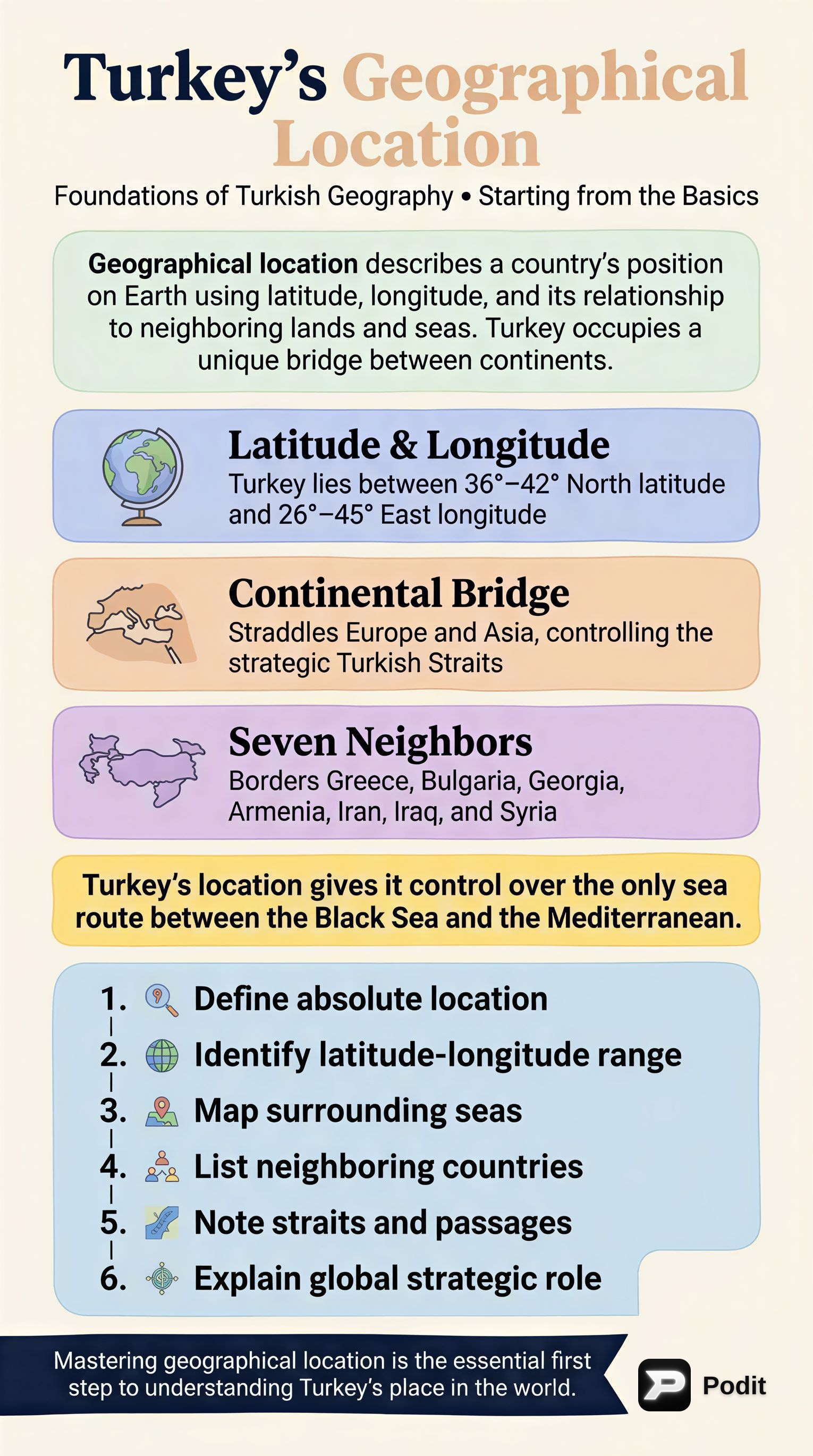
Understanding Geographical Location: Absolute & Relative - görsel özet infografik
Tam boyutta görüntüle →
03

Flash Kartlar

25 kart

Karta tıklayarak çevir. ← → ile gez, ⎵ ile çevir.

1 / 25
Tüm kartları metin olarak gör
  1. 1. What is the primary focus of the content provided by Podit?

    The primary focus of the content is "Geographical Location." This concept is fundamental to understanding our world and involves exploring how places are defined and positioned on Earth. It serves as a cornerstone for various geographical studies.

  2. 2. What are the two main types of geographical location discussed in the lesson?

    The two main types of geographical location discussed are absolute location and relative location. These two concepts provide different but complementary ways of understanding where a place is situated and its significance within its broader environment.

  3. 3. Define "absolute location" and state its alternative name.

    Absolute location refers to a precise, unchanging point on the Earth's surface, often described as a place's unique "cosmic address." It is also known as mathematical location, as it relies on a fixed, quantifiable grid system for identification.

  4. 4. What system is used to pinpoint absolute location on Earth?

    Absolute location is pinpointed using a grid system composed of imaginary lines. These lines are known as parallels of latitude and meridians of longitude, which intersect to create a unique coordinate for every specific point on Earth's surface.

  5. 5. Describe what parallels of latitude are and how they are oriented on Earth.

    Parallels of latitude are imaginary circles that run parallel to the Equator. They encircle the Earth horizontally, measuring distance north or south of the Equator. These lines never meet and maintain a consistent distance from each other.

  6. 6. What is the significance of the Equator in relation to latitude?

    The Equator is the 0-degree latitude line, holding significant importance as it divides the Earth into the Northern and Southern Hemispheres. It serves as the fundamental reference point from which all other latitude measurements are taken, indicating distance from this central line.

  7. 7. What is the range of latitude measurements, and what do the extreme points represent?

    Latitude measurements range from 0 degrees at the Equator to 90 degrees at the North and South Poles. The poles represent the northernmost and southernmost points on Earth, respectively, marking the maximum extent of latitude in each hemisphere.

  8. 8. How does latitude primarily determine climate zones?

    Latitude primarily determines climate zones by influencing the angle at which sunlight hits the Earth. Areas closer to the Equator receive more direct sunlight, leading to warmer climates. Conversely, areas closer to the poles receive sunlight at a more oblique angle, resulting in colder temperatures and distinct climate patterns.

  9. 9. Provide examples of how latitude affects climate zones, as mentioned in the text.

    As mentioned, countries near the Equator like Ecuador or Indonesia typically have tropical climates due to direct sunlight. In contrast, countries at higher latitudes, such as Canada or Russia, experience temperate or polar climates because the sun's rays hit the Earth at a more oblique angle, leading to less intense heating.

  10. 10. Describe what meridians of longitude are and how they are oriented on Earth.

    Meridians of longitude are imaginary semi-circles that run from the North Pole to the South Pole. Unlike latitude lines, they converge at the poles and are oriented vertically around the Earth. They are not parallel to each other, meeting at both poles.

  11. 11. What is the significance of the Prime Meridian in relation to longitude?

    The Prime Meridian is designated as 0 degrees longitude and passes through Greenwich, London. It serves as the primary reference line from which all other longitudes are measured, dividing the Earth into Eastern and Western hemispheres for the purpose of timekeeping and global positioning.

  12. 12. What is the range of longitude measurements?

    Longitude measurements range from 0 degrees at the Prime Meridian to 180 degrees east or west. The 180-degree meridian is roughly opposite the Prime Meridian and is often associated with the International Date Line, marking the transition of calendar days.

  13. 13. What is the main role of longitude in geographical understanding?

    The main role of longitude is crucial for determining time zones. As the Earth rotates on its axis, different longitudes face the sun at different times, leading to variations in local time across the globe. This system allows for a standardized global time framework.

  14. 14. Explain the relationship between longitude and time zones.

    For every 15 degrees of longitude one travels eastward, the local time advances by one hour. Conversely, traveling westward by 15 degrees means the time goes back by one hour. This systematic change is fundamental to the establishment and understanding of global time zones.

  15. 15. What are the overall benefits of understanding absolute location?

    Understanding absolute location is essential for navigation, mapping, and comprehending global climate patterns and time differences. It provides a fixed, unchangeable reference point that is fundamental for various geographical and logistical applications, ensuring precision in location identification.

  16. 16. Define "relative location" and state its alternative name.

    Relative location describes a place's position in relation to other places, features, or activities. Unlike absolute location, it is dynamic and answers questions like 'What is this place near?' or 'What is its relationship to its surroundings?' It is sometimes called special location due to its contextual nature.

  17. 17. How does relative location differ from absolute location in terms of its nature?

    Relative location is dynamic and contextual, describing a place's relationship to its surroundings and other entities. In contrast, absolute location is fixed and precise, providing an unchanging coordinate. Absolute location tells us 'where,' while relative location tells us the 'why' and 'how' a place matters in its context.

  18. 18. What kind of questions does relative location help to answer?

    Relative location helps answer questions such as 'What is this place near?' or 'What is its relationship to its surroundings?' These questions reveal the connections, influences, and interactions that define a place's identity and function within a broader geographical, economic, or cultural landscape.

  19. 19. How does relative location help us understand a place's characteristics and importance?

    Relative location helps us understand why a place is important, how it interacts with its environment, and how its characteristics are shaped. It highlights the influence of surrounding features, activities, and other places on its identity, revealing its role and significance in the world.

  20. 20. Provide the example of Turkey to illustrate the concept of relative location.

    Turkey serves as an excellent example of relative location, being described as a 'bridge between continents' (Asia and Europe). This strategic position has profoundly influenced its history, culture, trade routes, and geopolitical importance due to its connections to various regions and major landmasses.

  21. 21. How do Turkey's surrounding seas contribute to its relative location significance?

    Turkey is surrounded by the Black Sea to the north, the Aegean Sea to the west, and the Mediterranean Sea to the south. This proximity to major waterways has historically facilitated maritime trade and cultural exchange, enhancing its relative importance as a crossroads for civilizations and commerce.

  22. 22. Besides physical proximity, what other types of relationships can relative location involve?

    Beyond just physical proximity, relative location can also involve economic, political, or cultural relationships. For instance, a country's position within a major trade bloc, its historical alliances, or its cultural ties to neighboring regions can significantly impact its opportunities and challenges on a global scale.

  23. 23. Give an example of how a city's relative location to natural features can be significant.

    A city located at the confluence of two major rivers is a prime example. Its relative location to these rivers would naturally make it a hub for transportation, trade, and agriculture. The rivers provide resources, fertile land, and pathways for movement, shaping the city's development and function.

  24. 24. How can a country's relative location to natural resources impact it?

    A country rich in oil reserves, for example, has a relative location to these resources that significantly impacts its economy and global standing. This proximity to valuable resources can dictate its trade relationships, political power, and overall development, making it a key player in global markets.

  25. 25. What is the key difference in what absolute and relative location tell us about a place?

    Absolute location tells us the precise 'where' of a place, providing its fixed, unchanging coordinates. Relative location, on the other hand, tells us the 'why' and 'how' a place matters in its context, describing its connections, influences, and significance within its surroundings.

04

Bilgini Test Et

15 soru

Çoktan seçmeli sorularla öğrendiklerini ölç. Cevap + açıklama.

Soru 1 / 15Skor: 0

What are the two main types of geographical location discussed in the content?

05

Detaylı Özet

4 dk okuma

Tüm konuyu derinlemesine, başlık başlık.

This content is based on a YouTube video.


🌍 Understanding Geographical Location: Absolute vs. Relative

Introduction to Geographical Location

Geographical location is a fundamental concept for understanding our world. It's more than just a name on a map; it's about precisely defining a place's position and its relationship to its surroundings. This study material explores two main types of geographical location: absolute location and relative location. By grasping these concepts, you'll gain a deeper appreciation for how location influences everything from climate to culture.


1️⃣ Absolute Location: Your Cosmic Address 📍

Absolute location, also known as mathematical location, refers to a place's unique and precise point on the Earth's surface that remains fixed. Think of it as a cosmic address that never changes. We pinpoint this exact spot using a grid system of imaginary lines: parallels of latitude and meridians of longitude.

📚 Key Concepts:

  • Latitude (Parallels):

    • Imaginary circles running parallel to the Equator.
    • The Equator is the 0-degree latitude line, dividing the Earth into the Northern and Southern Hemispheres.
    • Measures distance north or south of the Equator.
    • Ranges from 0 degrees (Equator) to 90 degrees (North and South Poles).
    • Significance: Primarily determines climate zones.
      • Closer to the Equator: Generally warmer, direct sunlight.
      • Towards the Poles: Colder temperatures, sun's rays hit at an oblique angle.
    • Examples:
      • Countries near the Equator (e.g., Ecuador, Indonesia) have tropical climates.
      • Countries at higher latitudes (e.g., Canada, Russia) experience temperate or polar climates.
  • Longitude (Meridians):

    • Imaginary semi-circles running from the North Pole to the South Pole, intersecting at both poles.
    • The Prime Meridian, passing through Greenwich, London, is designated as 0 degrees longitude.
    • Measures distance east or west of the Prime Meridian.
    • Ranges from 0 to 180 degrees east or west.
    • Significance: Crucial for determining time zones.
      • The Earth rotates, causing different longitudes to face the sun at different times.
      • For every 15 degrees of longitude traveled eastward, local time advances by one hour.
      • For every 15 degrees of longitude traveled westward, local time goes back by one hour.
    • Example: When it's noon in London (0° longitude), it's later in countries to its east and earlier in countries to its west.

💡 Importance of Absolute Location:

Absolute location provides a fixed, unchangeable reference point essential for:

  • Navigation
  • Mapping
  • Understanding global climate patterns
  • Establishing time differences

2️⃣ Relative Location: Your Neighborhood's Influence 🌐

Relative location, sometimes called special location, is dynamic and describes a place in relation to other places, features, or activities. It answers questions like: "What is this place near?" or "What is its relationship to its surroundings?"

📚 Key Concepts:

  • Dynamic Nature: Unlike absolute location, relative location can change in significance as relationships or surrounding features evolve.
  • Contextual Understanding: It helps us understand why a place is important, how it interacts with its environment, and how its characteristics are shaped.

🇹🇷 Example: Turkey's Relative Location

Turkey serves as an excellent example to illustrate the power of relative location:

  • "Bridge Between Continents": Turkey connects Asia and Europe, a unique geographical position that has profoundly influenced its:
    • History: A crossroads of civilizations and empires.
    • Culture: A blend of Eastern and Western influences.
    • Trade Routes: Historically vital for land and sea trade.
    • Geopolitical Importance: A strategic location for regional and global powers.
  • Surrounding Seas:
    • Black Sea to the north
    • Aegean Sea to the west
    • Mediterranean Sea to the south
    • These seas have historically facilitated maritime trade, cultural exchange, and defense.
  • Proximity to Regions: Its closeness to the Middle East and the Balkans plays a significant role in its regional dynamics and foreign policy.

🗺️ Other Examples of Relative Location:

  • City at River Confluence: A city located where two major rivers meet would naturally become a hub for:
    • Transportation (river travel)
    • Trade (exchange of goods)
    • Agriculture (fertile river valleys)
  • Country with Rich Resources: A country's relative location to significant natural resources (e.g., oil reserves) can dramatically impact its:
    • Economy (resource extraction, export)
    • Global Standing (influence in international markets)

📈 Beyond Physical Proximity:

Relative location isn't limited to physical closeness. It also encompasses:

  • Economic Relationships: A country's position relative to major trade routes or within an economic bloc (e.g., European Union) can define its economic opportunities and challenges.
  • Political Relationships: Its proximity to allies or adversaries, or its role in regional political organizations.
  • Cultural Relationships: Its connections to areas sharing similar cultural heritage or language.

💡 Importance of Relative Location:

While absolute location tells us the precise "where," relative location explains the "why" and "how" a place matters within its broader geographical, economic, political, and cultural context. It highlights the connections and interactions that define a place's identity and function.


✅ Conclusion: The Indispensable Duo

Both absolute and relative location are indispensable for a complete understanding of geography.

  • Absolute location provides the precise, unchanging coordinates using latitude and longitude, helping us understand global climate and time.
  • Relative location describes a place's position in relation to its surroundings, revealing its connections, influences, and significance.

When studying any place, remember to consider both aspects:

  1. "Where is it precisely?" (Absolute Location)
  2. "What is it near, and how does that affect it?" (Relative Location)

By asking these questions, you'll gain a much richer and more nuanced appreciation for the world around you. Keep exploring!
Kendi çalışma materyalini oluştur

PDF, YouTube videosu veya herhangi bir konuyu dakikalar içinde podcast, özet, flash kart ve quiz'e dönüştür. 1.000.000+ kullanıcı tercih ediyor.

Sıradaki Konular

Tümünü keşfet
Geographical Location: Absolute vs. Relative

Geographical Location: Absolute vs. Relative

Explore the two main types of geographical location – absolute and relative – and understand how they define a place on Earth, covering latitude, longitude, and contextual positioning.

Özet 25 15 Görsel
Geographical Location: Absolute vs. Relative

Geographical Location: Absolute vs. Relative

Explore the fundamental concepts of geographical location, differentiating between absolute (mathematical) and relative (special) location, and their significance in geography.

25 15 Görsel
Geographical Location: Absolute and Relative Aspects

Geographical Location: Absolute and Relative Aspects

An academic overview of absolute and relative geographical location, focusing on key concepts and their application to Turkey's geography, relevant for the KPSS examination.

8 dk Özet 25 15
Geographical Location of Turkey: Absolute and Relative Aspects

Geographical Location of Turkey: Absolute and Relative Aspects

This summary explores Turkey's geographical location, differentiating between absolute and relative positions. It covers parallels, meridians, and the geopolitical significance of its unique placement.

7 dk 25
Turkey's Climate: Understanding Temperature

Turkey's Climate: Understanding Temperature

Explore the key factors influencing temperature across Turkey, from latitude and altitude to maritime and continental effects. Learn how these elements shape the diverse climate regions.

Özet 25 Görsel
Introduction to Geography for KPSS-MEB AGS 2026

Introduction to Geography for KPSS-MEB AGS 2026

This audio summary provides an academic overview of foundational geographical concepts relevant to the KPSS-MEB Field Knowledge Examination, specifically focusing on introductory geography principles.

5 dk Özet 25 15 Görsel
Introduction to Geography for KPSS-AGS Examination

Introduction to Geography for KPSS-AGS Examination

This summary provides an academic overview of foundational geographical concepts relevant to the KPSS-AGS examination for prospective geography teachers in Turkey, emphasizing key principles and their educational significance.

6 dk Özet 25 15
Turkey's Climate: Temperature Dynamics

Turkey's Climate: Temperature Dynamics

An academic overview of temperature characteristics and influencing factors across Turkey, essential for understanding its diverse climate zones and for educational contexts like the KPSS examinations.

5 dk Özet 25 15