A Comprehensive Overview of Coffee: History, Production, & Types - kapak
Yemek#coffee#history#production#brewing

A Comprehensive Overview of Coffee: History, Production, & Types

This summary explores coffee's historical origins, global expansion, diverse production methods, various brewing techniques, and the distinct characteristics of Arabica and Robusta varietals.

dionimeyziJuly 4, 2026 ~23 dk toplam
01

Sesli Özet

6 dakika

Konuyu otobüste, koşarken, yolda dinleyerek öğren.

Sesli Özet

A Comprehensive Overview of Coffee: History, Production, & Types

0:006:17
02

Görsel Özet

İnfografik

Konunun tüm parçalarını tek bakışta gör.

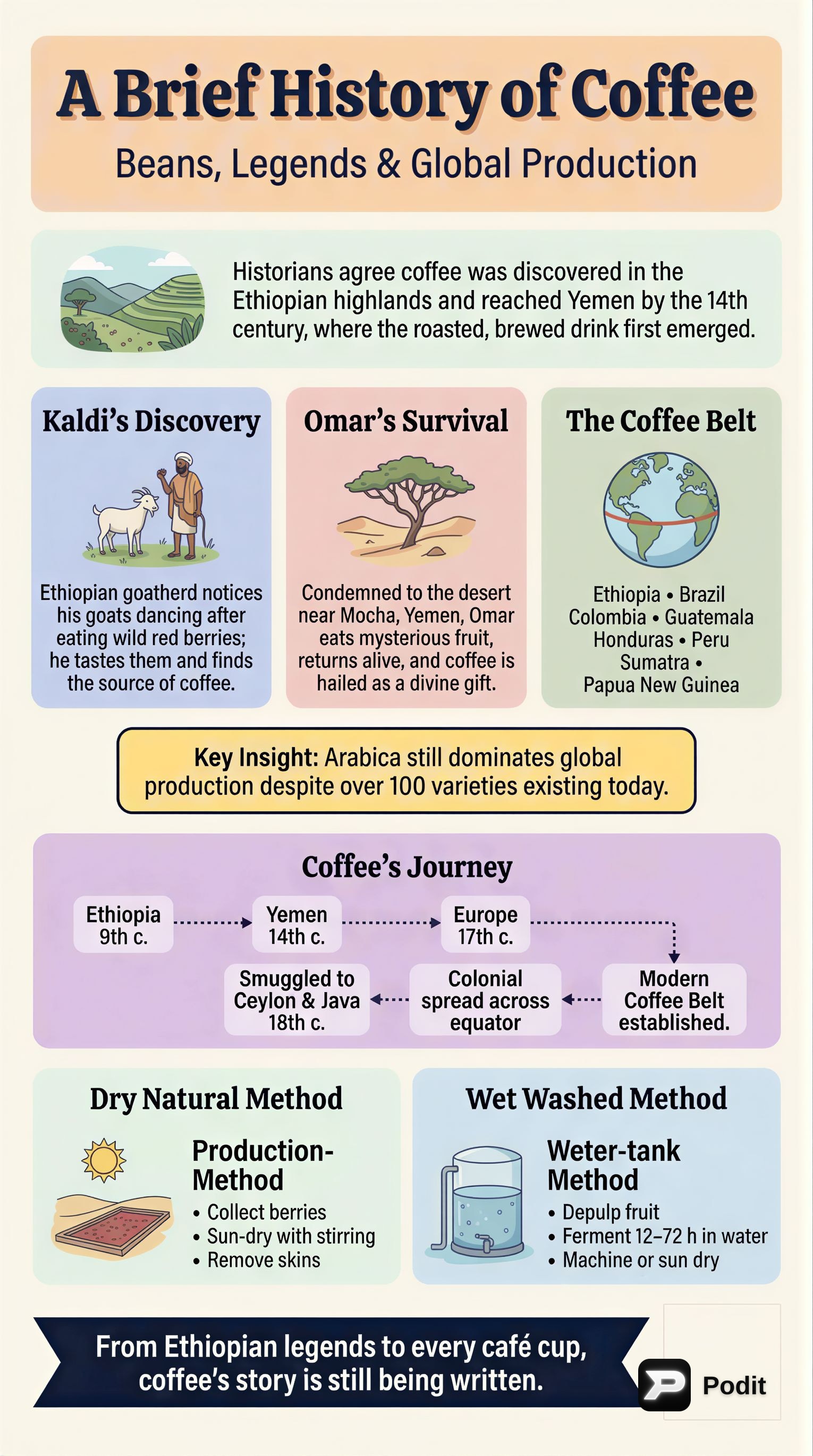
A Comprehensive Overview of Coffee: History, Production, & Types - görsel özet infografik
Tam boyutta görüntüle →
03

Flash Kartlar

25 kart

Karta tıklayarak çevir. ← → ile gez, ⎵ ile çevir.

1 / 25
Tüm kartları metin olarak gör
  1. 1. What is the primary socio-cultural significance of coffee mentioned in the text?

    Coffee holds significant socio-cultural importance across Africa, the Arabian Peninsula, and Anatolia. Its rich history is deeply intertwined with various narratives detailing its emergence and global dissemination, making it more than just a beverage but a cultural staple.

  2. 2. According to the most widely recounted narrative, who is credited with the discovery of coffee?

    The most widely recounted story attributes coffee's discovery to Kaldi, an Ethiopian goat herder. He observed his goats becoming unusually energetic after consuming wild fruits, and upon trying them himself, experienced a similar stimulating effect.

  3. 3. How did Kaldi's discovery lead to the first coffee beverage?

    After experiencing the stimulating effect of the wild fruits, Kaldi presented them to a Sufi leader. This leader then prepared the first coffee beverage by cooking and mixing the fruits with water, which was subsequently used in night prayers to maintain alertness.

  4. 4. Describe the second historical narrative concerning coffee's emergence, involving Omar.

    The second narrative involves Omar in Mocha, Yemen, who was condemned to the desert. In a state of delirium, he dreamt of a tree and was instructed to find it. Consuming its fruits enabled his survival and return, which was seen as a divine sign, popularizing coffee.

  5. 5. Where do historians generally agree coffee was first discovered and where did the practice of roasting and brewing originate?

    Historians generally agree coffee was discovered in the Ethiopian highlands. The practice of roasting, grinding, and brewing coffee, however, originated when it was introduced to Yemen around the 14th century.

  6. 6. What is the primary species of coffee mentioned that remains widely used today?

    The primary species mentioned is Coffee Arabica. Despite there being over 100 known varieties of coffee, Coffee Arabica remains the most widely used and recognized species globally due to its desirable characteristics.

  7. 7. What fueled the global expansion of coffee in the 17th century?

    The global expansion of coffee in the 17th century was fueled by surging European demand. Europeans also desired to bypass the Turkish and Arab trade monopoly, leading to efforts to cultivate coffee elsewhere to secure their own supply.

  8. 8. How did coffee cultivation spread beyond its original regions in the 18th century?

    An 18th-century Polish businessman successfully smuggled coffee plants, establishing cultivation in Ceylon and Java. This act initiated coffee's spread to colonial territories and the equatorial 'Coffee Belt,' diversifying its production locations.

  9. 9. Name some regions that are part of the equatorial 'Coffee Belt.'

    The equatorial 'Coffee Belt' encompasses regions like Ethiopia, Brazil, Sumatra, Peru, Honduras, Guatemala, and Colombia. These areas are characterized by suitable climates, including consistent temperatures and rainfall, which are ideal for coffee production.

  10. 10. Describe the dry (natural) method of coffee processing.

    The dry method involves collecting coffee berries and sun-drying them with continuous stirring. After drying, the outer skins are separated, and the raw beans are stored. While it can produce fruit flavors, it's less preferred today due to high labor and inconsistent results.

  11. 11. What are the main drawbacks of the dry (natural) method of coffee processing?

    The main drawbacks of the dry method include high labor requirements and inconsistent results. This inconsistency can potentially lead to undesirable aromas and flavors in the final product, making it less favored for specialty coffee production.

  12. 12. Explain the wet (washed) method of coffee processing.

    The wet method involves collecting coffee fruits, separating their peels, and then soaking the beans in water for 12-72 hours to separate them from the fruit pulp. After this soaking, the seeds are dried either by machine or under the sun, resulting in a cleaner flavor profile.

  13. 13. What are some hybrid coffee processing methods mentioned in the text?

    Hybrid coffee processing methods mentioned include semi-washed and Honey (Miel) methods. These methods combine aspects of both dry and wet processing, often involving partial removal of the fruit pulp before drying, and are particularly prevalent in regions like Brazil.

  14. 14. Why are green coffee beans stored before roasting, and when do their intense flavors develop?

    Green coffee beans are stored to preserve their aroma and maintain their quality before processing. Their characteristic intense flavors do not develop until the roasting process, which is a crucial stage for unlocking their full aromatic potential through chemical changes.

  15. 15. What is the importance of roasting in coffee production, and what chemical reactions occur?

    Roasting is a complex and crucial stage responsible for most of coffee's aromas. This high-temperature process initiates chemical reactions, primarily the Maillard reaction, among sugars, fats, and proteins, forming complex aromatic compounds that define the coffee's flavor.

  16. 16. Describe the temperature stages and aroma evolution during coffee roasting.

    Roasting starts around 260-270°C for a short phase (5-8 minutes), then reduces to 150-170°C for continued aroma development. Aroma evolution progresses from green and hay notes to bread, then to nutmeg, malt, caramel, and cocoa, reflecting the Maillard reaction's progression.

  17. 17. Why is grinding essential after roasting, and how does fineness vary?

    Grinding is essential after roasting because it increases the surface area of the coffee, allowing for efficient extraction of flavors during brewing. The fineness of the grind varies significantly depending on the chosen brewing method, as different methods require different particle sizes for optimal flavor extraction and contact time with water.

  18. 18. How does an Espresso Machine brew coffee, and when was it invented?

    An Espresso Machine, invented in the early 1900s, brews coffee by using pressurized hot water forced through finely ground coffee. This method results in an intense, concentrated flavor and a beverage with a rich crema, characteristic of espresso.

  19. 19. Explain the brewing mechanism of a Moka Pot.

    The Moka Pot, designed in 1933, uses steam pressure to force hot water from a lower chamber, through a filter basket containing coffee grounds, and into an upper chamber. The resulting coffee is strong and concentrated, suitable for fine to medium grounds.

  20. 20. What is the origin and characteristic outcome of the Pour Over brewing method?

    The Pour Over method, a 1908 German discovery, yields a lighter and cleaner coffee. It involves pouring hot water slowly and evenly over medium-fine to medium grounds placed in a paper filter, allowing for precise control over extraction and a nuanced cup.

  21. 21. Describe the French Press brewing method, including its origin and grind requirement.

    The French Press, with origins in the early 1800s, involves steeping coarsely ground coffee in hot water for several minutes. After steeping, a plunger with a mesh filter is used to separate the grounds from the liquid, resulting in a full-bodied coffee with sediment.

  22. 22. What is Cold Brew coffee, and when did it gain popularity?

    Cold Brew coffee, of Japanese origin, involves brewing extra-thick ground coffee with cold water over an extended period, typically 12-24 hours. This method gained significant popularity in the 1990s, producing a smooth, low-acid concentrate that can be diluted.

  23. 23. What criteria are assessed during coffee tasting, or cupping?

    During coffee tasting, also known as cupping, various criteria are assessed to evaluate the coffee's quality and characteristics. These include sweetness, acidity, mouthfeel (body), balance, and the overall flavor profile, allowing for a comprehensive evaluation.

  24. 24. Compare the caffeine content of Arabica and Robusta coffee varietals.

    Arabica coffee generally has less caffeine, typically about one-third of the caffeine content found in Robusta. Robusta is known for its significantly higher caffeine levels, which contribute to its more bitter and intense flavor profile.

  25. 25. What are the typical growing conditions and flavor profile of Arabica coffee?

    Arabica coffee is typically grown at high altitudes. Its flavor profile includes fruity, floral notes, mid-to-high body, medium-to-high acidity, a clean finish, and high sweetness, generally considered superior and more complex than Robusta.

04

Bilgini Test Et

15 soru

Çoktan seçmeli sorularla öğrendiklerini ölç. Cevap + açıklama.

Soru 1 / 15Skor: 0

According to the most widely recounted narrative, who is credited with the discovery of coffee?

05

Detaylı Özet

7 dk okuma

Tüm konuyu derinlemesine, başlık başlık.

Coffee: A Comprehensive Study Guide ☕

This study material compiles information from a lecture audio transcript and copy-pasted text, providing a structured overview of coffee's history, production, and characteristics.


📚 Introduction to Coffee's Significance

Coffee is more than just a beverage; it holds profound socio-cultural importance across Africa, the Arabian Peninsula, and Anatolia. Its rich history is interwoven with captivating narratives of discovery and global dissemination. This guide explores coffee's foundational stories, its journey from origin to widespread cultivation, diverse production and preparation methods, and the distinct characteristics of its primary varietals.


🌍 The Historical Journey of Coffee

The origins of coffee are steeped in legend, with two primary narratives often recounted, both set in similar geographical regions.

1. The Kaldi Legend (Ethiopia)

Discovery: The most widely told story attributes coffee's discovery to Kaldi, an Ethiopian goat herder in the mountainous regions. 🐐 Observation: Kaldi noticed his goats exhibiting unusual energy and "dancing" after consuming wild red berries from a particular plant. 💡 Experimentation: Curious, Kaldi tried the fruits himself and experienced a similar stimulating effect, becoming the first human to discover coffee's invigorating properties. 🙏 Spiritual Connection: He then collected these fruits and presented them to a Sufi leader. The leader cooked the fruits and mixed them with water, creating the first coffee beverage. 🌙 Purpose: This stimulating drink was subsequently used during night prayers to help devotees stay awake and alert. 🗺️ Early Spread: From Ethiopia, coffee spread through Yemen, the Arabian Peninsula, the Mediterranean, and eventually reached Anatolia and Europe.

2. The Omar Legend (Yemen)

🏜️ Exile: In the city of Mocha, Yemen, a man named Omar was condemned to starve in the desert. 🌳 Divine Intervention: Fainting from hunger and heat, Omar dreamt of a tree and heard a voice instructing him to find it. 🍎 Survival: He found the tree, ate its fruits, and survived, returning to his people. ✨ Sign of Allah: The fruit that saved him was seen as a divine sign, leading to the popularization of coffee drinking. ⚕️ Medicinal Use: Some accounts also suggest Omar, who was a healer, used coffee as medicine after he was pardoned.

Historical Consensus

Historians generally agree that coffee was first discovered in the Ethiopian highlands and later introduced to Yemen around the 14th century. It was in Yemen that the practice of roasting, grinding, and brewing coffee as we know it today truly emerged. The coffee mentioned in these early stories is primarily Coffee Arabica, which remains one of the most widely used beans despite over 100 known herbal varieties.


🌐 Coffee's Global Expansion & The Coffee Belt

The 17th century marked a significant turning point for coffee as its popularity surged in Europe. This increased demand, coupled with Europe's desire to circumvent the near-monopoly held by Turkish and Arab traders, spurred its global spread.

The Journey to New Lands

1️⃣ Smuggling: In the 18th century, a Polish businessman successfully smuggled coffee plants out of the Arabian Peninsula. 2️⃣ Cultivation: These plants were first successfully cultivated in Ceylon (now Sri Lanka) and Java (Indonesia). 3️⃣ Colonial Spread: From these initial successful plantings, coffee was carried to various colonial countries and eventually established itself across the equatorial region.

The Coffee Belt 🗺️

This equatorial region, known as the Coffee Belt, is where the vast majority of the world's coffee production is concentrated due to its ideal climate and altitude. ✅ Key Coffee Belt Countries:

  • Ethiopia
  • Brazil
  • Sumatra (Indonesia)
  • Peru
  • Papua New Guinea
  • Honduras
  • Guatemala
  • Colombia

⚙️ Coffee Production Stages

Coffee production involves several critical stages, from harvesting the cherries to preparing the beans for roasting.

1. Harvesting & Processing Methods

Coffee cherries are harvested, and the beans are extracted using two primary methods:

a. Dry (Natural) Method ☀️

This is the oldest and simplest method, requiring significant labor and specific weather conditions. 1️⃣ Collection: Coffee berries are collected. 2️⃣ Drying: The fruits are spread out in the sun and continuously stirred to ensure even drying. 3️⃣ Separation: Once dry, the outer skins and pulp are mechanically separated from the coffee beans. 4️⃣ Storage: The raw, green coffee beans are then stored. ⚠️ Considerations: While this method can impart desirable fruit flavors (e.g., blueberry, strawberry), it is less preferred today due to high labor requirements and potential for inconsistent results, which can lead to undesirable aromas like mold or fermentation if not managed carefully.

b. Wet (Washed) Method 💧

This method generally produces cleaner, brighter coffee flavors. 1️⃣ Collection: Fruits are collected. 2️⃣ Pulping: The outer peels are separated from the fruit, usually by machine. 3️⃣ Fermentation: The coffee beans, still covered in mucilage, are kept in water for 12-72 hours. This process allows enzymes to break down the mucilage, separating the bean from the fruit. 4️⃣ Drying: The cleaned seeds are then dried, either by machine or by spreading them in the sun.

c. Hybrid Methods

These methods combine aspects of both dry and wet processing to achieve specific flavor profiles.

  • Semi-washed method
  • Honey (Miel) Method: Particularly popular in Brazil, this method leaves some of the mucilage on the bean during drying, imparting sweetness and body.

2. Roasting ♨️

Green coffee beans have a slightly fruity, often "green" flavor and do not possess the intense aromas we associate with coffee until roasted. Roasting is a complex and crucial step responsible for most of coffee's final aroma and flavor. 🔥 High-Temperature Process: Roasting typically begins at around 260-270°C. ⏳ Initial Phase (5-8 minutes): At this stage, sugars, fats, and proteins within the bean undergo complex chemical reactions, initiating aroma development. 🌡️ Secondary Phase: The temperature is then reduced to 150-170°C, allowing further aroma development. 👃 Aroma Transformation (Maillard Reaction): The aroma profile evolves significantly:

  • Green/Hay notes ➡️ Bread notes ➡️ Nutmeg, malt, caramel, cocoa notes. 💡 Control: Controlling these reactions is key to distinguishing good coffee from bad.

3. Grinding ⚙️

After roasting, coffee beans are stored in their whole form to preserve aroma. Grinding is performed just before brewing, and the fineness of the grind is critical, varying significantly depending on the brewing method.


☕ Coffee Brewing Methods

The same coffee bean can yield coffees with vastly different textures and aromas depending on the brewing technique, roasting, and grinding. Over the years, numerous methods have evolved.

  • Espresso Machine 🚀
    • Origin: Early 1900s.
    • Process: Passes pressurized hot water through finely ground coffee.
    • Result: Produces intensely fragrant and aromatic coffees, forming the base for many modern coffee drinks.
  • Moka Pot 🇮🇹
    • Origin: Designed by Italian engineer Bialetti in 1933.
    • Process: Water in the lower chamber boils, creating pressure that forces hot water through a filter basket of coffee into the upper chamber.
    • Grind: Suitable for fine to medium-ground coffee.
  • Pour Over 🇩🇪
    • Origin: Discovered in Germany in 1908.
    • Process: Hot water is poured over coffee grounds in a filter cone, allowing the coffee to drip through a paper filter into a vessel below.
    • Result: Produces a lighter-tasting coffee.
    • Grind: Suitable for medium-fine to medium-ground coffee.
  • French Press 🇫🇷🇮🇹
    • Origin: History shared between France (early 1800s) and Italy (patented 1929).
    • Process: Coarsely ground coffee is steeped in hot water, then a plunger with a mesh filter is pressed down to separate the grounds from the brewed coffee.
    • Grind: Requires thick (coarse) ground coffee.
  • Cold Brew 🇯🇵
    • Origin: First examples developed in Japan, based on cold tea brewing. Popularized in the US in the 1990s.
    • Process: Extra-thick (coarse) ground coffee is steeped in cold water for an extended period (12-24 hours).
    • Result: Produces a less acidic, smoother coffee concentrate.

📊 Coffee Tasting (Cupping) & Varietals

Cupping is a systematic method used to evaluate coffee's sensory characteristics. ✅ Features Examined:

  • Sweetness
  • Acidity
  • Mouthfeel (Palate Feeling)
  • Balance
  • Flavor (Taste & Aroma)

Key Coffee Varietals

1. Arabica 🍒

Generally considered superior in quality, Arabica accounts for about 60% of the world's coffee production.

  • Caffeine Content: Lower caffeine (approximately 1/3 of Robusta).
  • Growing Conditions: Typically grown at high altitudes.
  • Acidity: Generally less acidic than Robusta, with a long, clean finish.
  • General Profile:
    • Fruity (berry, tropical fruit, dried fruit) 🍓🍍
    • Floral 🌸
    • Mid-to-high body
    • Medium-to-high acidity
    • Clean finish (aftertaste)
    • High sweetness

2. Robusta 🌰

Known for its hardiness and higher caffeine content.

  • Caffeine Content: High caffeine.
  • Growing Conditions: Can grow in hotter climates and lower altitudes.
  • Acidity: High sourness and bitterness.
  • General Profile:
    • Earthy flavors (mushroom, cocoa, raw almond) 🍄🍫
    • High sourness
    • High bitterness
    • High body

✨ Conclusion

From its mythical origins in the Ethiopian highlands and Yemen to its global cultivation across the Coffee Belt, coffee's journey is a testament to its enduring appeal. The intricate processes of dry and wet production, the transformative art of roasting, and the diverse array of brewing methods all contribute to the complex aromatic profiles that make coffee a globally cherished beverage. Understanding the distinct characteristics of varietals like Arabica and Robusta further enriches the appreciation for this remarkable drink.

Kendi çalışma materyalini oluştur

PDF, YouTube videosu veya herhangi bir konuyu dakikalar içinde podcast, özet, flash kart ve quiz'e dönüştür. 1.000.000+ kullanıcı tercih ediyor.

Sıradaki Konular

Tümünü keşfet
The History, Production, and Characteristics of Coffee

The History, Production, and Characteristics of Coffee

This summary explores the historical origins of coffee, its global journey, diverse production and brewing methods, and the distinct characteristics of Arabica and Robusta beans.

8 dk Özet 25 15 Görsel
Tea: Plant, Production, and Types

Tea: Plant, Production, and Types

An academic overview of the Camellia Sinensis plant, the diverse methods of tea production, including CTC and orthodox processes, and a detailed classification of various tea types such as green, black, oolong, white, Pu'er, and yellow teas.

6 dk Özet 25 15 Görsel
Whiskey Production and Classification

Whiskey Production and Classification

This summary details the intricate processes of whiskey production, from malting to aging, and explores its diverse classifications based on grain, region, and blending techniques.

5 dk Özet 25 15 Görsel
Beer and Food Pairings: Characteristics and Principles

Beer and Food Pairings: Characteristics and Principles

This summary explores beer and food pairing, detailing beer characteristics like color, body, and carbonation, and outlining pairing principles for various Ale and Lager types.

6 dk Özet 25 15 Görsel
White Noble Grapes and Essential Wine Concepts

White Noble Grapes and Essential Wine Concepts

An academic overview of key white noble grape varieties, their characteristics, aroma profiles, food pairings, and fundamental wine terminology.

9 dk Özet 25 15 Görsel
Ottoman Culture and Civilization: State & Society

Ottoman Culture and Civilization: State & Society

Explore the sophisticated administrative structures, legal system, and unique social organization of the Ottoman Empire, focusing on its enduring cultural and civilizational aspects.

15 Görsel
The Ottoman Empire's Decline in the 18th Century

The Ottoman Empire's Decline in the 18th Century

An academic overview of the Ottoman Empire's period of decline during the 18th century, examining key internal and external factors and significant events.

4 dk Özet 25 15
Comprehensive Guide to Beverages: Distillation, Production, and Pairing

Comprehensive Guide to Beverages: Distillation, Production, and Pairing

Explore the intricate world of beverages, from the science of distillation and diverse production methods of spirits, coffee, and tea, to the emerging trends in functional drinks and the art of food pairing.

10 dk Özet 25 15