Tea: Plant, Production, and Types - kapak
Yemek#tea#camellia sinensis#tea production#tea types

Tea: Plant, Production, and Types

An academic overview of the Camellia Sinensis plant, the diverse methods of tea production, including CTC and orthodox processes, and a detailed classification of various tea types such as green, black, oolong, white, Pu'er, and yellow teas.

dionimeyziJuly 4, 2026 ~23 dk toplam
01

Sesli Özet

7 dakika

Konuyu otobüste, koşarken, yolda dinleyerek öğren.

Sesli Özet

Tea: Plant, Production, and Types

0:006:33
02

Görsel Özet

İnfografik

Konunun tüm parçalarını tek bakışta gör.

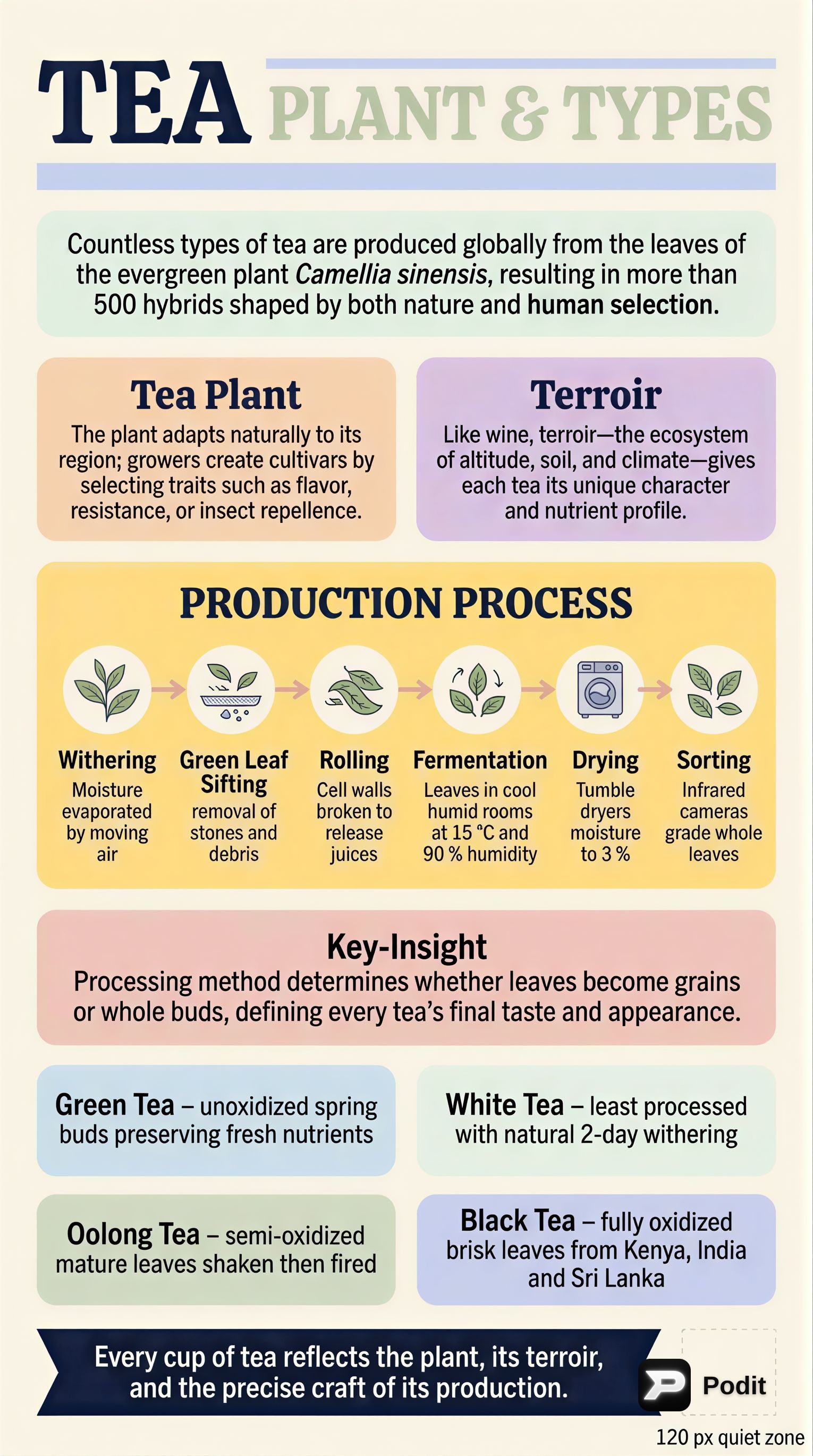
Tea: Plant, Production, and Types - görsel özet infografik
Tam boyutta görüntüle →
03

Flash Kartlar

25 kart

Karta tıklayarak çevir. ← → ile gez, ⎵ ile çevir.

1 / 25
Tüm kartları metin olarak gör
  1. 1. From which single plant species do all tea varieties originate?

    All tea varieties, despite their diverse appearances and flavors, originate from the evergreen plant known as Camellia Sinensis. This foundational plant is the source of all teas, from green to black, and its inherent characteristics are the starting point for all tea production.

  2. 2. How many hybrids of Camellia Sinensis have been developed through natural adaptation and human intervention?

    Over 500 hybrids of the Camellia Sinensis plant have been developed. This extensive development is a result of both natural adaptation to various environments and deliberate human intervention, where growers select plants with desirable traits to create new varieties.

  3. 3. What is the significance of the tea plant's adaptability?

    The tea plant's remarkable ability to adapt to its ambient conditions makes it inherently suited to specific growing regions. This adaptability allows it to thrive in diverse environments, contributing to the unique characteristics and flavors found in teas from different parts of the world.

  4. 4. Define "cultivars" in the context of tea plants.

    Cultivars, or cultivated varieties, are specific types of tea plants developed by growers. These growers select plants that exhibit desirable traits, such as unique flavor profiles, resilience to drought, or resistance to pests, to propagate and cultivate for specific tea production.

  5. 5. Explain the concept of "terroir" in tea production.

    Terroir in tea production refers to the interdependent environmental conditions that significantly influence a tea's character, similar to its role in wine. It encompasses factors like altitude, soil composition, and climatic conditions, all of which shape the development and quality of the tea leaves, affecting their flavor, character, and nutritional content.

  6. 6. What are the two primary methods employed in factory tea production?

    The two primary methods employed in factory tea production are the CTC (Crush, Tear, Curl) method and the orthodox method. These distinct processes largely dictate the final form and characteristics of the tea leaves, leading to different tea types and qualities.

  7. 7. Describe the CTC (Crush, Tear, Curl) method of tea production.

    The CTC method, introduced in the 1930s, uses industrial machinery to process tea leaves. It involves blade-slicing, crushing, and bruising larger, lower-grade leaves to accelerate oxidation, followed by machine-rolling them into small, uniform grains. This method is primarily used for black tea, especially commodity tea, and is common in regions like Sri Lanka, Kenya, and parts of India.

  8. 8. What is the general characteristic of the orthodox method compared to the CTC method?

    The orthodox method generally involves a more traditional and less mechanized approach to tea production compared to the CTC method. It typically results in more whole-leaf teas, indicating a higher grade, and allows for more nuanced control over the oxidation process, contributing to a wider range of complex flavors and aromas.

  9. 9. List the main steps involved in CTC tea manufacture.

    The main steps in CTC tea manufacture include withering, green leaf sifting, rolling, fermentation (oxidation), drying, grading, sorting, and packing. Each step plays a crucial role in transforming the fresh tea leaves into the final product, influencing its texture, flavor, and shelf life.

  10. 10. What is the purpose of "withering" in tea production?

    Withering is a crucial step in tea production that involves reducing the moisture content of the tea leaves. This is typically achieved by blowing air over the leaves, making them pliable and preparing them for subsequent processing steps like rolling, which would otherwise cause them to crumble.

  11. 11. Why is "green leaf sifting" performed in tea manufacture?

    Green leaf sifting is performed to remove extraneous materials from the tea leaves before further processing. This step is essential to prevent damage to the machinery used in subsequent stages, ensuring smooth and efficient production while maintaining the quality of the tea.

  12. 12. Explain the purpose of "rolling" for different tea types.

    Rolling serves different purposes depending on the tea type. For oolong and black teas, it shapes the leaves, breaks cell walls, and prepares them for optimal oxidation. For green and yellow teas, rolling brings aromatic compounds to the surface, enhancing their natural fragrances.

  13. 13. What is "fixing" (or 'kill green') and why is it applied to green and yellow teas?

    Fixing, also known as 'kill green,' is a process applied to green and yellow teas, typically by pan-firing or steaming. Its purpose is to quickly destroy the enzymes in the tea leaves, thereby preventing oxidation. This crucial step helps preserve the volatile oils and aromas, maintaining the tea's fresh, green character.

  14. 14. Describe the process of "fermentation" (oxidation) in tea production and its impact.

    Fermentation, or oxidation, is a critical stage where enzymes in the tea leaf transform into theaflavins and thearubigins. Theaflavins contribute to taste, while thearubigins influence color. This process occurs in cool, moist, darkened rooms under controlled temperature and humidity, and its duration determines the tea's classification as non-fermented, semi-fermented, fully-fermented, or post-fermented.

  15. 15. What is the primary goal of the "drying" stage in tea processing?

    The primary goal of the drying stage in tea processing is to reduce the leaf's moisture content to approximately three percent. This step halts further oxidation and prevents spoilage, making the tea stable for storage. Traditionally done over charcoal, it is now primarily achieved using tumble dryers.

  16. 16. What is the significance of "sorting" in tea production, especially for orthodox tea?

    Sorting, done either by hand or machine, separates tea leaves by size and removes unwanted elements. For orthodox tea, well-produced varieties feature more whole leaves, which is indicative of a higher grade and quality. This step ensures uniformity and enhances the aesthetic appeal of the final product.

  17. 17. How are teas broadly categorized based on their processing?

    Teas are broadly categorized based on their processing methods and their level of oxidation. This classification system helps distinguish between major types like green, white, oolong, and black teas, each having unique characteristics resulting from how they are processed after plucking.

  18. 18. Describe the characteristics of "green tea."

    Green tea is characterized by being unoxidized, meaning it closely resembles the freshly plucked leaf. It retains abundant nutrients and typically has a fresh, sometimes grassy or vegetal flavor. Its processing involves fixing (kill green) to prevent oxidation, preserving its natural color and delicate aromas.

  19. 19. What is "crude tea"?

    Crude tea refers to tea leaves where enzymatic oxidation has been halted, and their moisture content has been reduced. This processing makes the leaves suitable for storage and further processing into various tea types, ensuring their stability and preventing spoilage.

  20. 20. What is "Matcha" and what are its key characteristics?

    Matcha is a Japanese green tea that is finely powdered, known for its vibrant green color and a slightly bitter, vegetal taste. It is central to traditional Japanese tea ceremonies and is prepared by whisking the powder with hot water, resulting in a frothy beverage.

  21. 21. Describe "white tea" and its processing.

    White tea, primarily from China's Fujian province, is the least processed tea. It undergoes a long natural withering process and minimal oxidation before being baked. Varieties range from tender leaves with fine white fuzz, known as 'pekoe,' to larger, slightly more oxidized leaves, offering delicate and subtle flavors.

  22. 22. What are the characteristics and processing of "Oolong tea"?

    Oolong tea is a semi-oxidized variety, mainly from Fujian and Taiwan. Its rigorous process involves withering mature leaves, then 'rattling' or shaking them to bruise them, aiding flavor release during a controlled oxidation that can last for hours. The leaves are then fired, rolled, and often roasted, resulting in forms from small pellets to long, twisted leaves.

  23. 23. Describe "black tea," its characteristics, and notable types.

    Black tea is a fully oxidized tea, produced globally in regions like Kenya, Sri Lanka, China, and India. It is characterized by brisk, malty, full-bodied flavors and is often used in tea bags and blends. The Chinese refer to it as 'red tea' due to the liquid's color, and notable types include Ceylon, Assam, and Darjeeling.

  24. 24. What makes "Lapsang Souchong" a distinct black tea?

    Lapsang Souchong is a distinct black tea known for its unique smoky flavor. This characteristic is achieved by smoking the tea over a fire, with the intensity of the smoke aroma adjusted by the proximity of the leaves to the heat source during processing.

  25. 25. Explain "Pu'er tea" (dark tea) and its two main forms.

    Pu'er tea, or dark tea, from China's Yunnan province, is post-fermented and contains probiotic microorganisms, often consumed for digestive and immune benefits. It is steamed and formed into cakes. 'Sheng' Pu'er ferments naturally over years, while 'shou' Pu'er undergoes accelerated fermentation in controlled environments.

04

Bilgini Test Et

15 soru

Çoktan seçmeli sorularla öğrendiklerini ölç. Cevap + açıklama.

Soru 1 / 15Skor: 0

What is the scientific name for the evergreen plant from which all tea varieties originate?

05

Detaylı Özet

6 dk okuma

Tüm konuyu derinlemesine, başlık başlık.

📚 Comprehensive Study Guide: The World of Tea - Plant, Production, and Types


Source Information: This study material has been compiled from a combination of copy-pasted text and a lecture audio transcript.


🌿 Introduction to Tea: The Versatile Camellia Sinensis

Tea, a globally cherished beverage, comes in countless varieties, each with distinct flavors and appearances. Despite this diversity, all true teas originate from a single evergreen plant species: Camellia Sinensis. This remarkable plant has adapted naturally to various environments, and through human intervention, over 500 hybrids have been developed.

1. The Tea Plant: Camellia Sinensis

Origin: All tea types are derived from the leaves of Camellia Sinensis. ✅ Adaptability: The tea plant naturally adapts to its ambient conditions, making it well-suited to specific growing regions. ✅ Cultivars: Growers develop "cultivars" (cultivated varieties) by selecting plants with desirable traits, such as unique flavor profiles, drought resistance, or insect repellence.

2. Terroir: The Ecosystem's Influence

💡 Just like wine, each tea possesses a unique character influenced by its growing environment. This concept is known as terroir.

📚 Terroir Definition: The interdependent conditions of an ecosystem in which the tea plant is grown. These natural factors profoundly influence the tea's development and quality:

  • Altitude: Higher altitudes can lead to slower growth and more concentrated flavors.
  • Soil Composition: Mineral content and pH of the soil affect nutrient uptake.
  • Climatic Conditions: Temperature, rainfall, humidity, and sunlight exposure all shape the flavor, character, and chemical composition (vitamins, minerals, compounds) of the leaves.

🏭 Tea Production Processes: Shaping Flavor and Form

The method of production significantly determines the final characteristics of tea leaves. Two primary factory methods exist: the CTC method and the Orthodox method, alongside various traditional techniques.

1. The CTC (Crush, Tear, Curl) Method

Invented in the 1930s, the CTC method uses industrial machinery to process tea leaves, primarily for black tea production, especially commodity tea for commercial uses.

1️⃣ Blade-Slicing & Crushing: Large, thick, lower-grade leaves are blade-sliced, crushed, and bruised. This process speeds up oxidation. 2️⃣ Machine-Rolling: The leaves are then machine-rolled into tiny, uniform grains. 3️⃣ Oxidation: These grains undergo oxidation. 4️⃣ Prevalence: This method is common in Sri Lanka, Kenya, and parts of India, but not typically in China. 5️⃣ Steps in CTC Manufacture: * Withering of harvested crop * Green leaf sifting * Rolling * Fermentation (Oxidation) * Drying, grading * Sorting and packing

2. General Processing Stages (Often Associated with Orthodox Methods)

These stages are common in tea production, particularly for Orthodox teas, and their execution varies significantly depending on the desired tea type.

  • Withering:
    • Purpose: To reduce moisture content in the green leaf.
    • Process: Air is blown or moved over the leaves in a withering trough, causing evaporation.
  • Green Leaf Sifting:
    • Purpose: To remove extraneous matter (stones, sand, metal) that could damage machinery.
  • Rolling:
    • Purpose: To shape the leaves (rolled, twisted, curled) and break down cell walls.
    • Effect: This releases tea juices, condenses flavors, and prepares the leaf for optimal oxidation (for oolong and black teas) or brings aromatics to the surface (for green and yellow teas).
  • Fixing (Kill Green):
    • Application: Exclusively for green and yellow teas.
    • Process: Leaves are quickly subjected to high heat (e.g., pan-firing) to destroy enzymes and prevent oxidation.
    • Result: Preserves the leaves' aromas and volatile oils.
  • Oxidation (Fermentation):
    • Process: Enzymes in the leaf transform into theaflavins (contributing to taste) and thearubigins (contributing to color).
    • Conditions: Leaves are spread on flat surfaces in cool, moist, darkened rooms (e.g., 15°C, 90% humidity). Aluminum or wood surfaces are preferred to avoid chemical reactions.
    • Duration: Can last from 45 minutes to several hours, depending on the desired level of oxidation.
    • Classification: Teas are classified by their degree of oxidation:
      • Non- and Light-Fermented (e.g., Green, White)
      • Semi-Fermented (e.g., Oolong)
      • Fully-Fermented (e.g., Black)
      • Post-Fermented (e.g., Pu'er)
  • Drying:
    • Purpose: To reduce moisture content to about 3% to prevent spoilage.
    • Methods: Traditionally done over charcoal (e.g., Lapsang Souchong, Long Jing), but now mostly in tumble dryers.
  • Sorting:
    • Process: Leaves are sorted by hand or machine (sometimes using infrared cameras) into grades, separating whole leaves from smaller pieces and removing stems.
    • Quality Indicator: Well-produced orthodox tea has more whole leaves, indicating a higher grade.

🍵 Diverse Tea Types: A World of Flavors

Teas are primarily categorized by their processing methods and level of oxidation.

1. Green Tea

  • Oxidation: Unoxidized.
  • Characteristics: Closely resembles the original plucked leaf, retaining abundant nutrients and oils.
  • Crude Tea: Refers to tea leaves where enzymatic oxidation has been halted, and moisture reduced for storage.
  • Matcha: A Japanese green tea powder made from finely ground dried green tea leaves. It has a vibrant green color (high chlorophyll) and a slightly bitter, vegetal taste. Central to traditional Japanese tea ceremonies.

2. White Tea

  • Oxidation: Least processed, with slight natural oxidation from a long withering process.
  • Production: Mostly in China's Fujian province. Takes 2-3 days to produce.
  • Process: Long natural withering (about 2 days), baked at low heat, sorted, and baked again.
  • Types: Some are made from tender leaves and buds with fine white fuzz ("pekoe"), others from larger, slightly more oxidized leaves.

3. Oolong Tea

  • Oxidation: Semi-oxidized.
  • Production: China's Fujian province (Wuyi Mountains) and Taiwan's mountainsides.
  • Process: Mature leaves are withered, then "rattled" or shaken to bruise them and break cell walls, aiding flavor release during controlled oxidation. Oxidation can last for hours. Leaves are then fired, rolled, and often roasted.
  • Appearance: Lightly oxidized oolongs are small, shiny, dark-green pellets; heavily oxidized oolongs are long, dark, twisted leaves.

4. Black Tea

  • Oxidation: Fully oxidized.
  • Production: Kenya, Sri Lanka, China, India.
  • Characteristics: Brisk, malty, full-bodied, and bracing due to rich flavors developed during oxidation. Often used in tea bags and blends (e.g., breakfast, afternoon teas).
  • Terminology: Chinese refer to black teas as "red teas" due to the liquid's color.
  • Major Types: Ceylon (Sri Lanka), Assam (India), Darjeeling (India).
  • Lapsang Souchong: A distinct black tea where leaves are smoked over a fire, either cold-smoked during processing or hot-smoked after processing. The intensity of the smoke aroma is controlled by proximity to the heat source and duration.

5. Pu'er Tea (Dark Tea)

  • Oxidation: Post-fermented.
  • Production: Yunnan province, China.
  • Characteristics: Contains probiotic microorganisms, aiding digestion and promoting a healthy immune system. Often consumed for weight loss.
  • Process: After rolling, steamed and formed into cakes for fermentation.
  • Types:
    • Sheng (raw) Pu'er: Left to ferment naturally over many years, culturing microorganisms slowly.
    • Shou (ripe) Pu'er: Fermented or aged over several months in humidity-controlled storage facilities.

6. Yellow Tea

  • Oxidation: Unique "yellowing" process.
  • Production: Rare, produced in only a few areas of China (e.g., Hunan, Sichuan provinces).
  • Characteristics: Fresh and delicate flavor, named for the slight yellow cast of the leaf. Best grades come from leaves harvested early in spring.

7. Other Teas

  • Blooming Tea (Flower Tea): Consists of fresh flowers encased in white tea leaves. When steeped, the compact balls unfurl to reveal the flowers within, creating an aesthetic display.

📊 Conclusion: The Intricate World of Tea

The vast array of tea types available globally all stem from the single species, Camellia Sinensis. The plant's inherent adaptability, combined with human cultivation and the unique environmental conditions of its terroir, contributes significantly to its diverse characteristics. Furthermore, the intricate and varied production methodologies—from the industrial CTC process to the nuanced Orthodox methods involving precise control over withering, oxidation, and drying—are critical in shaping the final flavor, aroma, and appearance of teas. This complex interplay of genetics, environment, and processing techniques underscores the rich diversity and profound artistry found within the world of tea.

Kendi çalışma materyalini oluştur

PDF, YouTube videosu veya herhangi bir konuyu dakikalar içinde podcast, özet, flash kart ve quiz'e dönüştür. 1.000.000+ kullanıcı tercih ediyor.

Sıradaki Konular

Tümünü keşfet
The History, Production, and Characteristics of Coffee

The History, Production, and Characteristics of Coffee

This summary explores the historical origins of coffee, its global journey, diverse production and brewing methods, and the distinct characteristics of Arabica and Robusta beans.

8 dk Özet 25 15 Görsel
A Comprehensive Overview of Coffee: History, Production, & Types

A Comprehensive Overview of Coffee: History, Production, & Types

This summary explores coffee's historical origins, global expansion, diverse production methods, various brewing techniques, and the distinct characteristics of Arabica and Robusta varietals.

6 dk Özet 25 15 Görsel
Whiskey Production and Classification

Whiskey Production and Classification

This summary details the intricate processes of whiskey production, from malting to aging, and explores its diverse classifications based on grain, region, and blending techniques.

5 dk Özet 25 15 Görsel
Beer and Food Pairings: Characteristics and Principles

Beer and Food Pairings: Characteristics and Principles

This summary explores beer and food pairing, detailing beer characteristics like color, body, and carbonation, and outlining pairing principles for various Ale and Lager types.

6 dk Özet 25 15 Görsel
White Noble Grapes and Essential Wine Concepts

White Noble Grapes and Essential Wine Concepts

An academic overview of key white noble grape varieties, their characteristics, aroma profiles, food pairings, and fundamental wine terminology.

9 dk Özet 25 15 Görsel
Comprehensive Guide to Beverages: Distillation, Production, and Pairing

Comprehensive Guide to Beverages: Distillation, Production, and Pairing

Explore the intricate world of beverages, from the science of distillation and diverse production methods of spirits, coffee, and tea, to the emerging trends in functional drinks and the art of food pairing.

10 dk Özet 25 15
Functional Beverages: Trends, Categories, and Science

Functional Beverages: Trends, Categories, and Science

An academic overview of functional beverages, covering their definition, market landscape, key categories, specific examples like energy and sports drinks, probiotic options, and emerging market trends.

5 dk Özet 25 15 Görsel
Early Turkic States: Origins and Empires

Early Turkic States: Origins and Empires

This academic summary explores the foundational early Turkic states, examining their origins, political structures, cultural contributions, and historical impact across Central Asia and Eurasia.

10 dk Özet 25 15 Görsel