Podit
Podit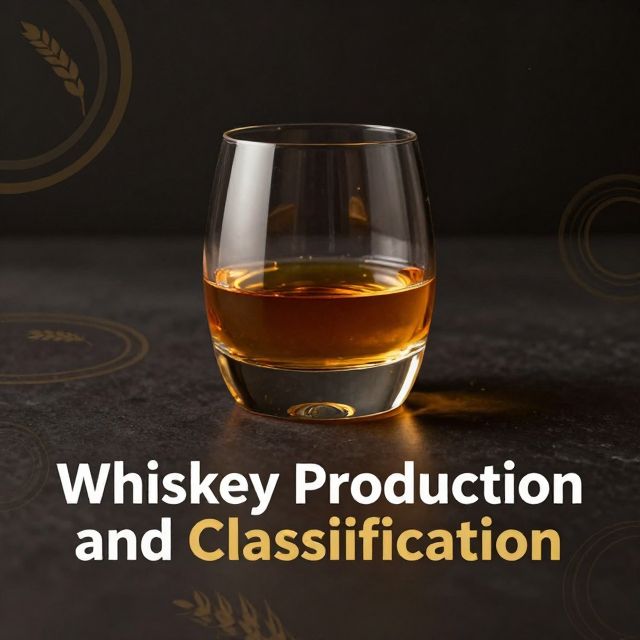
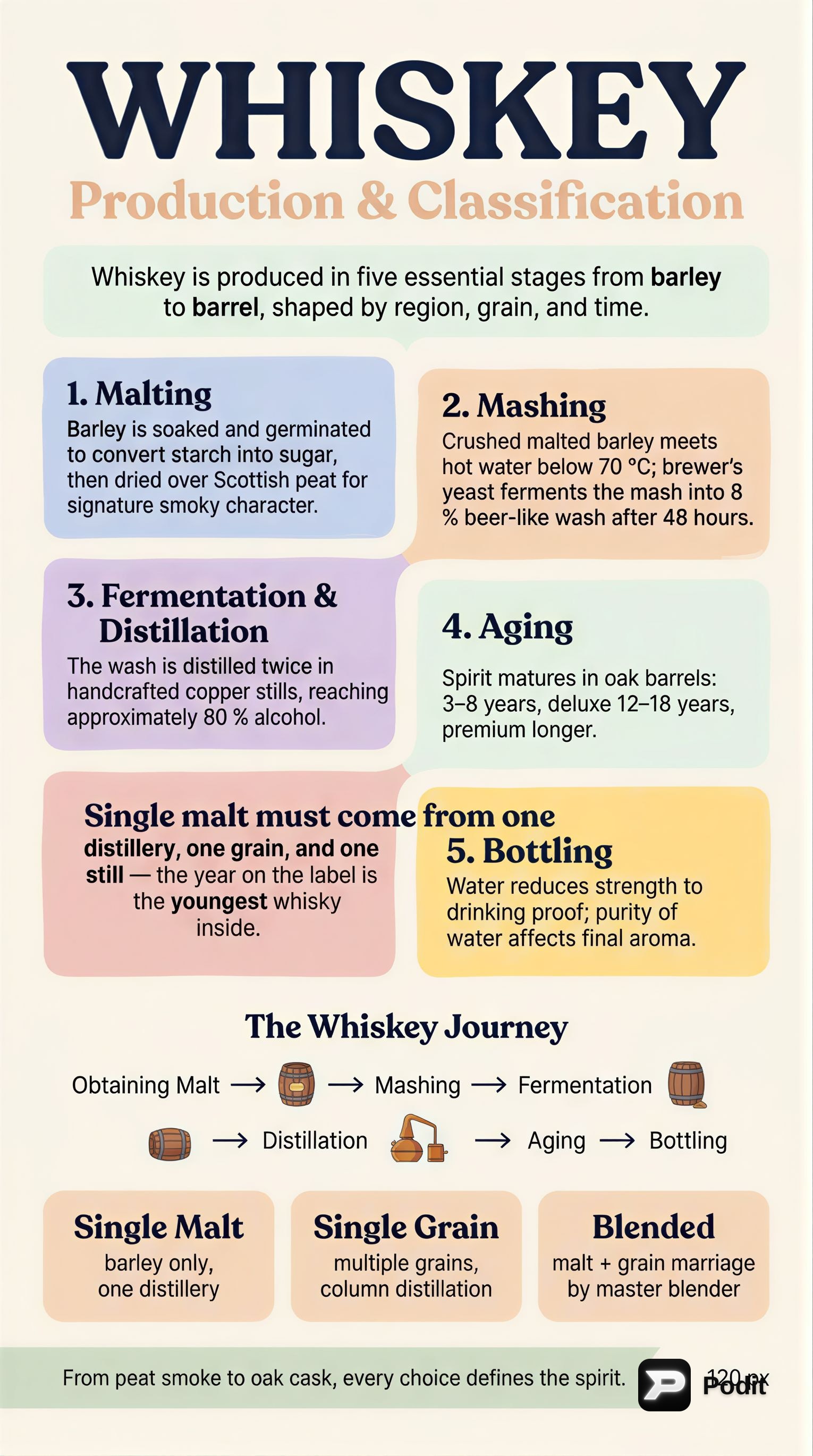
This study material provides a comprehensive overview of whiskey production and classification, drawing information from a copy-pasted text and a lecture audio transcript.
📚 Whiskey: Production & Classification Study Guide
Whiskey, a globally renowned spirit, is the result of a meticulous production process and is categorized by its ingredients, manufacturing methods, and geographical origin. Understanding whiskey involves delving into its creation stages and the diverse types that have evolved across different regions.
1. 🌾 Whiskey Production Process
Whiskey production is a five-stage journey that transforms grains into a complex spirit.
1.1. Malting
The foundational raw material for most whiskeys is barley. ✅ Purpose: To convert starch in barley into simple sugars, essential for fermentation. 1️⃣ Soaking: Barley is soaked in water to initiate germination (sprouting). 2️⃣ Drying (Scotland Specific): In Scotland, after sprouting, barley is dried in ovens called 'kilns' using 'peat' charcoal. * ⚠️ Peat's low-calorie fire halts germination and infuses the barley with a distinctive smoky aroma, a hallmark of Scotch whisky. * 💡 While malt whiskeys use only barley, grain whiskeys can incorporate other cereals.
1.2. Mashing
After malting, the barley is prepared for sugar extraction. 1️⃣ Crushing & Heating: Dried barley is crumbled, and hot water is gradually added in special mills, ensuring the temperature does not exceed 70°C. 2️⃣ Mash Creation: This process extracts the sugars, forming a sugary liquid called 'mash'.
1.3. Fermentation
The mash is now ready to be converted into alcohol. 1️⃣ Cooling & Yeast Addition: The mash is cooled and transferred to giant tanks where brewer's yeast is added. 2️⃣ Alcohol Production: Over approximately 48 hours, the yeast consumes the sugars, producing alcohol and carbon dioxide. * ✅ Result: A liquid resembling beer, with an alcohol content of about 8%. * 💡 Quality Factors: Temperature, humidity, water characteristics, and yeast quantity significantly impact the final whiskey's quality.
1.4. Distillation
The fermented liquid is concentrated to increase its alcohol content. 1️⃣ Process: The fermented liquid undergoes distillation, typically twice, in specially designed copper alembics (stills). 2️⃣ Alcohol Content: This process raises the alcohol content to around 80%, preparing the spirit for maturation.
1.5. Aging (Maturation)
The distilled spirit develops its character during aging. 1️⃣ Barrel Transfer: Before bottling, the high-proof spirit is transferred to special oak barrels for maturation. 2️⃣ Duration: The aging period varies significantly by brand and desired quality: * Standard Whiskeys: 3 to 8 years * Deluxe Whiskeys: 12 to 18 years * Malt and Premium Whiskeys: Often aged for longer periods. 3️⃣ Post-Aging: After maturation, water is added to reduce the alcohol content to a marketable level. * ⚠️ The purity and aromatic properties of this water are crucial, as they directly influence the final whiskey's taste.
2. 🗺️ Whiskey Classification: Types & Regions
Whiskey is classified based on its production methods, the type of grains used, and its geographical origin.
2.1. Scotch Whisky (Scotland)
Scotch whiskeys are among the oldest globally, with methods largely unchanged since the 15th century. There are five official Scotch Whisky regions: Campbeltown, Highland, Islay, Lowland, and Speyside. Scotch is broadly divided into three main types:
2.1.1. Single Malt Scotch Whisky
📚 Definition: Made exclusively from malted barley and water, double-distilled in copper pot stills, and produced at a single distillery. ✅ Characteristics: Often associated with Scotland, but can be produced elsewhere. Valued single malts typically have a minimum age of 10 years, which is explicitly stated on the label. 📈 Regional Example: The Highland region produces 25% of Scotch, famous for its single malts (e.g., Dalmore, Glenmorangie).
2.1.2. Single Grain Scotch Whisky
📚 Definition: Distilled at a single distillery from water and malted barley, with or without whole grains of other malted or unmalted cereals (e.g., wheat, corn, rye). It does not meet the definition of Single Malt Scotch Whisky. ✅ Characteristics: Softer and less aromatic than single malts. Often produced using column distillation for efficiency, as there's no legal obligation for pot stills. 💡 Historical Note: Early widespread whiskeys in America and Canada were often single grain types.
2.1.3. Blended Scotch Whisky
📚 Definition: The most widely consumed category, created by mixing malt whiskey and grain whiskey from different distilleries. ✅ Development: Developed in the 19th century by figures like John Walker and George Ballantine. ✅ Flexibility: Can combine whiskeys from two different mills, single malts from different workshops, or different malt and grain whiskeys from the same workshop. 💡 "Marriage": The process of combining two or more whiskeys is called "marriage." ⚠️ Age Statement: The age stated on a blended whiskey label refers to the age of the youngest whiskey in the blend. 👤 Master Blenders: Experts responsible for combining different whiskeys to achieve a consistent and desired flavor profile.
2.2. Irish Whiskey (Ireland)
Irish whiskey holds a significant historical place in whiskey production. ✅ Distillation: Typically triple-distilled in copper pot stills. ✅ Spelling: Irish producers added the "e" to "Whiskey" to distinguish themselves from Scotch whisky. ✅ Types: Can be prepared as single malt or blended. 💡 Influence: Irish immigrants played a crucial role in establishing American whiskey production.
2.3. American Whiskey (United States)
American whiskey production began with Irish immigrants settling in regions like Tennessee, Kentucky, and Virginia. ✅ Primary Grain: Often utilizes corn as a primary grain due to its availability.
2.3.1. Tennessee Whiskey
📚 Definition: A distinct American spirit distilled in Tennessee, made from at least 51% corn, aged in new charred oak barrels, and undergoing a specific filtering process. ✅ Lincoln County Process: Before barreling, the new spirit is filtered through layers of sugar-maple charcoal (often 10 feet deep). * ✅ Purpose: This process removes impurities and imparts a smoother, subtly different character. * 💡 Differentiation: This charcoal mellowing is the most obvious difference between Tennessee Whiskey and Bourbon. 📈 Famous Brands: Jack Daniel's is a prominent example.