Podit
Podit
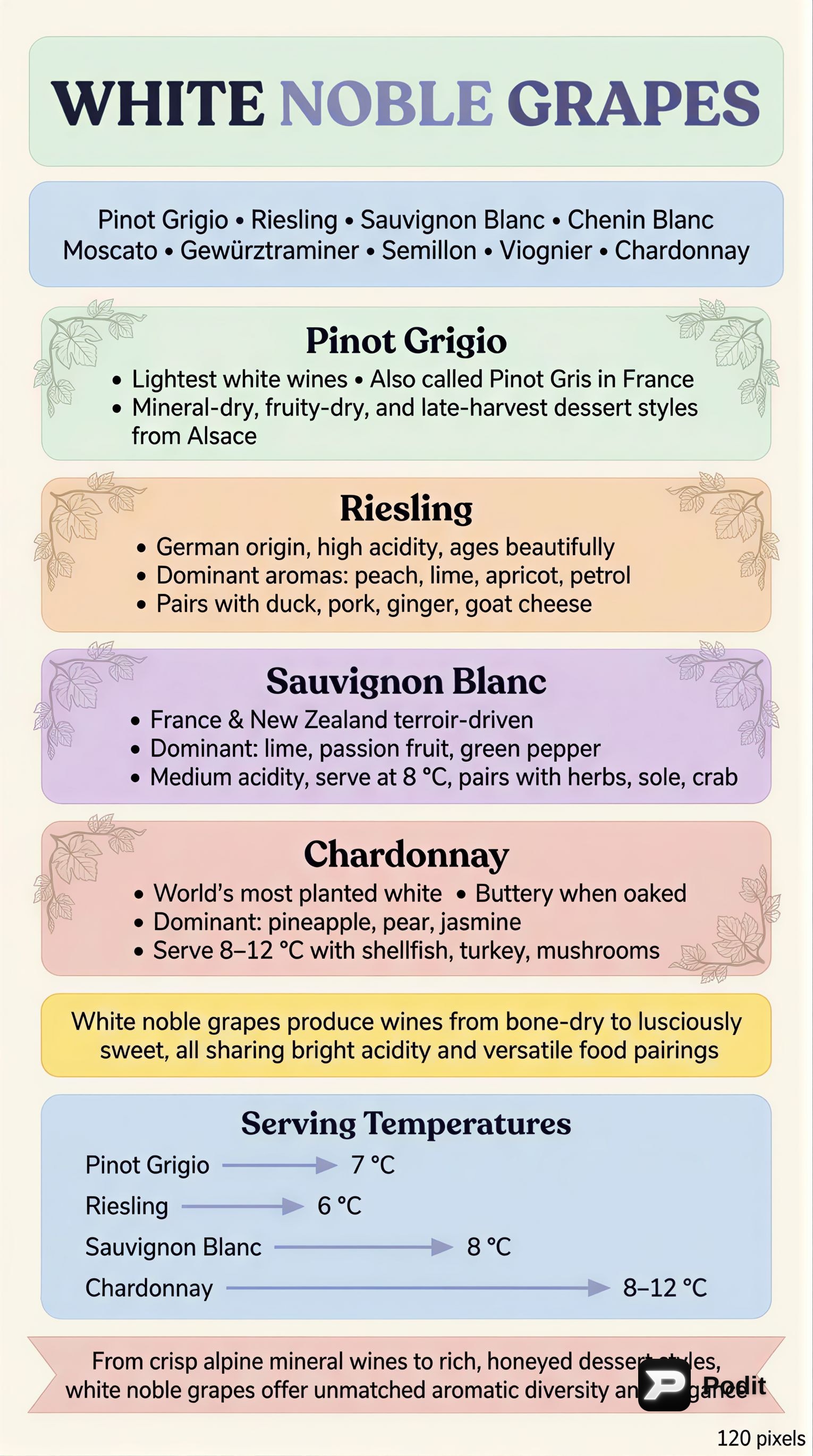
📚 White Noble Grapes & Essential Wine Concepts: A Study Guide
Source Information: This study material has been compiled and organized from a lecture audio transcript and supplementary copy-pasted text.
📝 Introduction to White Noble Grapes and Wine Concepts
This study guide provides a comprehensive overview of prominent white noble grape varieties, detailing their origins, distinct characteristics, aroma profiles, and recommended food pairings. Furthermore, it elucidates fundamental wine concepts such as alcohol content, decanting, and the distinction between monovarietal and blended wines, offering a foundational understanding of viticulture and oenology.
🍇 Characteristics of Key White Noble Grape Varieties
1. Pinot Grigio (Pinot Gris)
- Origin: Italy (Pinot Grigio) and France (Pinot Gris).
- Characteristics:
- Produces some of the lightest white wines.
- Sugar content varies significantly with harvest time.
- Three Main Types:
- Mineral & Dry: From Italy's Alpine region. Very dry, sugar-free, high acidity. Malolactic fermentation is not applied to preserve acidity.
- Fruity & Dry: Undergoes malolactic fermentation, resulting in a softer flavor.
- Fruity & Demi-Sec: Native to Alsace, France. Sweeter and denser due to late grape harvest.
- A rosé version can also be produced, with color intensity varying by maceration time.
- Aroma Profile:
- ✅ Dominant Aromas: Lemon, Green Apple, White Peach
- ✅ Other Flavors: Sweetened lemon, honey, clove, ginger, almond
- 📊 Acidity: Medium-high or High
- 🌡️ Service Temperature: 7°C
- Food Pairings:
- Unprocessed fish products (e.g., sushi, sashimi)
- Seafood (e.g., scallops, mussels, oysters)
- Poached fish
- Herbs (e.g., parsley, mint, lemon thyme)
- Semi-aromatic cheeses
2. Riesling
- Origin: Germany (primary producer). Also grown in France, Argentina, South Africa.
- Characteristics: Highly suitable for aging.
- Aroma Profile:
- ✅ Dominant Aromas: Peach, Nectarine, Apricot, Apple, Lime, Pineapple
- ✅ Other Aromas: Honey, ginger, petroleum, lemon blossom, gasoline
- 📊 Acidity: High
- 🌡️ Service Temperature: 6°C
- Food Pairings:
- Duck, Pork, Chicken, Shrimp, Lobster, Crab
- Spices (e.g., ginger, clove, turmeric, sesame)
- Goat cheese, dried fruits
- Grilled vegetables
3. Sauvignon Blanc
- Origin: France. Also produced in New Zealand, USA, Chile, South Africa.
- Characteristics:
- Very sensitive to terroir, meaning its taste varies significantly by region.
- Suitable for aging.
- Aroma Profile:
- ✅ Dominant Aromas: Lime, Green Apple, Passion Fruit, Guava, Kiwi, Nectarine
- ✅ Other Flavors: Green pepper, basil, tarragon, celery, concrete, chalk
- ✅ Aged Notes: Vanilla, Tart, Nutmeg
- 📊 Acidity: Medium
- 🌡️ Service Temperature: 8°C
- Food Pairings:
- Aromatic herbs (e.g., salads, rosemary, parsley, basil, coriander)
- Chicken, sea bass, sole, crab, lobster
- Sour cheeses
- Legumes, yogurt
4. Chenin Blanc
- Origin: South Africa. Also produced in France and New World countries.
- Characteristics:
- Often used for sweeter demi-dry wines.
- Very suitable for sparkling wine production.
- Aroma Profile:
- ✅ Dominant Aromas: Passion Fruit, Apple, Pear, Baked Apple, Melon, Orange
- ✅ Other Aromas: Ginger, honey, jasmine, chamomile, cabbage, sake
- 📊 Acidity: Medium-High
- 🌡️ Service Temperature: 8°C
- Food Pairings:
- Sweet-sour sauces
- Turkey, chicken, veal, pork
- Spices (e.g., cinnamon, tarragon, dill, fennel, cumin, cashew)
- Semi-soft cheeses, cream cheeses, cheddar, goat cheese
- Vegetables (e.g., cauliflower, mushrooms, corn, spring onions)
5. Moscato (Misket)
- Origin: Anatolian lands. Also produced in France, Italy, Australia, Israel, Greece.
- Characteristics:
- Can produce white, rosé, and a slightly colored red wine (from a specific "Black Marble" variety).
- Highly suitable for sweet wine making, often resulting in dessert wines.
- Aroma Profile:
- ✅ Dominant Aromas: Orange, Orange Blossom, Lemon, Pear, Honeysuckle
- ✅ Other Flavors: Mint, tropical flavors, strawberry, caramel
- 📊 Acidity: Low-Medium
- 🌡️ Service Temperature: 6°C
- Food Pairings:
- Asian dishes, fermented sauces
- Chicken, Duck, Pig, Flat Fish
- Herbs/Spices (e.g., basil, mint, cloves, peanuts, coriander, cashews)
- Hard cheeses
- Vegetables (e.g., carrot, green pepper, orange)
6. Gewurztraminer
- Origin: France. Also produced in Germany, Austria, USA, New Zealand.
- Characteristics:
- Suitable for aging; aroma development improves with age.
- Similar aromatic profile to Moscato but with lower acidity and distinct dominant aromas.
- Aroma Profile:
- ✅ Dominant Aromas: Lychee, Pineapple, Grapefruit, Peach, Apricot
- ✅ Other Aromas: Rose, honey, allspice, cinnamon
- 📊 Acidity: Low
- 🌡️ Service Temperature: 6°C
- Food Pairings:
- Tropical fruits
- Green curry, Thai food
- Duck, chicken, pork, bacon
- Spices (e.g., cloves, cinnamon, ginger, pepper, bay leaf, almond, sesame)
- Low-flavor, hard-textured cheeses
- Grilled vegetables (e.g., zucchini, peppers, carrots)
7. Semillon
- Origin: France. Also cultivated in New World countries, South Africa, and the USA.
- Characteristics:
- Taste and aroma profile reminiscent of Chardonnay.
- Semillons grown in cold vs. hot climates can carry different aromas.
- Suitable for aging.
- Aroma Profile:
- ✅ Dominant Aromas: Lemon, Lime, Grapefruit, Apple, Pear, Papaya, Mango
- ✅ Other Aromas: Lanolin (wet wool), honeysuckle, beeswax, saffron, fig
- ✅ Aged Notes: Wood, smoked, butter, popcorn
- 📊 Acidity: Medium
- 🌡️ Service Temperature: 8°C
- Food Pairings:
- Mildly spicy foods
- Chicken, Turkey, Whole Fish
- Herbs (e.g., dill, chives, star anise, fennel)
- Hard and fatty cheeses (e.g., Gruyere, Cheddar)
- Vegetables (e.g., leeks, potatoes, sweet potatoes, pumpkin)
8. Viognier
- Origin: Southern France. Also produced in Australia, USA, Italy, South Africa, Argentina, Chile.
- Characteristics:
- A very strong white grape with high aroma and dominant taste notes.
- Suitable for aging.
- Aroma Profile:
- ✅ Dominant Aromas: Mandarin, Peach, Rose, Mango, Honeysuckle
- ✅ Other Aromas: Vanilla, Nutmeg, Clove
- ✅ Aged Notes: Caramel, Honey, Wood, Smoked
- 📊 Acidity: Low
- 🌡️ Service Temperature: 11-12°C
- Food Pairings:
- Medium spicy foods
- Oven/grilled chicken, turkey dishes, veal, duck
- Herbs/Spices (e.g., lemon, orange, allspice, chives, lemongrass, sage)
- Fruits (e.g., apricot, papaya, passion fruit, pumpkin)
- Cheeses (e.g., Brie, Camembert)
9. Chardonnay
- Origin: France and Germany. The most well-known white wine globally.
- Characteristics:
- Intense aroma, high body, and balanced finish among white wines.
- One of the most cultivated grapes worldwide.
- Suitable for aging, though extended aging may impart a "greasy" feeling.
- Aroma Profile:
- ✅ Dominant Aromas: Pineapple, Pear, Apple, Fig, Jasmine
- ✅ Other Aromas: Celery leaf, almond, lemon peel, beeswax
- ✅ Aged Notes: Butter, vanilla, tart dough, coconut, cream, caramel sauce
- 📊 Acidity: Medium-low
- 🌡️ Service Temperature: 8-12°C
- Food Pairings:
- Sole, angler, turbot, scallops, oysters, shellfish, chicken, turkey, pork
- Herbs (e.g., tarragon, parsley, lemon peel)
- Mild/Medium spicy dishes
- Goat cheese
- Vegetables/Nuts (e.g., peas, asparagus, artichokes, mushrooms, almonds, cashews)
🍷 Fundamental Wine Terminology
Understanding these key concepts is essential for wine appreciation.
1. Alcohol Content
- Wines can have varying alcohol percentages, typically from 5% to 23%.
- The alcohol content is influenced by the type of wine, grape variety, and production processes.
- Classifications:
- Low Alcohol Wines: Less than 10% alcohol content (e.g., some white and sparkling wines).
- Medium Alcohol Wines: 10-15% alcohol content (e.g., most red wines).
- High Alcohol Wines: 15% or more alcohol content (e.g., dessert wines, Madeira, Malbec).
2. Decanting
- 📚 Definition: Decanting is the aeration process used to enhance the aroma and flavor of wine.
- Purpose: Allows the wine to "breathe," releasing complex aromas and softening tannins.
- Application:
- Primarily necessary for most red wines.
- Can also benefit some aged white wines.
- Method: Various carafes can be used to facilitate aeration.
- Duration: Generally, thicker (full-bodied) wines require longer decanting periods, ranging from 20 minutes to 2 hours.
3. Monovarietal vs. Blended Wines
- 📚 Monovarietal (Monosepaj): Refers to wines made exclusively from a single grape variety.
- 📚 Blended (Kupaj): Refers to wines made from two or more grape varieties, combined to achieve a desired balance or complexity.
✅ Conclusion
This study guide has provided a detailed examination of several white noble grape varieties, highlighting their unique characteristics, complex aroma profiles, and suitable food pairings. Additionally, we have explored fundamental wine concepts including alcohol content, decanting, and the distinction between blended and monovarietal wines. This comprehensive understanding underscores the diversity and intricate nature of white wines, enriching the appreciation of their production and consumption.