The History, Production, and Characteristics of Coffee - kapak
Yemek#coffee history#coffee production#coffee beans#arabica

The History, Production, and Characteristics of Coffee

This summary explores the historical origins of coffee, its global journey, diverse production and brewing methods, and the distinct characteristics of Arabica and Robusta beans.

dionimeyziJuly 4, 2026 ~24 dk toplam
01

Sesli Özet

8 dakika

Konuyu otobüste, koşarken, yolda dinleyerek öğren.

Sesli Özet

The History, Production, and Characteristics of Coffee

0:008:27
02

Görsel Özet

İnfografik

Konunun tüm parçalarını tek bakışta gör.

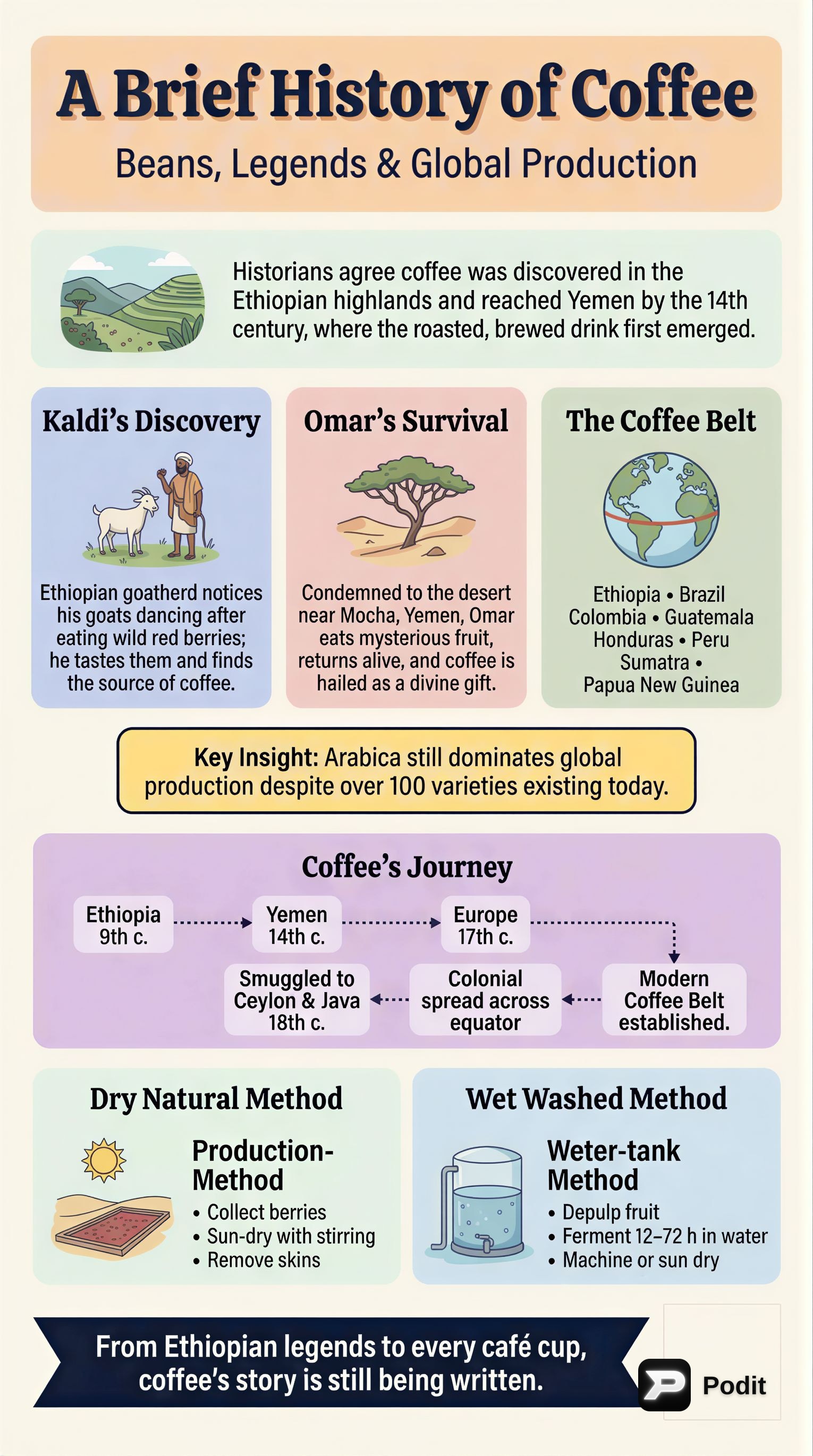
The History, Production, and Characteristics of Coffee - görsel özet infografik
Tam boyutta görüntüle →
03

Flash Kartlar

25 kart

Karta tıklayarak çevir. ← → ile gez, ⎵ ile çevir.

1 / 25
Tüm kartları metin olarak gör
  1. 1. What is the primary socio-cultural significance of coffee mentioned in the text?

    Coffee holds significant socio-cultural importance across Africa, the Arabian Peninsula, and Anatolia. Its emergence is surrounded by a rich tapestry of historical narratives, highlighting its deep integration into the social and cultural fabric of these regions. It has played a role in daily life, rituals, and social gatherings.

  2. 2. According to one origin story, who is credited with the discovery of coffee?

    One prominent origin story attributes the discovery of coffee to Kaldi, an Ethiopian goat herder. He observed his goats becoming unusually energetic after eating wild berries from a mountain plant, and upon trying them himself, experienced a similar stimulating effect, thus discovering coffee's properties.

  3. 3. How did Kaldi's discovery lead to the first preparation of coffee?

    After experiencing the stimulating effects of the berries, Kaldi presented them to a Sufi leader. The leader then prepared the first coffee by cooking the fruit and mixing it with water, creating an invigorating beverage. This drink was subsequently utilized in night prayers to maintain alertness and fitness.

  4. 4. Describe the alternative origin story involving Omar from Mocha.

    The second prominent account involves Omar from Mocha, Yemen. Condemned to perish in the desert, Omar, in a state of delirium, dreamt of a tree. A voice instructed him to locate this tree, whose fruits he consumed, enabling his survival and return. This fruit was perceived as a divine sign, leading to the widespread adoption of coffee consumption, with some versions also depicting Omar as a healer who utilized coffee as medicine.

  5. 5. Where does historical consensus place the discovery of coffee and its introduction to Yemen?

    Historical consensus places coffee's discovery in the Ethiopian highlands. Its introduction to Yemen is believed to have occurred around the 14th century. It was in Yemen that the practice of roasting, grinding, and brewing coffee with water, as it is known today, is thought to have originated.

  6. 6. Which coffee species is primarily referenced in early historical accounts?

    The initial coffee species referenced in these historical accounts is Coffee Arabica. Despite the existence of over a hundred herbal coffee types, Arabica remains one of the most widely cultivated varieties globally. It is prized for its complex flavor profile and lower caffeine content.

  7. 7. What spurred coffee's global expansion in the 17th century?

    Coffee's global expansion gained momentum in the 17th century due to its surging popularity in Europe. This increased demand, coupled with Europe's desire to circumvent the near-monopolistic trade controlled by Turkish and Arab merchants, motivated its spread beyond its origins and into new cultivation areas.

  8. 8. How did coffee cultivation spread beyond its original regions?

    An 18th-century Polish businessman initiated the smuggling of coffee plants, successfully cultivating them in Ceylon (now Sri Lanka) and Java. Subsequently, coffee cultivation extended to various colonial territories and the equatorial region. This expansion led to the establishment of the 'Coffee Belt,' a geographical zone ideal for coffee production.

  9. 9. Name at least three countries located within the 'Coffee Belt'.

    Notable countries within the 'Coffee Belt' include Ethiopia, Brazil, Sumatra, Peru, Papua New Guinea, Honduras, Guatemala, and Colombia. This geographical zone, situated around the equator, provides the optimal climate and altitude for coffee cultivation, making it the heart of global coffee production.

  10. 10. Explain the 'dry' or 'natural' method of coffee processing.

    The dry, or natural, method involves collecting coffee berries and sun-drying them with continuous stirring. After drying, the outer skins are separated, and the raw beans are stored. This method, while capable of imparting fruit flavors, is less preferred today due to its high labor requirements and potential for inconsistent results, including undesirable aromas.

  11. 11. What are some disadvantages of the dry processing method?

    Disadvantages of the dry processing method include its high labor requirements and the potential for inconsistent results. If not managed carefully, it can lead to undesirable aromas such as mold or fermentation in the beans. These factors make it less favored in modern, large-scale production compared to other methods.

  12. 12. Describe the 'wet' or 'washed' method of coffee processing.

    The wet, or washed, method involves collecting coffee fruits and separating them from their peels. The peeled fruits are then soaked in water for 12 to 72 hours to separate the bean from the fruit, often through fermentation. Finally, the seeds are dried either mechanically or by sun-spreading, resulting in a cleaner, brighter flavor profile.

  13. 13. What are 'hybrid' coffee processing methods, and where are they prevalent?

    Hybrid methods, such as the semi-washed and Honey or Miel methods, combine aspects of both dry and wet processing. These methods are particularly prevalent in Brazil, where they allow producers to achieve specific flavor characteristics and manage processing efficiency. They represent an innovative approach to coffee production.

  14. 14. What is the characteristic flavor of green coffee beans before roasting?

    Green coffee beans, before undergoing the roasting process, possess a slightly fruity or green flavor. They are typically stored in this state to prevent aroma loss, as the complex aromas develop significantly during roasting. This raw flavor is quite different from the brewed coffee we consume.

  15. 15. At what temperature does the coffee roasting process typically begin, and what happens during this phase?

    The coffee roasting process typically commences around 260 to 270 degrees Celsius. During this initial high-temperature phase, sugars, fats, and proteins within the bean undergo complex chemical reactions. These reactions are responsible for forming the majority of coffee's characteristic aromas and flavors.

  16. 16. How does the aroma profile of coffee evolve during roasting?

    The aroma profile of coffee evolves significantly during roasting, indicative of the Maillard reaction. It transitions from initial green and hay notes to more complex aromas like bread, nutmeg, malt, caramel, and cocoa. This transformation is crucial for developing the rich sensory experience of coffee.

  17. 17. When did the espresso machine emerge, and what is its primary characteristic?

    The espresso machine emerged in the early 1900s and rapidly gained global popularity. Its primary characteristic is its ability to produce intensely fragrant and aromatic coffees by forcing pressurized hot water through finely ground coffee. This method creates a concentrated shot, forming the basis for many modern coffee beverages.

  18. 18. Who designed the Moka pot, and how does it brew coffee?

    The Moka pot was designed by Italian engineer Bialetti in 1933. It consists of two chambers and a filter system. Water in the lower chamber evaporates, creating pressure that forces hot water through the coffee grounds in the middle filter into the upper chamber, producing a strong, stovetop espresso-like brew.

  19. 19. Describe the pour-over brewing method and its typical result.

    The pour-over method, discovered in Germany in 1908, utilizes a paper filter placed in a cone. Hot water is slowly poured over medium-fine to medium-ground coffee, allowing it to drip through. This technique produces a lighter-tasting coffee with a clean cup, as the paper filter traps most of the oils and sediments.

  20. 20. What is the key characteristic of the French press brewing method?

    The French press method involves steeping thick-ground coffee in hot water for several minutes. After steeping, a plunger with a mesh filter is pressed down, separating the grounds from the liquid. This method is known for producing a full-bodied coffee with a rich mouthfeel, as it allows more oils and fine sediments to pass through.

  21. 21. What are the origins of cold brew coffee, and when did it become popular in the US?

    Cold brew coffee originated from Japanese tea-brewing techniques and gained widespread use in Far Eastern cultures. It became a trend in the United States in the 1990s. This method involves brewing extra-thick ground coffee with cold water over an extended period, resulting in a less acidic and smoother concentrate.

  22. 22. What five features are evaluated during coffee tasting, or 'cupping'?

    During coffee tasting, or 'cupping,' five key features are evaluated: sweetness, acidity, mouthfeel, balance, and overall flavor. Overall flavor encompasses both the taste and aroma components of the coffee, providing a comprehensive assessment of its quality and characteristics.

  23. 23. What are the two primary coffee species that dominate the market?

    The two primary coffee species that dominate the market are Arabica and Robusta. These two varieties account for the vast majority of global coffee production and consumption. They each possess distinct characteristics in terms of flavor, growing conditions, and caffeine content.

  24. 24. Compare the caffeine content of Arabica and Robusta coffees.

    Arabica coffees generally possess significantly less caffeine compared to Robusta. Arabica typically contains approximately one-third the amount of caffeine found in Robusta. This difference makes Robusta a more potent choice for those seeking a higher caffeine kick, while Arabica is often preferred for its nuanced flavors.

  25. 25. Describe the typical growing conditions and acidity level of Arabica coffee.

    Arabica coffees are typically cultivated at high altitudes, which contributes to their slower maturation and development of complex flavors. They generally exhibit lower acidity compared to Robusta, contributing to their often-preferred smoother and more refined flavor profile, with a prolonged finish.

04

Bilgini Test Et

15 soru

Çoktan seçmeli sorularla öğrendiklerini ölç. Cevap + açıklama.

Soru 1 / 15Skor: 0

According to the first narrative, where is the genesis of coffee primarily attributed to?

05

Detaylı Özet

6 dk okuma

Tüm konuyu derinlemesine, başlık başlık.

Coffee: A Comprehensive Study Guide ☕

Source Information: This study material has been compiled from a combination of copy-pasted text and a lecture audio transcript.


1. Introduction: The World of Coffee 🌍

Coffee is more than just a beverage; it holds profound socio-cultural significance across Africa, the Arabian Peninsula, and Anatolia, enriching its history with countless stories. This guide explores coffee's origins, global journey, intricate production processes, diverse brewing methods, and the distinct characteristics of its main bean varieties. Understanding these elements provides a comprehensive appreciation for this globally cherished drink.


2. Coffee History & Origins 📜

The genesis of coffee is primarily attributed to two widely recounted stories, both set in similar geographical regions and timeframes. Historians generally agree that coffee was discovered in the Ethiopian highlands before being introduced to Yemen around the 14th century. It was in Yemen that the practice of roasting, grinding, and brewing coffee with water, as we know it today, is believed to have originated.

2.1. The Legend of Kaldi (Ethiopia) 🐐

The most popular origin story features Kaldi, an Ethiopian goat herder. ✅ He observed his goats behaving unusually, "dancing" with energy after consuming wild red berries from a mountain plant. ✅ Kaldi tasted the fruit himself and experienced a similar stimulating effect, thus discovering coffee. ✅ He then took these berries to a Sufi leader, who prepared the first coffee by cooking the fruit and mixing it with water. ✅ This invigorating drink was used during night prayers to maintain alertness and sobriety, eventually spreading to Europe via Yemen, the Arabian Peninsula, the Mediterranean, and Anatolia.

2.2. The Tale of Omar (Yemen) 🌳

A second prominent story originates from the city of Mocha in Yemen, involving a man named Omar. ✅ Condemned to starve in the desert, Omar, in a state of delirium, dreamt of a tree. ✅ A voice instructed him to find this tree, whose fruits he consumed, enabling his survival and return. ✅ This fruit was seen as a divine sign, leading to the widespread adoption of coffee consumption. ✅ Some versions also depict Omar as a healer who used coffee as medicine after his pardon.

2.3. The First Beans: Coffee Arabica 🌿

The coffee mentioned in these early stories is Coffee Arabica. Despite over 100 known herbal coffee varieties today, Arabica remains one of the most widely used and recognized beans.


3. Coffee's Global Journey & The Coffee Belt 🌍

Coffee's popularity surged in Europe during the 17th century. This increased demand, coupled with Europe's desire to bypass the near-monopolistic trade controlled by Turkish and Arab merchants, fueled its global expansion.

3.1. Expansion and Cultivation 📈

✅ In the 18th century, a Polish businessman successfully smuggled coffee plants, cultivating them in Ceylon (now Sri Lanka) and Java. ✅ Subsequently, coffee cultivation spread to various colonial territories and the equatorial region.

3.2. The Coffee Belt 🗺️

This equatorial region, known as the Coffee Belt, is where coffee production is concentrated due to ideal climatic conditions. Key countries within this belt include:

  • Ethiopia
  • Brazil
  • Sumatra
  • Peru
  • Papua New Guinea
  • Honduras
  • Guatemala
  • Colombia

4. Coffee Production: From Berry to Bean ⚙️

Coffee production involves several stages, transforming the raw fruit into the aromatic beans we know.

4.1. Processing Methods: Dry vs. Wet 💧☀️

Coffee processing can be done in two main ways:

4.1.1. Dry (Natural) Method ☀️

This method involves drying the entire coffee cherry. 1️⃣ Collection: Coffee berries are collected. 2️⃣ Drying: Fruits are spread in the sun and continuously stirred. 3️⃣ Separation: The outer skins are separated once dry. 4️⃣ Storage: Raw coffee beans are stored. ⚠️ Note: While this method can impart fruit flavors (e.g., blueberry, strawberry), it requires high labor and can lead to inconsistent results, including undesirable aromas like mold or fermentation. It is less preferred today for specialty coffee.

4.1.2. Wet (Washed) Method 💧

This method removes the fruit pulp before drying the bean. 1️⃣ Collection: Fruits are collected. 2️⃣ Pulping: Fruits are separated from their peels. 3️⃣ Fermentation: The coffee bean is separated from the remaining fruit pulp by soaking in water for 12-72 hours. 4️⃣ Drying: The seeds are dried, either mechanically or by spreading in the sun.

4.1.3. Hybrid Methods 🧪

Other methods combine aspects of dry and wet processing:

  • Semi-washed method
  • Honey (Miel) Method (popular in Brazil)

4.2. Roasting: The Aroma Transformation 🔥

Green coffee beans have a slightly fruity, often "green" flavor and don't possess the intense aromas we associate with coffee. Roasting is a complex, high-temperature process crucial for developing coffee's characteristic flavors. ✅ Initial Stage: Roasting typically starts around 260-270°C for 5-8 minutes. ✅ Chemical Reactions: Sugars, fats, and proteins in the bean undergo complex chemical reactions (e.g., Maillard reaction), initiating aroma development. ✅ Secondary Stage: Temperature is then reduced to 150-170°C, allowing aroma changes to continue. ✅ Aroma Evolution: The aroma profile evolves through stages: * Green ➡️ Hay ➡️ Bread ➡️ Nutmeg, Malt, Caramel, Cocoa (full Maillard development) 💡 Insight: Controlling these reactions is key to distinguishing good from bad coffee.

4.3. Grinding 🔪

After roasting, beans are ground to prepare them for brewing. The grind size significantly impacts the final coffee flavor.


5. Brewing Methods: Crafting the Drink ☕

The same coffee bean can yield diverse textures and aromas depending on roasting, grinding, and preparation techniques. Brewing methods have evolved significantly over time.

  • Espresso Machine (Early 1900s)
    • Produces intensely fragrant and aromatic coffees.
    • Forces pressurized water through finely ground coffee.
    • Forms the basis for many modern coffee beverages.
  • Moka Pot (Designed by Bialetti, 1933)
    • Consists of two main parts and a filter system.
    • Water in the lower chamber evaporates, creating pressure that carries coffee to the upper chamber.
    • Uses fine to medium-ground coffee.
  • Pour Over (Discovered in Germany, 1908)
    • Prepares a lighter-tasting coffee.
    • Water flows from top to bottom through a paper filter.
    • First technique to use a paper filter in brewing.
    • Suitable for medium-fine to medium-ground coffee.
  • French Press (History shared between France and Italy, 1800s)
    • Thick-ground coffee is steeped in hot water.
    • Coffee settles, then is filtered through a plunger.
    • First simple design patented in 1852, later refined in 1929.
  • Cold Brew (Developed in Japan, popularized in US in 1990s)
    • Based on the technique of brewing tea in cold water.
    • Brewed with extra-thick ground coffee and cold water.

6. Coffee Bean Varieties & Tasting 📊

6.1. Coffee Tasting (Cupping) 👅

When tasting coffees, several features are examined to assess their quality and profile:

  • Sweetness
  • Acidity
  • Mouthfeel (Feeling in the Palate)
  • Balance
  • Flavor (Taste & Aroma)

6.2. Arabica 🍒

Arabica coffees are generally considered to have superior characteristics compared to Robusta.

  • Caffeine Content: Less caffeine (approximately 1/3 of Robusta).
  • Growing Conditions: Grown at high altitudes.
  • Acidity: Generally less acidic.
  • Finish: Long finish (aftertaste).
  • General Profile:
    • Fruity (berry, tropical fruit, dried fruit)
    • Floral
    • Mid-high body
    • Medium-high acidity
    • Clean finish
    • High sweetness

6.3. Robusta 🌰

Robusta coffees offer a different set of characteristics.

  • Caffeine Content: High caffeine.
  • General Profile:
    • Earthy flavors (mushroom, cocoa, raw almond, etc.)
    • High sourness
    • High bitterness
    • High body

7. Conclusion ✅

Coffee's journey, from its legendary discovery in Ethiopia and Yemen to its status as a globally cherished beverage, is marked by a rich history and intricate processes. The evolution of cultivation, from the original Arabica beans to diverse production methods and myriad brewing techniques, profoundly influences its final characteristics and the vast spectrum of sensory experiences it offers. Understanding these elements, alongside the distinct profiles of Arabica and Robusta, provides a comprehensive appreciation for the complexity and cultural significance of coffee.

Kendi çalışma materyalini oluştur

PDF, YouTube videosu veya herhangi bir konuyu dakikalar içinde podcast, özet, flash kart ve quiz'e dönüştür. 1.000.000+ kullanıcı tercih ediyor.

Sıradaki Konular

Tümünü keşfet
A Comprehensive Overview of Coffee: History, Production, & Types

A Comprehensive Overview of Coffee: History, Production, & Types

This summary explores coffee's historical origins, global expansion, diverse production methods, various brewing techniques, and the distinct characteristics of Arabica and Robusta varietals.

6 dk Özet 25 15 Görsel
Tea: Plant, Production, and Types

Tea: Plant, Production, and Types

An academic overview of the Camellia Sinensis plant, the diverse methods of tea production, including CTC and orthodox processes, and a detailed classification of various tea types such as green, black, oolong, white, Pu'er, and yellow teas.

6 dk Özet 25 15 Görsel
Whiskey Production and Classification

Whiskey Production and Classification

This summary details the intricate processes of whiskey production, from malting to aging, and explores its diverse classifications based on grain, region, and blending techniques.

5 dk Özet 25 15 Görsel
Beer and Food Pairings: Characteristics and Principles

Beer and Food Pairings: Characteristics and Principles

This summary explores beer and food pairing, detailing beer characteristics like color, body, and carbonation, and outlining pairing principles for various Ale and Lager types.

6 dk Özet 25 15 Görsel
White Noble Grapes and Essential Wine Concepts

White Noble Grapes and Essential Wine Concepts

An academic overview of key white noble grape varieties, their characteristics, aroma profiles, food pairings, and fundamental wine terminology.

9 dk Özet 25 15 Görsel
Functional Beverages: Trends, Categories, and Science

Functional Beverages: Trends, Categories, and Science

An academic overview of functional beverages, covering their definition, market landscape, key categories, specific examples like energy and sports drinks, probiotic options, and emerging market trends.

5 dk Özet 25 15 Görsel
Early Turkic States: Origins and Empires

Early Turkic States: Origins and Empires

This academic summary explores the foundational early Turkic states, examining their origins, political structures, cultural contributions, and historical impact across Central Asia and Eurasia.

10 dk Özet 25 15 Görsel
Advanced Topics in Business Economics and Strategy

Advanced Topics in Business Economics and Strategy

Explore key concepts in business economics and strategy, including market dynamics, cost structures, transaction costs, market concentration, and strategic decision-making.

Özet 25 15