 Podit
Podit
📚 Introduction to Beer and Food Pairing
This study material is compiled from a combination of copy-pasted text and a lecture audio transcript, providing a comprehensive overview of beer characteristics and principles for successful food pairing.
🎯 Understanding Beer for Optimal Food Pairing
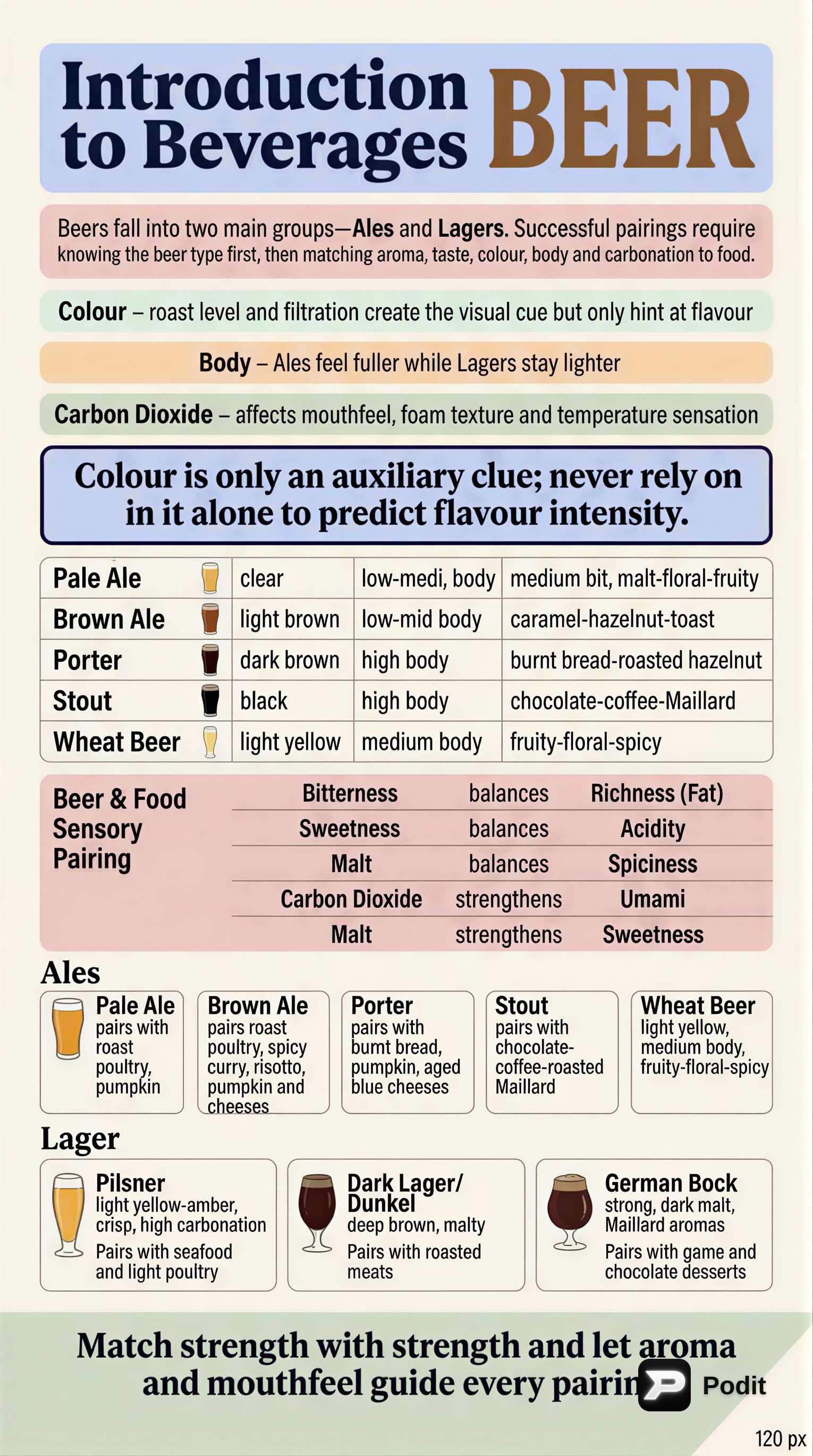
Successful beer and food pairing hinges on a thorough understanding of beer types and their unique characteristics. Beers are broadly classified into two primary groups: Ales and Lagers. Each group possesses distinct attributes that influence how they interact with food. Before attempting any pairing, it is crucial to identify the beer's type and then assess its aroma and taste profiles.
1️⃣ Key Characteristics for Beer Evaluation
To achieve taste harmony between beer and food, several features must be considered during beer evaluation:
- Colour 🎨:
- Influenced by barley roasting duration, fermentation, and filtration.
- While darker beers might suggest roasted, nutty flavors and lighter beers might imply fruity notes, this is not a definitive rule.
- Some very dark beers can have light aromas, and intensely flavored beers can be very light in color.
- 💡 Insight: Colour is an auxiliary element, offering an initial inference, but not a primary determinant of flavor.
- Aroma 👃: The scent profile, often revealing notes of malt, hops, yeast, or adjuncts.
- Carbon Dioxide Ratio 🫧:
- Varies based on yeast, fermentation time, and bottling.
- Significantly impacts the beer's "mouthfeel" – the textural and temperature sensations in the mouth, distinct from taste and aroma.
- ✅ Example: Coldness or the size of foam bubbles affect mouthfeel.
- Body 🏋️:
- Refers to the beer's perceived weight and fullness in the mouth.
- Ales generally have a fuller body, while Lagers tend to be lighter.
- The body is also linked to the carbon dioxide rate.
- 📈 Scale: Pilsner < Pale Ale < Stout (e.g., Guinness)
- Taste 👅: The overall flavor profile, including sweetness, bitterness, sourness, and umami.
2️⃣ Principles of Beer & Food Pairing
When pairing beer with food, the aroma profile and taste characteristics are paramount, similar to wine pairing. Additionally, the serving temperature, effervescence (fizziness), and colour of the beer are crucial for taste perception.
General Pairing Guidelines:
- Strong with Strong 💪: Stronger beers should be paired with robust, strong-flavored foods. Consider alcohol content, malt characteristics, bitterness, sweetness, and body compatibility.
- Creating Combinations 🤝: Aim for balanced and harmonious pairings based on common aroma profiles, much like in wine pairing.
- Texture/Mouthfeel Balance ⚖️: Use specific properties of beer and food to balance the mouthfeel.
Special Sensory Interactions:
Understanding how beer and food components interact can elevate a pairing:
- Beer Bitterness ↔️ Food Sweetness: Balances
- Beer Malt ↔️ Food Richness (Fat): Balances
- Beer Carbon Dioxide ↔️ Food Umami: Enhances
- Beer Sweetness ↔️ Food Acidity: Balances
- Beer Malt ↔️ Food Spiciness: Balances
- Beer Bitterness ↔️ Food Spiciness: Strengthens (⚠️ Use with caution, can overwhelm)
🍺 Exploring Beer Types and Their Pairings
Beers are broadly categorized into Ales and Lagers, each with distinct characteristics and ideal food pairings.
A. Ale Beers
Ales are typically fermented at warmer temperatures with top-fermenting yeast, often resulting in more complex, fruity, or spicy flavor profiles.
1. Pale Ale
- Characteristics:
- Colour: Clear 🟡
- Body: Low-Medium
- Bitterness: Medium
- Malt Taste: Medium-High
- Carbon Dioxide: Low, small pores
- Aroma: Malt, floral, fruity 🌸
- Food Pairing Examples:
- Poultry (duck, quail, turkey – roasted, grilled) 🍗
- Spicy foods (curry, spicy sauces) 🌶️
- Risotto, roasted rice dishes 🍚
- Pumpkin, ginger, caramel 🎃
- Cheeses: Cheddar, Gouda, Gorgonzola 🧀
2. Brown Ale
- Characteristics:
- Colour: Light brown 🟫
- Body: Low-Medium
- Bitterness: Medium
- Malt Taste: Medium-High
- Carbon Dioxide: Low
- Aroma: Caramel, hazelnut, toast 🌰
- Food Pairing Examples:
- Pork products, meat products, delicatessen (especially sausage – roasted, grilled, BBQ) 🍖
- Aged semi-hard cheeses (Edam, Gouda, Gruyère) 🧀
- Roasted/grilled vegetables (pumpkin, celery, potatoes, yams) 🥔
- Grilled/BBQ fish (salmon, mackerel) 🐟
- Nuts (almonds, walnuts, hazelnuts) 🥜
3. Porter
- Characteristics:
- Colour: Dark brown 🍫
- Body: High
- Bitterness: Medium-High
- Malt Taste: High (roasted)
- Carbon Dioxide: Low
- Aroma: Burnt bread, roasted hazelnuts 🍞
- Food Pairing Examples:
- Spicy meat products, strong delicatessen (e.g., sucuk) 🥩
- Butter/cream-based sauces (e.g., ravioli with cream sauce, meat ragu) 🍝
- Desserts (tarts, chocolate products, soufflé) 🍰
- Cheeses: Parmesan, aged Gruyère, blue-veined cheeses 🧀
4. Stout
- Characteristics:
- Colour: Black ⚫
- Body: High
- Bitterness: High
- Malt Taste: High (roasted)
- Carbon Dioxide: Moderate
- Aroma: Maillard (roasted), chocolate, coffee ☕
- Food Pairing Examples:
- BBQ, spicy meats 🍖
- Long-marinated game animals 🦌
- Grilled seafood (lobster, crayfish, crab) 🦞
- Cheeses: Parmesan, Pecorino Romano, blue-veined cheeses 🧀
- Chocolate desserts 🍫
5. Wheat Beer
- Characteristics:
- Colour: Light Yellow-Yellow 🍋
- Body: Medium
- Bitterness: Low
- Malt Taste: Low
- Carbon Dioxide: Medium/High
- Aroma: Fruity, floral, spicy 🍌
- Food Pairing Examples:
- Sushi, seafood 🍣
- Poultry (chicken, turkey, duck) 🐔
- Soft cheeses (Mozzarella, Stracciatella, cream cheese) 🧀
- Legumes 🌱
- Other sea products 🌊
B. Lager Beers
Lagers are fermented at colder temperatures with bottom-fermenting yeast, typically resulting in cleaner, crisper, and often less fruity profiles than Ales.
1. Pilsner
- Description: The most popular beer type globally, a light-colored lager known for its clean and sharp profile due to distinct yeast. Originating from Pilsner, Czech Republic, it accounts for approximately two-thirds of global beer consumption.
- Characteristics:
- Lighter in taste and body than Ales.
- More carbonated.
- Colour: Ranges from light yellow to amber.
- ✅ Example: Efes Pilsen is named after this style.
2. Dark Lager / Dunkel
- Description: A German-associated beer type made with dark brown malt and lager yeast.
3. German Bock
- Description: The word "Bock" means "goat" in German. It is the strongest variety among lager beers, derived from dark malt and featuring prominent Maillard aromas.
✅ Conclusion
A profound understanding of beer characteristics – including its type (Ale or Lager), colour, body, carbon dioxide content, aroma, and taste – is indispensable for successful food pairing. This knowledge empowers you to create harmonious and enjoyable culinary experiences, enhancing both the beer and the food.