From Chalumeau to Clarinet: A Musical Evolution - kapak
Müzik#clarinet#chalumeau#musical instruments#woodwind

From Chalumeau to Clarinet: A Musical Evolution

Explore the fascinating journey of the clarinet, from its humble ancestor, the chalumeau, through key innovations by Denner and others, to the sophisticated instrument we know today.

catsandcoffeeJune 1, 2026 ~22 dk toplam
01

Sesli Özet

12 dakika

Konuyu otobüste, koşarken, yolda dinleyerek öğren.

Sesli Özet

From Chalumeau to Clarinet: A Musical Evolution

0:0011:35
02

Görsel Özet

İnfografik

Konunun tüm parçalarını tek bakışta gör.

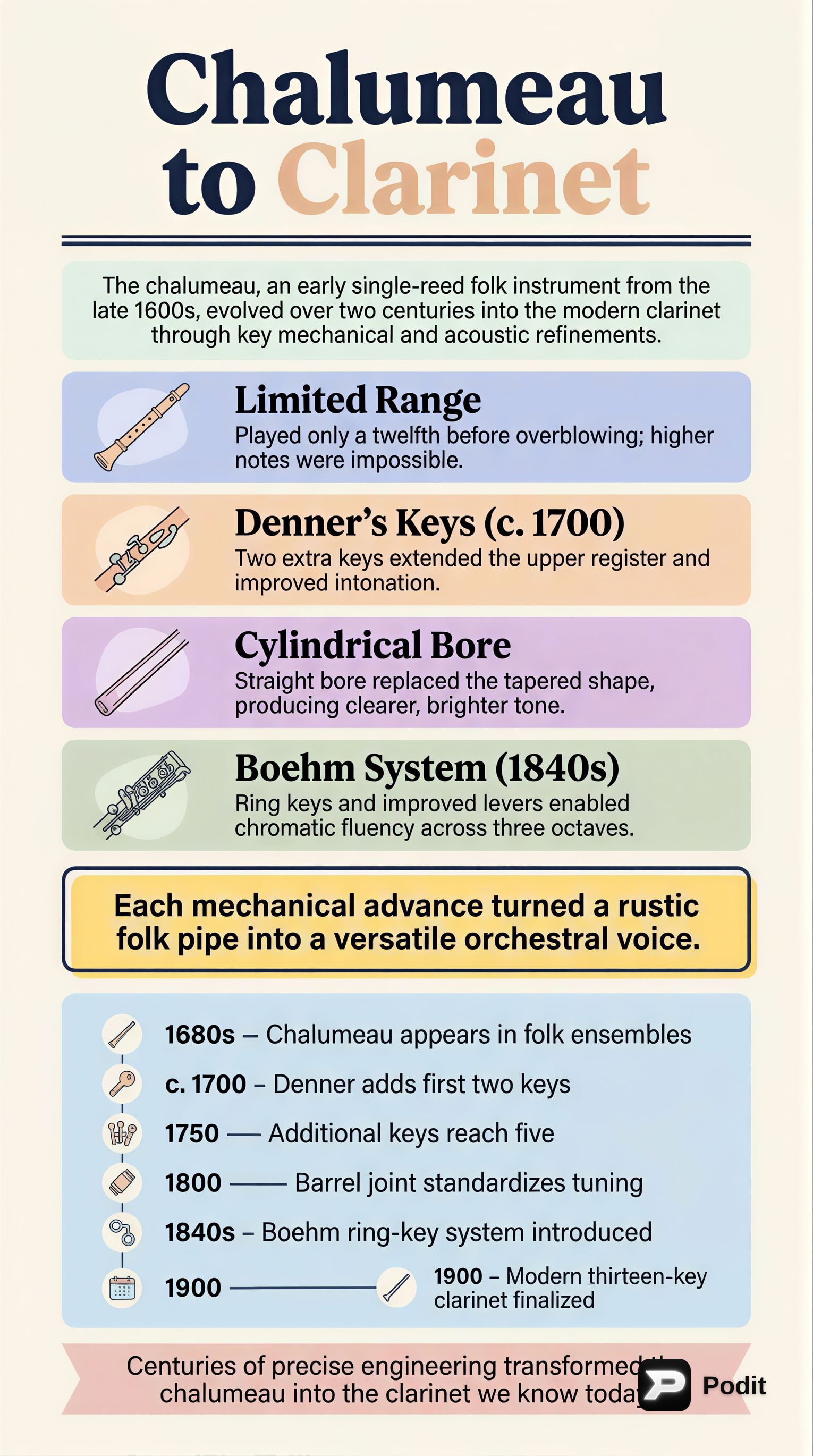
From Chalumeau to Clarinet: A Musical Evolution - görsel özet infografik
Tam boyutta görüntüle →
03

Flash Kartlar

25 kart

Karta tıklayarak çevir. ← → ile gez, ⎵ ile çevir.

1 / 25
Tüm kartları metin olarak gör
  1. 1. What instrument is considered the direct predecessor of the modern clarinet, and what was its primary characteristic?

    The chalumeau is the direct predecessor of the modern clarinet. It was a single-reed woodwind instrument, popular in Europe from the late 17th to early 18th century, characterized by its simple design and limited capabilities compared to the clarinet. Its name, derived from the Latin 'calamus,' meaning 'reed,' reflects its core identity.

  2. 2. Describe the physical design of a chalumeau.

    The chalumeau was typically made from a single piece of wood, often boxwood, and featured a cylindrical bore. It resembled a recorder but had a single reed attached to a beak-shaped mouthpiece. It usually had seven or eight finger holes on the front and one thumb hole on the back, with some later versions including one or two keys.

  3. 3. What was the typical sound and range of the chalumeau?

    The chalumeau produced a soft, mellow, and somewhat reedy tone, primarily in its fundamental register, known as the 'chalumeau register.' This register is characterized by its dark, rich, and warm quality. Its range was quite restricted, typically spanning only about an octave and a fifth, or sometimes just over an octave.

  4. 4. What was a significant limitation of the chalumeau regarding its playing technique?

    A significant limitation of the chalumeau was its inability to 'overblow' effectively into higher registers. While it could overblow, it often produced notes that were out of tune or difficult to control. This made it challenging to play fast passages or music requiring a wider melodic range, limiting its agility and intonation.

  5. 5. Who is widely credited with making the crucial improvements that led to the birth of the clarinet?

    Johann Christoph Denner and his family in Nuremberg, Germany, are widely credited with making the crucial improvements that led to the clarinet. While the exact timeline and specific inventors are debated, Denner's innovations were pivotal in transforming the chalumeau into a more versatile instrument.

  6. 6. What was the most significant improvement Johann Christoph Denner introduced to the chalumeau?

    Denner's most significant improvement was the addition of two key mechanisms to the chalumeau. These keys fundamentally changed the instrument's capabilities, dramatically expanding its range and making it more versatile. One key was the speaker key, allowing overblowing, and the other helped bridge registers.

  7. 7. Explain the function of the 'speaker key' or 'register key' introduced by Denner.

    The speaker key, placed on the back of the instrument, allowed the clarinet to overblow into its upper register, known as the clarino register. Due to the clarinet's cylindrical bore, it overblows at the twelfth (an octave and a fifth) above the fundamental, dramatically expanding its range. This was a monumental breakthrough for the instrument.

  8. 8. What is the 'clarino register' and how did it get its name?

    The 'clarino register' is the upper register of the clarinet, made accessible by Denner's speaker key. It is characterized by a bright and trumpet-like sound. The term 'clarinet' itself is derived from 'clarino,' meaning 'little clarino,' reflecting this register's resemblance to a trumpet's sound.

  9. 9. What was the purpose of the second key Denner added to the early clarinet?

    The second key Denner added was placed on the front of the instrument. Its purpose, along with the speaker key, was to help bridge the gap between the chalumeau and clarino registers. This made the transition between registers smoother and more reliable, facilitating the playing of notes previously unavailable or difficult to produce in tune.

  10. 10. How did Denner and his contemporaries refine the bore and mouthpiece of the early clarinet?

    Denner and his contemporaries refined the bore of the instrument through subtle adjustments to its dimensions and the placement and size of the tone holes. These refinements enhanced its acoustic properties, contributing to a more even tone quality across registers and improved responsiveness. The mouthpiece design also saw gradual improvements to accommodate the expanded range.

  11. 11. Describe the characteristics of 'baroque clarinets' or early clarinets.

    Early clarinets, often called 'baroque clarinets,' were relatively simple, typically having two keys, sometimes three or four in later 18th-century versions. They were made in different sizes and pitches (e.g., C, D, B-flat). Their sound was brighter and perhaps more rustic than modern instruments, but they possessed a clarity that captivated composers.

  12. 12. How did the early clarinet's versatility appeal to composers?

    The early clarinet's versatility stemmed from its ability to perform roles previously reserved for trumpets (clarinos) in its higher register, while also retaining the warm, dark qualities of the chalumeau in its lower register. This duality made it incredibly appealing, leading composers like Vivaldi, Rameau, and Mozart to incorporate it into their works.

  13. 13. What significant development occurred in clarinet design during the 18th century?

    During the 18th century, the clarinet saw a gradual increase in the number of keys. As music became more chromatic and complex, more keys were added to facilitate difficult passages, improve intonation, and provide alternative fingerings. By the late 18th century, clarinets often had five or six keys.

  14. 14. What contributions did Iwan Müller make to the clarinet's development in the 19th century?

    Iwan Müller, a German clarinetist and instrument maker, introduced a system of 13 keys around 1812. His innovations included features like padded keys, which provided a better seal over tone holes. He also standardized the bore and tone hole sizes, leading to more consistent instruments and marking a major step towards the modern clarinet.

  15. 15. Who adapted the Boehm key system for the clarinet, and when?

    The Boehm key system was adapted for the clarinet by Hyacinthe Klosé and Louis-Auguste Buffet in the 1840s. They applied the system, originally designed for the flute by Theobald Boehm, to the clarinet, revolutionizing its playability and technical capabilities.

  16. 16. Describe the key features and impact of the Boehm system on the clarinet.

    The Boehm system, with its ring keys and rod axles, provided a much more logical and ergonomic fingering system for the clarinet. It typically featured 17 keys and 6 rings, enabling players to execute complex passages with unprecedented speed and accuracy. This system also offered superior intonation and tonal uniformity across the instrument's entire range, quickly becoming the global standard.

  17. 17. Are there other key systems for the clarinet besides the Boehm system?

    Yes, while the Boehm system became dominant globally, other systems exist. For example, the Oehler system is primarily used in Germany and Austria. Regardless of the specific key system, the core principles of the clarinet's design, such as its cylindrical bore and single reed, remain constant.

  18. 18. What are the core principles of the clarinet's design that remained constant throughout its evolution?

    The core principles of the clarinet's design that remained constant throughout its evolution include its cylindrical bore, the use of a single reed, and its unique ability to overblow a twelfth (an octave and a fifth) above the fundamental. These characteristics, building upon Denner's initial innovations, define the instrument's acoustic properties.

  19. 19. What is the significance of the cylindrical bore in the clarinet's acoustic properties?

    The cylindrical bore is a crucial characteristic shared by both the chalumeau and the clarinet. It contributes to the instrument's unique timbre, particularly its dark, rich lower register. More importantly, it causes the instrument to overblow at a twelfth (an octave and a fifth) above the fundamental, rather than an octave, which is key to its extended range.

  20. 20. What is the etymology of the word 'chalumeau'?

    The name 'chalumeau' is derived from the Latin word 'calamus.' 'Calamus' means 'reed,' which perfectly reflects the instrument's core identity as a single-reed woodwind instrument. This etymology highlights the fundamental component that defines its sound production.

  21. 21. What is the etymology of the word 'clarinet'?

    The word 'clarinet' is derived from 'clarino,' meaning 'little clarino.' This refers to the instrument's upper register, the 'clarino register,' which produces a bright, trumpet-like sound. The name reflects the early clarinet's ability to perform roles previously associated with clarino trumpets.

  22. 22. Which composers wrote for the chalumeau, appreciating its unique voice despite its limitations?

    Composers of the time, such as Telemann and Handel, did write for the chalumeau. They appreciated its unique voice and gentle, pastoral sound, incorporating it into their folk and chamber music. However, their compositions were always constrained by the instrument's inherent limitations in range and agility.

  23. 23. Which composers quickly recognized the potential of the early two-keyed clarinet and incorporated it into their works?

    Composers like Vivaldi, Rameau, and later Mozart, quickly recognized the potential of the early two-keyed clarinet. Its expanded range and versatility allowed it to perform new roles, solidifying its place in the orchestral and chamber music landscape. Mozart, in particular, wrote iconic works featuring the clarinet.

  24. 24. What is the 'chalumeau register' on a modern clarinet?

    The 'chalumeau register' on a modern clarinet refers to its lowest register, characterized by a dark, rich, and warm quality. This term is a direct legacy from the chalumeau, the clarinet's predecessor, which primarily played in this fundamental range. Modern clarinets retain and enhance this characteristic tone.

  25. 25. What was the purpose of 'padded keys' introduced by Iwan Müller?

    Iwan Müller introduced padded keys as part of his 13-key system around 1812. The purpose of these padded keys was to create a better, more airtight seal over the tone holes. This improvement contributed to more consistent intonation and a more reliable response from the instrument, enhancing its overall playability.

04

Detaylı Özet

5 dk okuma

Tüm konuyu derinlemesine, başlık başlık.

The Evolution of the Clarinet: From Chalumeau to Modern Masterpiece

This study material explores the fascinating historical journey of the clarinet, tracing its origins from the simpler chalumeau to the sophisticated instrument we know today. The content is derived from a detailed lecture transcript, providing a comprehensive overview of the key innovations and figures that shaped this beloved woodwind.


1. Introduction: A Historical Overture 🎶

The clarinet, with its rich, versatile sound, is a cornerstone of orchestral, chamber, and jazz music. Its ability to produce lyrical melodies, agile passages, and powerful tones makes it incredibly expressive. However, this complex instrument did not appear fully formed; it evolved over centuries from a much simpler ancestor: the chalumeau. This guide will delve into the chalumeau's characteristics, its limitations, and the ingenious improvements that led to the birth and refinement of the modern clarinet.


2. The Chalumeau: A Simple Foundation 📚

The chalumeau was the direct predecessor of the clarinet, popular in Europe from the late 17th to early 18th centuries. Its name, derived from the Latin 'calamus' (meaning 'reed'), perfectly encapsulates its essence as a single-reed woodwind instrument.

2.1. Physical Characteristics ✅

  • Material: Typically made from a single piece of wood, often boxwood.
  • Bore: Featured a cylindrical bore, a crucial characteristic shared with the modern clarinet, contributing to its unique timbre.
  • Mouthpiece: Had a single reed attached to a beak-shaped mouthpiece, similar to a modern clarinet.
  • Finger Holes: Usually had seven or eight finger holes on the front and one thumb hole on the back, much like a recorder.
  • Keywork: Some later versions might have included one or two keys to slightly extend its range, but generally, it had minimal to no keywork.

2.2. Sound and Range Limitations ⚠️

  • Tone: Produced a soft, mellow, and somewhat reedy tone.
  • Chalumeau Register: Primarily played in its fundamental register, known as the 'chalumeau register,' characterized by its dark, rich, and warm quality.
  • Limited Range: Its range was quite restricted, typically spanning only about an octave and a fifth, or sometimes just over an octave. This limited its melodic possibilities.
  • Ineffective Overblowing: A significant limitation was its inability to 'overblow' effectively into higher registers. While it could overblow, it often produced notes that were out of tune or difficult to control.
    • 💡 Overblowing is the technique of increasing air pressure and adjusting embouchure to produce notes higher than the fundamental.
  • Agility & Intonation: Simple keywork (or lack thereof) contributed to limited agility and intonation challenges.
  • Composers: Composers like Telemann and Handel wrote for the chalumeau, appreciating its unique voice, but were constrained by its inherent limitations.

3. Denner's Genius: The Birth of the Clarinet 💡

The musical world sought an instrument that retained the chalumeau's beautiful tone but offered a broader range and greater agility. Johann Christoph Denner (and his family) in Nuremberg, Germany, is widely credited with introducing the crucial improvements that led to the clarinet.

3.1. Revolutionary Key Mechanisms 1️⃣ 2️⃣

Denner's most significant contribution was the addition of two key mechanisms:

  1. The Speaker Key (Register Key):

    • Placement: Located on the back of the instrument, near the thumb hole.
    • Function: Allowed the instrument to overblow into its upper register, known as the clarino register.
    • Impact: This was a monumental breakthrough. Unlike many woodwinds that overblow an octave, the clarinet's cylindrical bore causes it to overblow at the twelfth (an octave and a fifth) above the fundamental. This dramatically expanded the instrument's range.
    • Clarino Register: This register was bright and trumpet-like, giving rise to the name 'clarinet' (meaning 'little clarino').
  2. The Second Key:

    • Placement: Located on the front of the instrument.
    • Function: Along with the speaker key, it helped to bridge the gap between the chalumeau and clarino registers, making transitions smoother and more reliable. It also facilitated the playing of previously unavailable or difficult-to-tune notes.

3.2. Further Refinements ✅

  • Bore: Subtle adjustments to the cylindrical bore's dimensions and the placement/size of tone holes enhanced acoustic properties, leading to a more even tone quality and improved responsiveness.
  • Mouthpiece: Gradual improvements in mouthpiece design accommodated the instrument's expanded range and dynamic capabilities.

3.3. Early Clarinets (Baroque Clarinets) 📜

  • Keywork: Typically had two keys, sometimes three or four in later 18th-century iterations.
  • Sizes: Often made in different sizes and pitches (e.g., C, D, B-flat) for various musical needs.
  • Sound: Brighter and perhaps more rustic than modern instruments, but possessed clarity and brilliance.
  • Impact on Composers: Composers like Vivaldi, Rameau, and later Mozart quickly recognized its potential, incorporating it into their works and solidifying its place in music.

4. Continuous Refinement: From Baroque to Modern 📈

The two-keyed clarinet was a significant step, but its evolution continued through the 18th and 19th centuries, driven by increasingly complex musical demands.

4.1. Increasing Keywork 🔑

  • 18th Century: As music became more chromatic, more keys were added to facilitate difficult passages, improve intonation, and provide alternative fingerings. By the late 18th century, clarinets often had five or six keys (e.g., those used by Mozart).
  • Iwan Müller (c. 1812): This German clarinetist and instrument maker introduced a system of 13 keys.
    • Innovations: Included features like padded keys for a better seal over tone holes and standardized bore and tone hole sizes, leading to more consistent instruments.

4.2. The Boehm System 📊

  • Klosé and Buffet (1840s): Hyacinthe Klosé and Louis-Auguste Buffet adapted the Boehm key system (originally for the flute) to the clarinet.
    • Features: Utilized ring keys and rod axles, creating a much more logical and ergonomic fingering system.
    • Impact: Provided a greater number of keys (typically 17 keys and 6 rings), enabling players to execute complex passages with unprecedented speed and accuracy, and offering superior intonation and tonal uniformity across the entire range. This system quickly became the global standard.

4.3. Other Systems & Enduring Principles 🌍

  • While the Boehm system is dominant, other systems like the Oehler system are used in Germany and Austria.
  • Regardless of the specific key system, the core principles of the clarinet's design have remained constant: its cylindrical bore, single reed, and the ability to overblow a twelfth.

5. Conclusion: The Enduring Legacy of Innovation ✅

The journey from the simple, limited chalumeau to the highly refined modern clarinet is a testament to human ingenuity and the relentless pursuit of musical expression. Johann Christoph Denner's pivotal addition of the register key, enabling the instrument to overblow a twelfth and access the clarino register, truly gave birth to the clarinet. Subsequent centuries saw continuous refinement, from the gradual increase in keys by figures like Iwan Müller to the revolutionary Boehm system by Klosé and Buffet, which standardized the instrument for unparalleled technical facility and expressive depth. Each improvement contributed to the versatile and beloved instrument we know today.


Kendi çalışma materyalini oluştur

PDF, YouTube videosu veya herhangi bir konuyu dakikalar içinde podcast, özet, flash kart ve quiz'e dönüştür. 1.000.000+ kullanıcı tercih ediyor.

Sıradaki Konular

Tümünü keşfet
British Popular Music and Fashion: A Historical Overview

British Popular Music and Fashion: A Historical Overview

This summary explores the evolution of British popular music and its intrinsic link with fashion and youth culture from the post-war era to the digital age, highlighting key genres, artists, and societal impacts.

8 dk Özet 25 15
English Language Essentials: Grammar, Vocabulary, and Culture

English Language Essentials: Grammar, Vocabulary, and Culture

Explore key English grammar points, essential vocabulary, common idioms, and a detailed look at the cello's musical significance.

7 dk Özet 25
Learning: Operant, Cognitive, and Observational Theories

Learning: Operant, Cognitive, and Observational Theories

This summary explores operant conditioning applications like shaping and behavior modification, cognitive learning theories including latent learning, insight, and learned helplessness, and Bandura's observational learning.

7 dk Özet 25 15 Görsel
Modernism and Postmodernism in Literary History

Modernism and Postmodernism in Literary History

This summary explores the evolution of literary history from Modernism to Postmodernism, examining key characteristics, historical contexts, influential figures, and the shift in literary aesthetics and critical approaches.

10 dk Özet 25 15 Görsel
Understanding Modernism and Postmodernism in Literature

Understanding Modernism and Postmodernism in Literature

Explore the profound shifts in literary history from Modernism to Postmodernism, examining their intellectual foundations, key characteristics, and impact on art and culture.

Özet 25 15 Görsel
Learning Theories: Classical and Operant Conditioning

Learning Theories: Classical and Operant Conditioning

This summary explores fundamental learning theories, defining learning as a behavioral change through experience. It details classical conditioning, including its elements and applications, and operant conditioning, focusing on reinforcement and punishment.

7 dk Özet 25 15 Görsel
Ottoman Empire in the Early 20th Century

Ottoman Empire in the Early 20th Century

An academic overview of the Ottoman Empire's final decades, covering political reforms, territorial losses, and its role in World War I, leading to its dissolution.

10 dk Özet 25 15 Görsel
The Ottoman Empire in the Early 20th Century

The Ottoman Empire in the Early 20th Century

An academic overview of the Ottoman Empire's political, military, and social transformations during the early 20th century, focusing on key events leading to its dissolution.

8 dk Özet 25 15 Görsel