Podit
Podit
This content is based on a YouTube video.
📚 Introduction to Geography: Scope and Significance
Geography is a fundamental academic discipline focused on understanding the Earth's surface, its physical features, climate, populations, and the phenomena occurring upon it. Originating from the Greek words meaning "Earth description" or "Earth writing," geography systematically describes and explains the spatial distribution of phenomena globally. It is an inherently interdisciplinary field, integrating insights from both natural and social sciences to analyze the complex interactions between human societies and their natural environments.
This study material provides a foundational understanding of geography, covering its core principles, major branches, essential tools, and key concepts in both physical and human geography. It aims to cultivate critical thinking, spatial reasoning, and an appreciation for global interconnectedness, crucial skills for academic study and professional applications like public administration and policy-making.
🌍 Fundamental Principles and Branches of Geographical Inquiry
Geographical analysis is structured around several guiding principles and broadly categorized into two main branches.
✅ Core Principles of Geography
These principles form the analytical bedrock of geographical study:
- Distribution: Examines the spatial arrangement of phenomena, addressing the "where" question.
- Example: Mapping the global distribution of rainforests.
- Causality: Investigates the underlying reasons for these distributions, exploring the "why there" aspect.
- Example: Understanding why rainforests are concentrated near the equator (due to high rainfall and consistent temperatures).
- Correlation: Analyzes the relationships and interdependencies between different phenomena across space, understanding how they interact.
- Example: The correlation between high population density and increased air pollution in urban areas.
- Change: Acknowledges that geographical landscapes and human-environment interactions are dynamic and constantly evolving over time.
- Example: Observing how coastal erosion reshapes shorelines over decades.
📊 Major Branches of Geography
Geography is primarily divided into two main branches:
-
Physical Geography: Focuses on the natural environment and its components.
- Geomorphology: Study of landforms and the processes that create them (e.g., mountains, valleys).
- Climatology: Study of Earth's climate and atmospheric processes (e.g., global warming patterns).
- Hydrology: Study of water distribution and movement (e.g., river systems, groundwater).
- Biogeography: Study of the distribution of species and ecosystems (e.g., biodiversity hotspots).
-
Human Geography: Investigates the spatial organization and distribution of human activities and their impact on the environment.
- Population Geography: Analyzes demographic patterns, distribution, density, growth, and composition (e.g., aging populations in developed countries).
- Economic Geography: Focuses on the spatial distribution of economic activities, industries, and trade (e.g., location of manufacturing plants).
- Political Geography: Examines the spatial implications of political processes, states, boundaries, and geopolitical dynamics (e.g., border disputes).
- Urban Geography: Studies cities, urbanization patterns, and urban challenges (e.g., growth of megacities).
- Cultural Geography: Explores spatial patterns of culture, including language, religion, ethnicity, and cultural landscapes (e.g., spread of a particular language).
💡 Essential Tools and Techniques
Modern geographical analysis relies heavily on advanced tools:
- Cartography: The art and science of map-making, central to visualizing spatial data.
- Geographic Information Systems (GIS): Powerful capabilities for capturing, storing, analyzing, and managing geographically referenced information.
- Example: Using GIS to identify areas prone to flooding based on elevation and rainfall data.
- Remote Sensing: Acquiring information about Earth's surface without direct contact, typically using satellites or aircraft.
- Example: Satellite imagery used for monitoring deforestation or urban expansion.
⛰️ Key Concepts in Physical Geography
Understanding physical geography begins with Earth's fundamental characteristics and processes.
-
Earth's Characteristics:
- Shape: An oblate spheroid (slightly flattened at the poles, bulging at the equator).
- Movements:
- Rotation: On its axis (causes day and night, influences global time zones).
- Revolution: Around the sun (causes seasons).
-
Atmosphere: The gaseous envelope surrounding Earth, stratified into distinct layers (e.g., troposphere, stratosphere), each influencing weather and climate.
- Key Weather Elements: Temperature, atmospheric pressure, wind, humidity, and precipitation.
- Climate Classification: Systems like the Köppen system categorize global climates based on temperature and precipitation patterns, revealing distinct biomes (e.g., tropical rainforest climate).
-
Hydrosphere: Encompasses all water on Earth (oceans, seas, rivers, lakes, groundwater).
- Water Cycle: Continuous process of evaporation, condensation, precipitation, and runoff, fundamental to sustaining life and shaping landscapes.
-
Lithosphere: Earth's rigid outer layer.
- Plate Tectonics: Theory explaining the movement of large crustal plates. This movement causes major geological events:
- Earthquakes: Sudden shaking of the ground.
- Volcanic Activity: Eruption of molten rock.
- Mountain Ranges: Formation through plate collision (e.g., Himalayas).
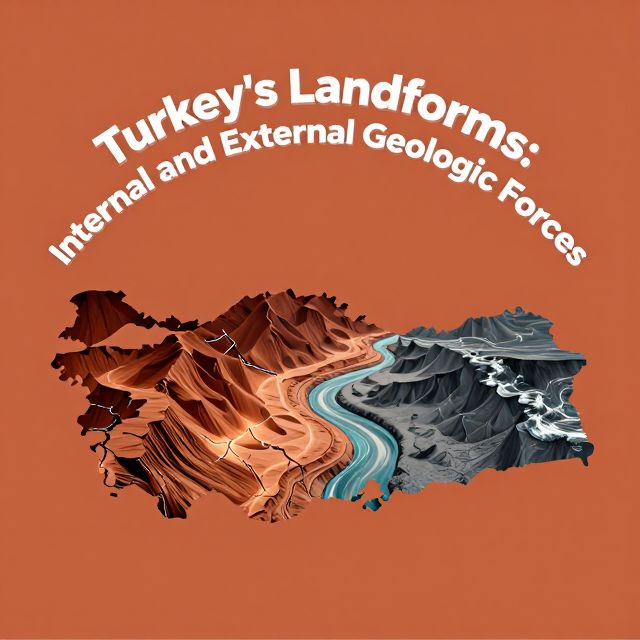
- Geomorphology: Studies landforms (mountains, plateaus, plains) shaped by:
- Endogenic Processes: Originating from within the Earth (e.g., volcanic eruptions, faulting).
- Exogenic Processes: External forces like weathering, erosion, and deposition.
- Weathering: Breakdown of rocks (e.g., frost wedging).
- Erosion: Transportation of weathered material (e.g., by rivers or wind).
- Deposition: Accumulation of transported material elsewhere (e.g., river deltas).
- Plate Tectonics: Theory explaining the movement of large crustal plates. This movement causes major geological events:
-
Biosphere: The sum of all ecosystems, comprising living organisms and their interactions with the physical environment.
- Biogeography: Explores the spatial distribution of flora and fauna, influenced by climate, topography, and human activities, highlighting the delicate balance within natural systems.
🏙️ Key Concepts in Human Geography
Human geography explores the spatial dimensions of human societies and their interactions with the environment.
-
Population Geography:
- Analyzes distribution, density, growth, and composition of human populations.
- Examines factors influencing population change: birth rates, death rates, and migration patterns.
- Demographic Transition Model: Describes population changes over time, typically from high birth/death rates to low birth/death rates.
- Migration: Both internal (within a country) and international, a significant driver of demographic shifts with profound social, economic, and cultural impacts.
- Example: Rural-to-urban migration in developing countries.
-
Economic Geography:
- Focuses on the spatial organization of economic activities.
- Economic Sectors:
- Primary: Extraction of raw materials (e.g., agriculture, mining).
- Secondary: Manufacturing and processing (e.g., car production).
- Tertiary: Services (e.g., retail, healthcare).
- Quaternary: Information and research (e.g., software development).
- Investigates industrial location, trade patterns, and globalization, which increasingly links economies worldwide.
-
Political Geography:
- Examines the spatial implications of political processes.
- Concepts:
- Territoriality: The connection of people, culture, and economic systems to the land.
- Sovereignty: The authority of a state to govern itself.
- Electoral Geography: The study of how spatial patterns influence election results.
- Studies the formation of states, boundary delineation, and geopolitical dynamics.
-
Urban Geography:
- Studies the spatial aspects of cities and urbanization.
- Analyzes urban growth patterns, internal city structure (e.g., land use zones, social areas), and challenges of rapid urbanization (housing, infrastructure, environmental sustainability).
- Example: The development of distinct residential and commercial districts within a city.
-
Cultural Geography:
- Explores the spatial patterns of cultural phenomena: language, religion, ethnicity, and cultural landscapes.
- Investigates how cultural traits diffuse across space, influence human perceptions of the environment, and contribute to regional character.
- Example: The spread of a particular architectural style across a region.
The interplay between human activities and the physical environment is a recurring theme, emphasizing how societies adapt to, modify, and are influenced by their geographical settings.
💡 Conclusion: The Integrated Perspective of Geography
Geography offers an integrated and holistic perspective on the world, bridging the gap between the natural and social sciences. It provides a systematic framework for understanding the spatial distribution of phenomena, the processes that shape them, and the complex interrelationships between human societies and their environments.
From Earth's physical systems (atmosphere, hydrosphere, lithosphere, biosphere) to the intricate patterns of human population, economic activities, political structures, and cultural landscapes, geography illuminates the interconnectedness of global systems. The application of geographical principles and tools like cartography, GIS, and remote sensing is crucial for addressing contemporary global challenges such as climate change, resource management, urbanization, and sustainable development.
A comprehensive grasp of these geographical concepts is not just about acquiring knowledge but about developing critical spatial awareness and analytical capability. This foundational understanding equips individuals to interpret complex spatial data, analyze environmental and societal issues, and contribute to informed decision-making in various professional capacities.